• Video
  • Shop
  • Culture
  • Family
  • Wellness
  • Food
  • Living
  • Style
  • Travel
  • News
  • Book Club
  • Newsletter
  • Privacy Policy
  • Your US State Privacy Rights
  • Children's Online Privacy Policy
  • Interest-Based Ads
  • Terms of Use
  • Do Not Sell My Info
  • Contact Us
  • © 2026 ABC News
ABC News

Climate and environment updates: 7 key measures of Earth's health in danger, report warns

PHOTO: Reef fishes swim over a reef affected by coral bleaching from high water temperature on May 08, 2024 in Trat, Thailand.
1:54
Sirachai Arunrugstichai/Getty Images
Summer temperatures stretching later into the season
By ABC Climate Unit
Last Updated: April 15, 2025, 3:18 PM

The climate crisis is not a distant threat; it's happening right now and affecting what matters most to us. Hurricanes intensified by a warming planet and drought-fueled wildfires are destroying our communities. Rising seas and flooding are swallowing our homes. And record-breaking heat waves are reshaping our way of life.

The good news is we know how to turn the tide and avoid the worst possible outcomes. However, understanding what needs to be done can be confusing due to a constant stream of climate updates, scientific findings and critical decisions that are shaping our future.

That's why the ABC News Climate and Weather Unit is cutting through the noise by curating what you need to know to keep the people and places you care about safe. We are dedicated to providing clarity amid the chaos, giving you the facts and insights necessary to navigate the climate realities of today -- and tomorrow.

Key Headlines

  • 7 key measures of the Earth's health are in now in danger: Report
  • Earth's oceans face 'triple planetary crisis,' new report warns
  • Climate change is straining America's health care system: Study
Here's how the news is developing.

Apr 15, 2025 3:18 PM

Surging AI energy needs could drive global eco-friendly energy transition: Report

Artificial intelligence is growing at a meteoric rate, requiring a larger share of the world's energy. Powering AI is a vast infrastructure of data centers, cloud networks and computing systems that are fueling a growing energy demand.

In a first-of-its-kind comprehensive report on AI and energy, the International Energy Agency said the global expansion of AI data centers is likely to drive some of the fastest growth in global electricity demand seen in recent years.

"With the rise of AI, the energy sector is at the forefront of one of the most important technological revolutions of our time," IEA Executive Director Fatih Birol said.

The IEA projects electricity demand from global data centers will more than double over the next five years and, by 2030, consume as much as the nation of Japan does today.

According to the report, data centers in the United States are likely to account for almost half of the growth in electricity demand. The report emphasizes that by 2030, the U.S. economy will use more electricity for data processing than for producing all energy-intensive goods combined, such as steel, aluminum, cement and chemicals.

PHOTO: An operator works at the data centre for OVHcloud in Roubaix, France, April 3, 2025.
Sameer Al-doumy/AFP via Getty Images
An operator works at the data centre for OVHcloud in Roubaix, France, April 3, 2025.
Sameer Al-doumy/AFP via Getty Images

Despite concerns over rising global energy demand, the IEA said their analysis shows positive impacts, like increased productivity, enhanced competitiveness and cost reductions, could outweigh the negative effects. In fact, the growth of AI in the energy sector could even help reduce global energy-related emissions, a reduction that could be far larger than new emissions from data centers, the report found.

While a mix of energy sources will be needed to meet the world's growing data center electricity demands, renewable sources are expected to supply roughly half of the global demand growth over the next five years, according to the report. Data centers may also serve as hubs for new low-emission energy projects. And as AI becomes more integrated into scientific research, the IEA said it could help accelerate innovation in energy technologies such as batteries and solar PV.

For example, leaks are a significant source of methane emissions in oil and gas production. The report said AI can facilitate rapid leak detection so that repairs happen sooner, limiting total emissions. AI could also help reduce transportation-related emissions by choosing the most efficient travel routes in real time, according to the report.

-ABC News meteorologist Dan Peck


Apr 08, 2025 9:02 PM

US tornado activity more than double the March average: NOAA

It has been an active start to the severe weather season. According to a new report from the National Oceanic and Atmospheric Administration, U.S. tornado activity in March was more than twice the monthly average, with over 200 tornadoes recorded.

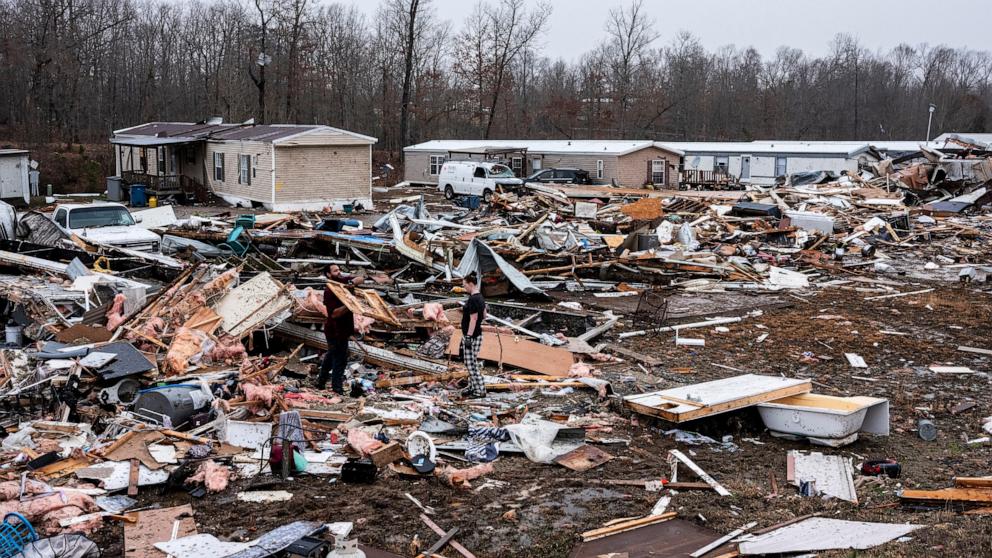
This trend continued through the first week of April, with more than 150 tornado reports across the South and Midwest during a devastating multi-day stretch of life-threatening weather conditions.

The report also highlighted notable temperature and precipitation trends nationwide in March. Last month, the average temperature of the contiguous U.S. was 46.9 degrees Fahrenheit, more than 5.4 degrees Fahrenheit above average. That ranked last month as the nation's sixth warmest March on record. Above-average to way above-average temperatures were observed across most of the Lower 48, except for parts of California and the Southeast.

PHOTO: Anthony Hudson, left, helps his sister, Kelsey Webb, right, search through her destroyed home inside of Harmony Hills trailer park on March 15, 2025, in Poplar Bluff, Missouri.
Brad Vest/Getty Images
Anthony Hudson, left, helps his sister, Kelsey Webb, right, search through her destroyed home inside of Harmony Hills trailer park on March 15, 2025, in Poplar Bluff, Missouri.
Brad Vest/Getty Images

Precipitation was below average across much of the Plains and South in March, which brought expanding and intensifying drought conditions to states like Texas, Oklahoma and Kansas. Persistently dry conditions also kept a drought in place across much of the Carolinas, fueling the destructive wildfires that ravaged both states last month.

North Carolina experienced its driest March since 2016, and South Carolina has had its driest first three months of the year in nearly 40 years. The extremely dry conditions were a primary contributor to the rapid spread of the flames, which was exacerbated by the millions of downed trees in the region due to Hurricane Helene last fall. This created an abundance of dry fuel, allowing wildfires to explode in size. Drought conditions are likely to persist across the Carolinas through the end of the month.

According to the latest U.S. Drought Monitor report released on April 1, about 43.4% of the contiguous U.S. is experiencing drought.

-ABC News meteorologist Dan Peck


Apr 08, 2025 2:02 AM

Global temperatures continue to exceed critical milestone

Last month was the second-warmest March on record globally, according to new data analyzed by the Copernicus Climate Change Service (C3S). And once again, the planet exceeded 1.5 degrees Celsius, as established by the 2015 Paris Climate Agreement, coming in slightly above that at 1.6 degrees Celsius above the pre-industrial average (1850-1900).

Last month marked the 20th of the previous 21 months to exceed the warming threshold established in the Agreement. The 1.5-degree ceiling was established because scientists and international climate organizations say limiting global temperatures to that level significantly reduces the risks and impacts of climate change.

It is important to note that exceeding the 1.5 degree Celsius threshold temporarily is not seen as a failure to limit warming under the Agreement since it looks at the climate average over multiple decades. Still, the trend is concerning.

The planet may have fallen just short of breaking another global temperature record for March, but Europe soared to a new record. The March average temperature over that continent was 2.41 degrees Celsius, or 4.34 degrees Fahrenheit, above the 1991-2020 average for the month, making it the warmest March on record.

Globally, the average surface air temperature was 14.06 degrees Celsius, or 57.31 degrees Fahrenheit.

PHOTO: People enjoy the warm weather in Battersea Park, London, March 20, 2025.
Yui Mok/PA Images via Getty Images
People enjoy the warm weather in Battersea Park, London, March 20, 2025.
Yui Mok/PA Images via Getty Images

Global daily sea surface temperatures across most of the world’s oceans remain well above average, including across the Atlantic Basin. The report found that the average global sea surface temperature for March 2025 was 69.73 degrees Fahrenheit, the second-highest value on record for the month.

Unusually warm sea surface temperatures could once again play a major role in tropical cyclone development during the upcoming Atlantic Hurricane Season, which begins on June 1. The National Oceanic and Atmospheric Administration will release its official outlook for the forthcoming season later next month.

Arctic sea ice extent dipped to its lowest value on record for the month of March at 6% below average. This was the fourth straight month with record-low ice cover for the corresponding month. Antarctic sea ice extent was 24% below average for the month, according to Copernicus.

-ABC News meteorologist Dan Peck


Apr 04, 2025 10:44 PM

WMO retires names of 3 devastating storms from 2024 Atlantic hurricane season

Hurricanes Beryl, Helen and Milton were so deadly and destructive that the World Meteorological Organization (WMO) says it will never use those names again.

During the hurricane committee's annual meeting earlier this week, the group decided that names from the 2024 Atlantic hurricane season will no longer be used for future tropical storms and hurricanes. Beryl, Helen and Milton join Katrina, Sandy, Maria and Harvey on the retired list.

The WMO's Hurricane Committee is responsible for the tropical cyclone name lists. It's the first time since 2020 that three names have been retired from the previous Atlantic Basin season. The list of names for tropical storms and hurricanes repeat every six years. In 2030, Beryl, Helene, and Milton will be replaced by Brianna, Holly and Miguel. Helene had been on the rotating list since 1958.

On July 2, Hurricane Beryl became the earliest Category 5 hurricane in the Atlantic basin on record and significantly impacted several Caribbean Islands as it marched west as a major hurricane. The storm also affected Jamaica, the Yucatan Peninsula of Mexico, and made a final landfall as a category one hurricane along the Texas Gulf Coast on July 8.

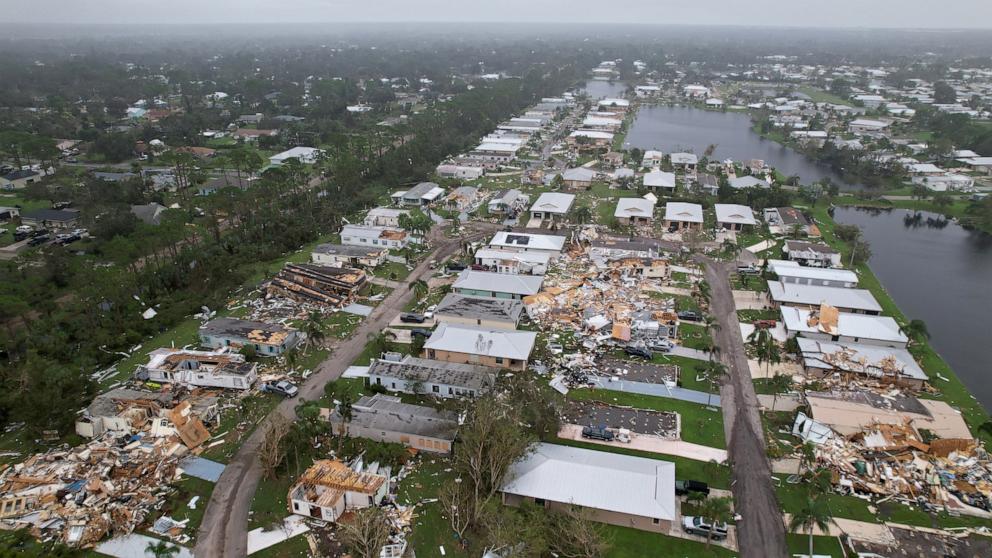
PHOTO: An aerial view shows destruction at the Spanish Lakes country club in Fort Pierce, Florida, in the aftermath of Hurricane Milton on October 10, 2024.
John Falchetto/AFP via Getty Images
An aerial view shows destruction at the Spanish Lakes country club in Fort Pierce, Florida, in the aftermath of Hurricane Milton on October 10, 2024.
John Falchetto/AFP via Getty Images

Helene became the deadliest continental U.S. hurricane since Katrina in 2005, killing more than 200 people after making landfall as the strongest hurricane on record to strike Florida's Big Bend region on Sept. 26. The National Oceanic and Atmospheric Administration (NOAA) estimates Helene caused nearly $79 billion in damages in the U.S.

Hurricane Milton made landfall as a Category 3 storm in western Florida on Oct. 9, affecting many of the same areas hit by Helene two weeks prior. Milton caused multiple storm-related fatalities and an estimated $34.3 billion in damages in the U.S.

The Atlantic hurricane season begins on June 1, with NOAA releasing its official outlook for the upcoming season next month.

-ABC News meteorologist Dan Peck


Nov 22, 2024 9:41 PM

UN climate conference delegates struggle to reach agreement on financing the climate fight

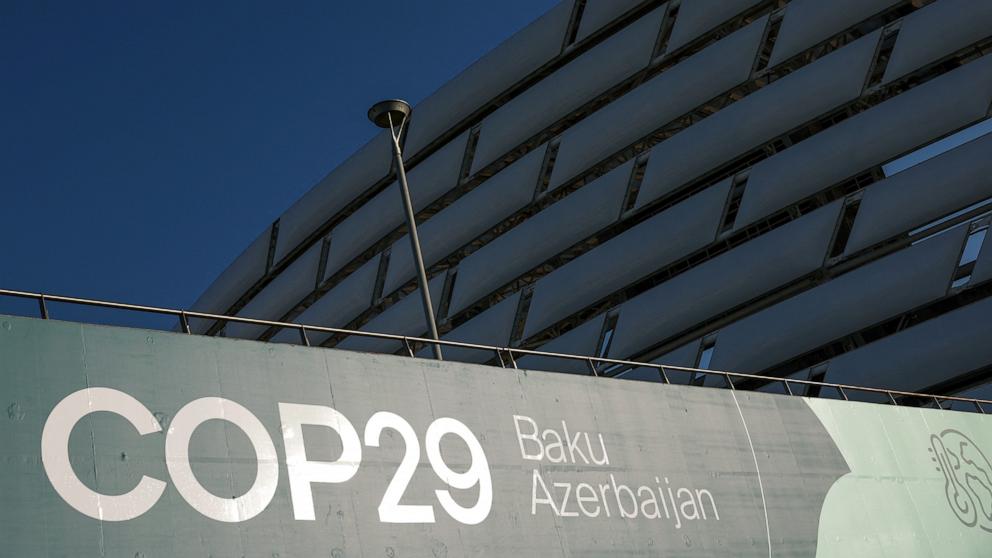
The U.N. climate conference in Azerbaijan was supposed to be the "finance COP." World leaders would determine how much fighting the climate crisis would cost and who would pay for it.

However, as COP29 winds down, many developing countries and nongovernmental organizations are dissatisfied with the current language in the proposed climate finance agreement.

In 2015, under the Paris Agreement, participating countries agreed to set a New Collective Quantified Goal, or NCQG, on climate finance in 2024 that would account for the needs of developing countries. Basically, how much money would each nation spend to support developing countries that are being disproportionately impacted by climate?

While several versions of the new NCQG have been proposed, a final agreement is still out of reach. The latest text calls for a $1.3 trillion climate finance investment annually until 2035 but only requires a $250 billion investment from developed countries.

PHOTO: A view shows a venue of the COP29 United Nations climate change conference, in Baku, Azerbaijan November 22, 2024.
Murad Sezer/Reuters
A view shows a venue of the COP29 United Nations climate change conference, in Baku, Azerbaijan November 22, 2024.
Murad Sezer/Reuters

"With a paltry climate finance offer of $250 billion annually, and a deadline to deliver as late as 2035, richer nations, including EU countries, and the United States are dangerously close to betraying the Paris Agreement," Dr. Rachel Cleetus, policy director for the Climate and Energy Program, Union of Concerned Scientists, said. "This is nowhere near the robust and desperately needed funding lower income nations deserve to combat climate change."

The latest NCQG language lays out a variety of funding sources that can play a part in reaching global climate finance goals, including multilateral development banks, or MDBs, that can distribute funds through grants and concessional loans for developing countries and adaptation projects.

However, the text does not make clear whether funds from MDBs are part of reaching the $250 billion goal or supplement that goal. It also includes provisions allowing for voluntary contributions from developing countries.

"The central demand coming into COP29 was for a strong, science-aligned climate finance commitment, which this appalling text utterly fails to provide," Cleetus said. "Wealthier nations seem content to shamefully renege on their responsibility and cave in to fossil fuel interests while unjustly foisting the costs of deadly climate extremes on countries that have contributed the least to the climate crisis."

World Resources Institute Global Climate, Economics and Finance Program Director Melanie Robinson agrees, releasing a statement Friday saying, "Developed countries should aim higher than the $250 billion they've put on the table."

"We should leave Baku with a goal that at least gets to $300 billion a year by 2035," Robinson said.

Tasneem Essop, executive director of Climate Action Network International, called the latest draft text "an insult to the people in the Global south."

"This latest draft text on the New Collective Quantified Goal is not just a joke -- it's an insult to the people in the Global South living on the front line of the climate crisis," Essop said. "In the meantime, millions of people's lives are at risk. We are angry, but we will keep fighting until the end."

-ABC News Climate Unit's Kelly Livingston and ABC News' Charlotte Slovin


GMA Newsletters

Sign up for our newsletters to get GMA delivered to your inbox every morning!

Up Next in news

PHOTO: Students with cellphones in an undated stock photo.

British prime minister announces social media ban for kids 16 and under

June 15, 2026
PHOTO: Karina Manley holds a sign against a proposed data center adjacent to the Nashville Zoo during a planning commission meeting, June 11, 2026, in Nashville, Tenn.

Residents fight to keep AI data center campus away from Nashville Zoo

June 12, 2026
PHOTO: Nena Morgan credits her 10-year-old daughter Elizabeth for helping to save their family during a house fire.

Mom says her 10-year-old daughter saved family from house fire

June 12, 2026

The latest lifestyle and entertainment news and inspiration for how to live your best life - all from Good Morning America.
  • Contests
  • Terms of Use
  • Privacy Policy
  • Do Not Sell My Info
  • Children’s Online Privacy Policy
  • Advertise with us
  • Your US State Privacy Rights
  • Interest-Based Ads
  • About Nielsen Measurement
  • Press
  • Feedback
  • Shop FAQs
  • ABC News
  • ABC
  • All Videos
  • All Topics
  • Sitemap

© 2026 ABC News
  • Privacy Policy— 
  • Your US State Privacy Rights— 
  • Children's Online Privacy Policy— 
  • Interest-Based Ads— 
  • Terms of Use— 
  • Do Not Sell My Info— 
  • Contact Us— 

© 2026 ABC News