• Video
  • Shop
  • Culture
  • Family
  • Wellness
  • Food
  • Living
  • Style
  • Travel
  • News
  • Book Club
  • Newsletter
  • Privacy Policy
  • Your US State Privacy Rights
  • Children's Online Privacy Policy
  • Interest-Based Ads
  • Terms of Use
  • Do Not Sell My Info
  • Contact Us
  • © 2026 ABC News
ABC News

'Welcome home, Artemis': Crew celebrates historic 10-day moon mission

PHOTO: (L-R) NASA's Artemis II mission astronauts Canadian Space Agency's Jeremy Hansen, mission specialist Christina Koch, pilot Victor Glover and commander Reid Wiseman attend a welcoming ceremony in Houston, Texas, on April 11, 2026.
3:01
Ronaldo Schemidt/AFP via Getty Images
Artemis II crew arrives back to Houston after the dramatic Pacific splashdown
By Mary Kekatos, Julia Jacobo, Leah Sarnoff, Ivan Pereira, Meredith Deliso
Last Updated: April 6, 2026, 11:21 PM

NASA's Artemis II mission lifted off on April 1 at 6:35 p.m. ET from the Kennedy Space Center in Florida.

The four-person crew completed a 695,081-mile, 10-day journey around the moon, also known as a lunar fly-by.

A "textbook" splashdown took place at 8:07 p.m. ET on Friday, April 10.

Key Headlines

  • Crew makes 1st appearance since return from historic mission
  • 'Welcome home, Artemis': Jubilant and emotional, crew speaks out on historic moon mission
  • Trump says he will welcome Artemis II crew to White House 'soon'
  • NASA officials hail 'new era' of space exploration after successful mission
  • Crew members hoisted into helicopters
  • All 4 crew members out of the capsule
Here's how the news is developing.

Apr 06, 2026 11:21 PM

Orion reaches maximum distance from Earth

While passing around the far side of the moon, the Orion spacecraft reached its maximum distance from Earth at 252,760 miles.

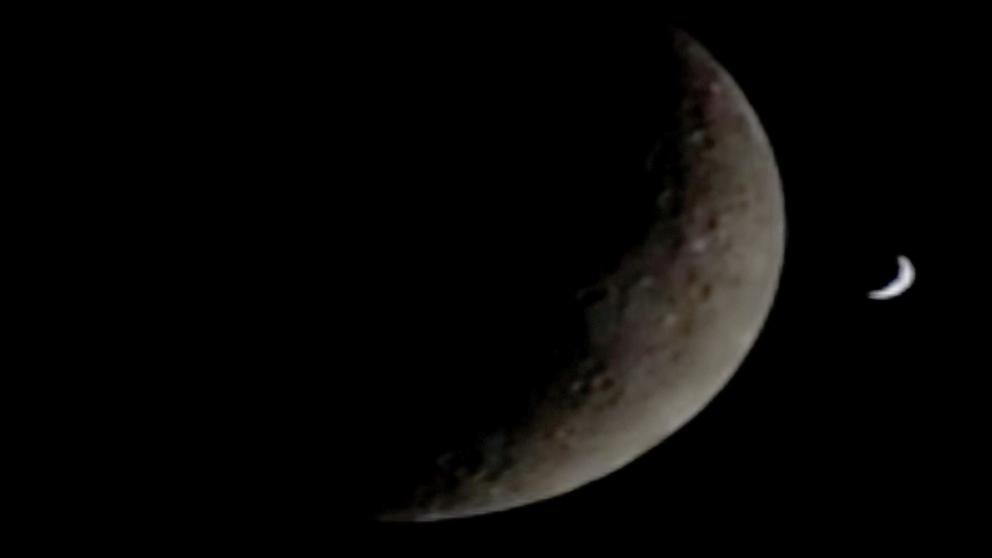
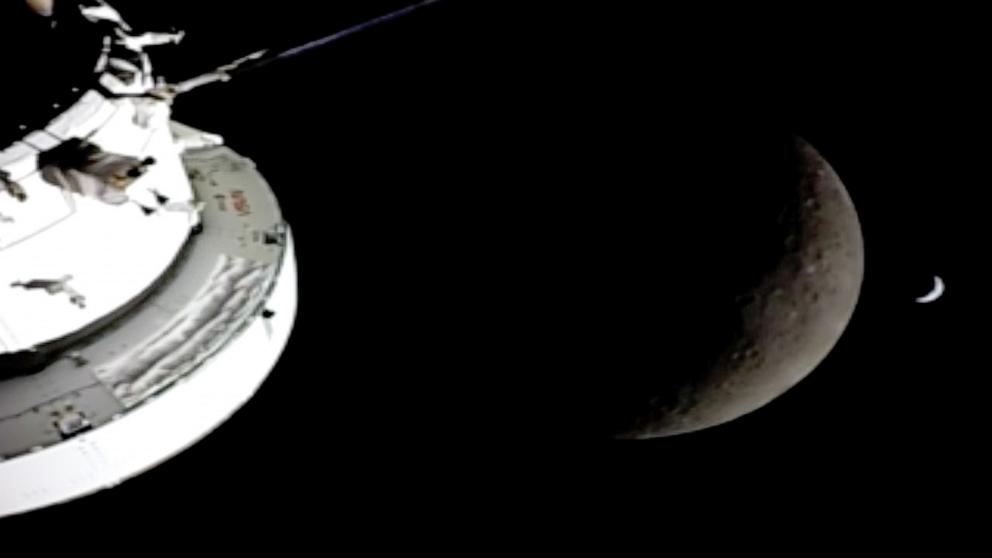
PHOTO: A crescent shaped Earth is seen behind the crescent Moon as seen just before the Orion spacecraft flew on the back side of the Moon, April 6, 2026.
NASA
A crescent shaped Earth is seen behind the crescent Moon as seen just before the Orion spacecraft flew on the back side of the Moon, April 6, 2026.
NASA

Apr 06, 2026 11:21 PM

Orion makes its closest approach to the moon

Shortly after losing communication with NASA, the Artemis II crew is making its closest approach to the moon.

Orion will be about 4,070 miles above the surface of the moon, according to NASA.

The Artemis II astronauts will be the first humans to see most of the far side of the moon, or the side not visible from Earth, since the Apollo missions.

PHOTO: NASA astronaut Christina Koch lays on her back as she take photographs of the Moon out the window of the Orion spacecraft, April 6, 2026.
NASA
NASA astronaut Christina Koch lays on her back as she take photographs of the Moon out the window of the Orion spacecraft, April 6, 2026.
NASA

"It turns out there's about 60% of the far side, I think, that has never been seen by human eyes because of the lighting conditions," Reid Wiseman, mission commander, said during a news conference on March 29. "Apollo always wanted that light on the front side of the moon for their landing and launch capability. ... We've seen it in satellite photos, but humans have never, ever seen that before. That's cool."


Apr 06, 2026 10:48 PM

Artemis II crew passes behind the moon, enters communications blackout

The Artemis II crew has reached the far side of the moon and has entered a communications blackout, NASA said.

The federal space agency said the communications blackout is planned and should last for about 40 minutes as Orion passes behind the moon.

PHOTO: A crescent shaped Earth is seen behind the Moon as seen just before the Orion spacecraft flew on the back side of the Moon, April 6, 2026.
NASA
A crescent shaped Earth is seen behind the crescent Moon as seen just before the Orion spacecraft flew on the back side of the Moon, April 6, 2026.
NASA

The moon blocks the radio signals needed for Mission Control to maintain contact with Orion via the Deep Space Network, which is NASA's international array of giant radio antennas that supports interplanetary spacecraft missions.


Apr 06, 2026 9:14 PM

Artemis II crew to be closest to moon at 7:00 p.m. ET

NASA has said the Artemis II crew will now make its closest approach to the moon at 7:00 p.m. ET and will reach its furthest distance from Earth at 7:02 p.m. ET.

Previously, the crew was supposed to make its closest approach at 7:02 p.m. ET and reach maximum distance from the Earth at 7:07 p.m. ET.

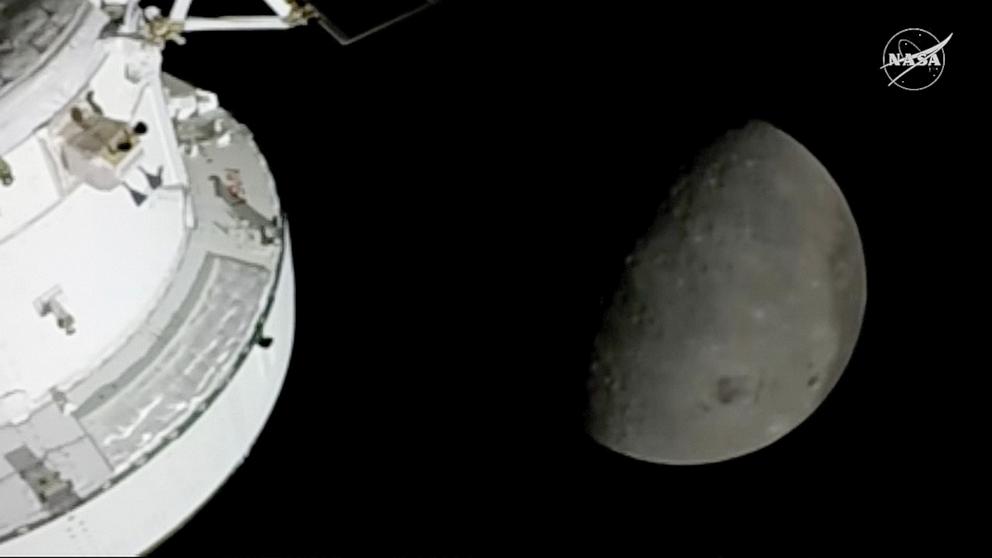
PHOTO: The Orion spacecraft flies towards the moon, April 6, 2026.
NASA
The Orion spacecraft flies towards the moon, April 6, 2026.
NASA

-ABC News' Briana Alvarado


Apr 02, 2026 9:58 PM

Breaking down Artemis II moon mission terms, jargon and what they mean

Following the path of Artemis II may be confusing as the astronauts, mission control and others use specific jargon and phrases.

Here are explanations of some of the terminology people may hear over the course of the mission:

Translunar injection burn

The translunar injection burn is the final step that sends the crew on the path to the moon, committing the Orion spacecraft to the remainder of its 10-day mission.

Lasting just minutes, it's a single-engine firing that propels the spacecraft out of Earth's orbit and on a "free-return trajectory."

PHOTO: NASA launched a new space toilet, the Universal Waste Management System (UWMS).
NASA
NASA launched a new space toilet, the Universal Waste Management System (UWMS), to the International Space Station on Northrop Grumman’s 14th contract resupply mission in September. Another UWMS unit will be installed in Orion for the Artemis II flight test that will send astronauts on a 10-day mission beyond the Moon and back.
NASA

Universal waste management system

The universal waste management system, otherwise known as a space toilet, is located inside a stall just like in a public restroom on Earth, according to NASA.

Space toilets use air flow to pull urine and feces away and into receptacles, which are stored for disposal. The astronauts have a handlebar to hold themselves down while using the toilet in the absence of gravity.

Read more here about the terms and jargon you may come across during the Artemis II mission.


GMA Newsletters

Sign up for our newsletters to get GMA delivered to your inbox every morning!

Up Next in news

PHOTO: Britain's King Charles III walks at Shenandoah National Park in Front Royal, Va., April 30, 2026.

King Charles III visit live updates: Charles visits Shenandoah National Park

April 30, 2026
PHOTO: Artemis II astronauts, from left to right, Reid Wiseman, Victor Glover, Christina Koch and Jeremy Hansen appear on "Good Morning America" on April 30, 2026.

Artemis II astronauts on their out-of-this-world mission: 'Adventure of a lifetime'

April 30, 2026
PHOTO: Stock photo of a person using their phone and laptop.

'Rogue' AI agent went haywire at tech company. The CEO is still 'bullish' on the technology

April 29, 2026

The latest lifestyle and entertainment news and inspiration for how to live your best life - all from Good Morning America.
  • Contests
  • Terms of Use
  • Privacy Policy
  • Do Not Sell My Info
  • Children’s Online Privacy Policy
  • Advertise with us
  • Your US State Privacy Rights
  • Interest-Based Ads
  • About Nielsen Measurement
  • Press
  • Feedback
  • Shop FAQs
  • ABC News
  • ABC
  • All Videos
  • All Topics
  • Sitemap

© 2026 ABC News
  • Privacy Policy— 
  • Your US State Privacy Rights— 
  • Children's Online Privacy Policy— 
  • Interest-Based Ads— 
  • Terms of Use— 
  • Do Not Sell My Info— 
  • Contact Us— 

© 2026 ABC News