• Video
  • Shop
  • Culture
  • Family
  • Wellness
  • Food
  • Living
  • Style
  • Travel
  • News
  • Book Club
  • Newsletter
  • Privacy Policy
  • Your US State Privacy Rights
  • Children's Online Privacy Policy
  • Interest-Based Ads
  • Terms of Use
  • Do Not Sell My Info
  • Contact Us
  • © 2026 ABC News
ABC News

'Welcome home, Artemis': Crew celebrates historic 10-day moon mission

PHOTO: (L-R) NASA's Artemis II mission astronauts Canadian Space Agency's Jeremy Hansen, mission specialist Christina Koch, pilot Victor Glover and commander Reid Wiseman attend a welcoming ceremony in Houston, Texas, on April 11, 2026.
3:01
Ronaldo Schemidt/AFP via Getty Images
Artemis II crew arrives back to Houston after the dramatic Pacific splashdown
By Mary Kekatos, Julia Jacobo, Leah Sarnoff, Ivan Pereira, Meredith Deliso
Last Updated: April 11, 2026, 1:17 AM

NASA's Artemis II mission lifted off on April 1 at 6:35 p.m. ET from the Kennedy Space Center in Florida.

The four-person crew completed a 695,081-mile, 10-day journey around the moon, also known as a lunar fly-by.

A "textbook" splashdown took place at 8:07 p.m. ET on Friday, April 10.

Key Headlines

  • Crew makes 1st appearance since return from historic mission
  • 'Welcome home, Artemis': Jubilant and emotional, crew speaks out on historic moon mission
  • Trump says he will welcome Artemis II crew to White House 'soon'
  • NASA officials hail 'new era' of space exploration after successful mission
  • Crew members hoisted into helicopters
  • All 4 crew members out of the capsule
Here's how the news is developing.

Apr 11, 2026 1:17 AM

Trump congratulates crew

President Donald Trump congratulated the Artemis II crew, calling it a "spectacular" trip, and said he looks forward to seeing them at the White House "soon," in a social media post following the successful splashdown.

A TV was wheeled into the roundtable dinner that the president was attending in Charlottesville, Virginia, and he watched the Artemis splashdown, according to a White House official.


Apr 11, 2026 1:19 AM

Side hatch opened

The side hatch of the Orion capsule is now open, as four Navy personnel -- one for each astronaut -- enter the capsule to check on the crewmembers.

PHOTO: The side hatch of NASA's Orion spacecraft is open as it floats in the Pacific Ocean off the coast of San Diego, April 10, 2026.
NASA
The side hatch of NASA's Orion spacecraft is open as it floats in the Pacific Ocean off the coast of San Diego, April 10, 2026.
NASA

Apr 11, 2026 1:00 AM

Recovery personnel arrive

Recovery personnel, including Navy divers, have pulled up along the Orion capsule to help extract the crewmembers.

PHOTO: NASA's Orion spacecraft with Artemis II crewmembers, Reid Wiseman, Victor Glover, Christina Koch and Jeremy Hansen floats in the Pacific Ocean off the coast of San Diego as US Navy divers arrive, April 10, 2026.
NASA
NASA's Orion spacecraft with Artemis II crewmembers, Reid Wiseman, Victor Glover, Christina Koch and Jeremy Hansen floats in the Pacific Ocean off the coast of San Diego as US Navy divers arrive, April 10, 2026.
NASA


Apr 11, 2026 12:40 AM

What comes next

The astronauts will stay inside the Orion capsule as it’s powered down and recovery teams move in to help them out and take their first breaths of fresh air on Earth since April 1.

They were initially expected to begin exiting the spacecraft around 9:06 p.m. ET but it's possible that could be pushed back. Christina Koch will exit first, followed by Victor Glover Jr., Jeremy Hansen, and Reid Wiseman last.

After they're helped out of the capsule, the crew will be moved onto a raft. From there, helicopters will lift each astronaut one by one and fly them to the USS John P. Murtha.

-ABC News' Briana Alvarado


Apr 07, 2026 6:21 PM

NASA shares more photos of far side of the moon

NASA has shared additional photos of the far side of the moon taken during the Artemis II crew's historic lunar flyby on Monday.

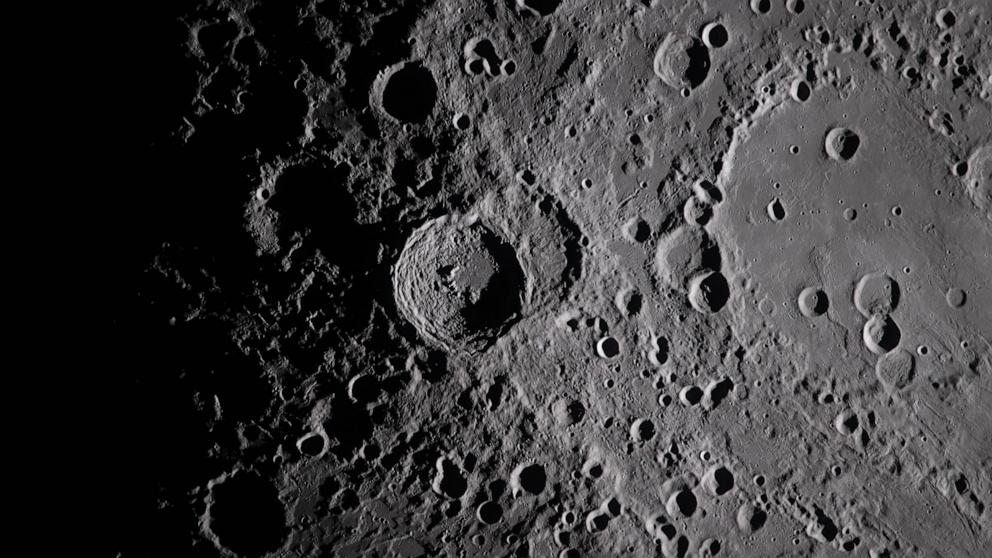
One image shows a close-up view of Vavilov Crater, an impact crater on the rim of the older and larger Hertzsprung impact basin, none of which can be seen from Earth.

PHOTO: A close-up view taken by the Artemis II crew of Vavilov Crater on the rim of the older and larger Hertzsprung basin, April 6, 2026.
NASA
A close-up view taken by the Artemis II crew of Vavilov Crater on the rim of the older and larger Hertzsprung basin, April 6, 2026.
NASA

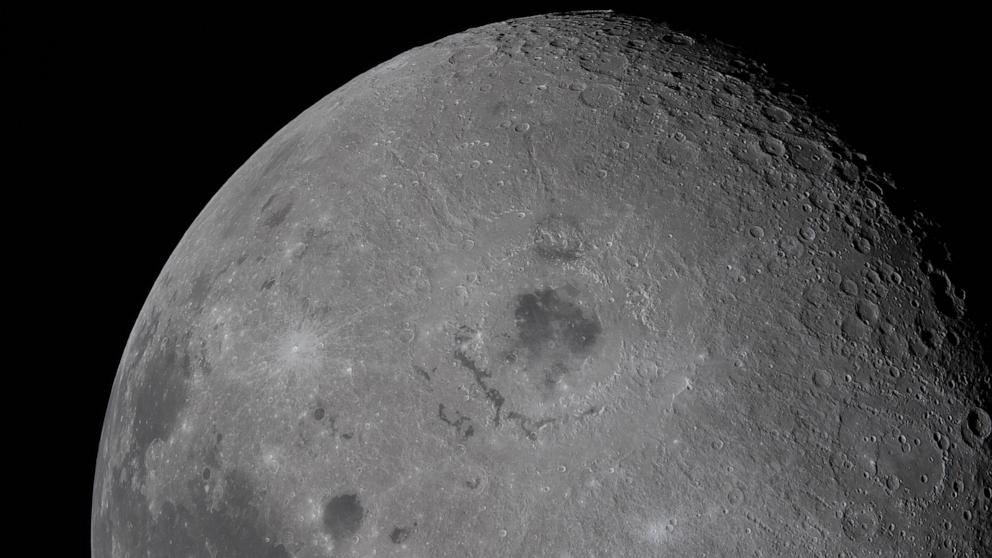
Another image shows the Orientale basin in the center with a black patch of ancient lava that punched through the moon's crust in an eruption billions of years ago. It is located on the western border between the near and far side of the moon and is hard to see from Earth.

PHOTO: Orientale basin is visible in the center, with a black patch of ancient lava in the center that punched through the Moon's crust in an eruption billions of years ago, in this view of the Moon, taken by the Artemis II crew, April 6, 2026.
NASA
Orientale basin is visible in the center, with a black patch of ancient lava in the center that punched through the Moon's crust in an eruption billions of years ago, in this view of the Moon, taken by the Artemis II crew, April 6, 2026.
NASA

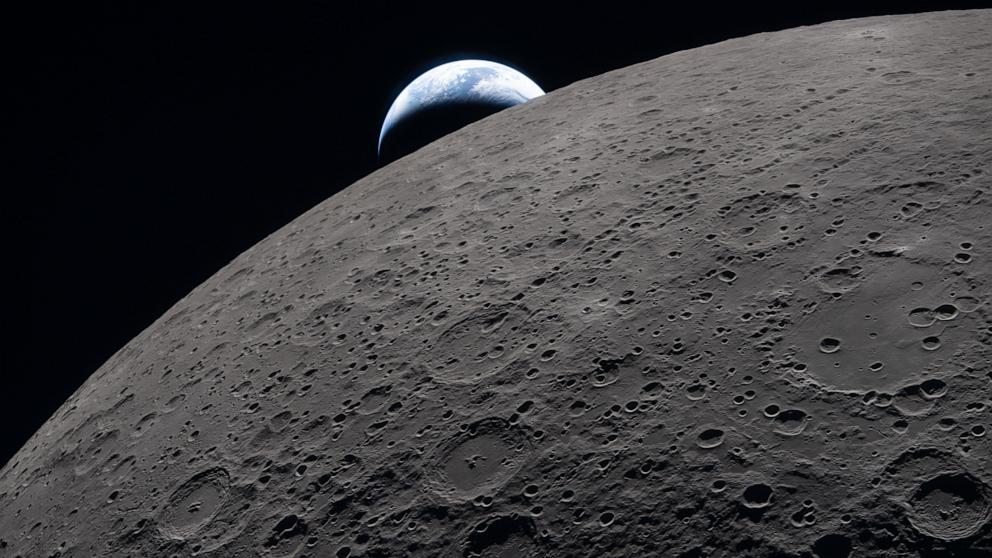
A third image captures the lunar surface in sharp detail while a distant Earth hovers in the background.

PHOTO: The lunar surface fills the frame in sharp detail, as seen during the Artemis II lunar flyby, while a distant Earth sets in the background, April 6, 2026.
NASA
The lunar surface fills the frame in sharp detail, as seen during the Artemis II lunar flyby, while a distant Earth sets in the background, April 6, 2026.
NASA

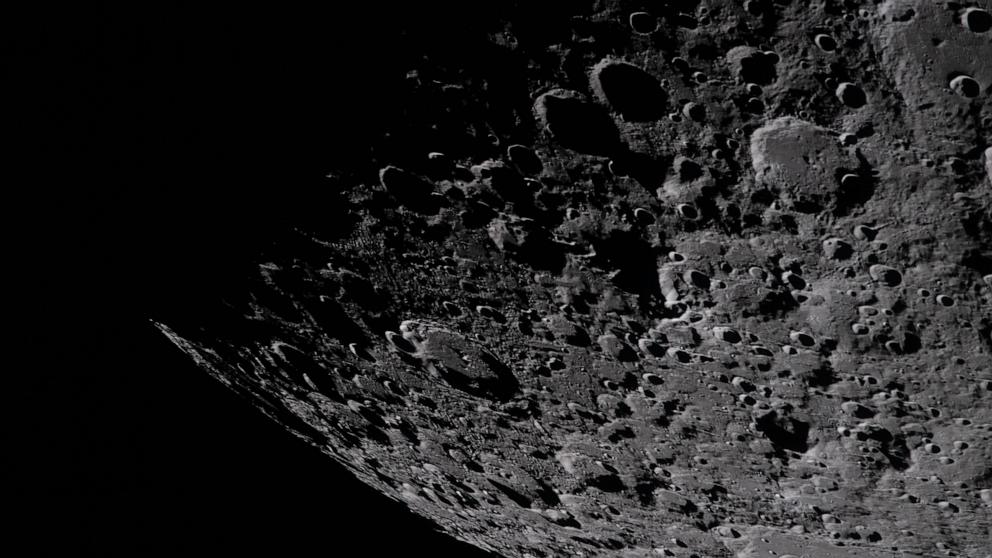
Also captured by the Artemis II crew is the heavily cratered terrain of the eastern edge of the South Pole-Aitken basin, an impact crater on the far side of the moon.

The basin is seen with the shadowed terminator -- the boundary between lunar day and night -- at the top of the image.

PHOTO: Captured by the Artemis II crew, April 6, 2026, the heavily cratered terrain of the eastern edge of the South Pole-Aitken basin is seen with the shadowed terminator, the boundary between lunar day and night at the top of the image.
NASA
Captured by the Artemis II crew, April 6, 2026, the heavily cratered terrain of the eastern edge of the South Pole-Aitken basin is seen with the shadowed terminator, the boundary between lunar day and night at the top of the image.
NASA

GMA Newsletters

Sign up for our newsletters to get GMA delivered to your inbox every morning!

Up Next in news

PHOTO: Three people, including two children, were injured after a tree fell on a playground at a school in Melrose, Mass., on May 4, 2026.

Student dies after tree falls on playground at Massachusetts school

May 5, 2026
PHOTO: This aerial picture shows a general view of the cruise ship MV Hondius stationary off the port of Praia, the capital of Cape Verde, on May 4, 2026.

American speaks out from cruise ship amid deadly hantavirus outbreak

May 5, 2026
PHOTO: A United Airlines plane wheel hit a bakery truck that was driving on the New Jersey Turnpike as the flight was landing at Newark Liberty International Airport.

United Airlines plane hits bakery truck during landing

May 4, 2026

The latest lifestyle and entertainment news and inspiration for how to live your best life - all from Good Morning America.
  • Contests
  • Terms of Use
  • Privacy Policy
  • Do Not Sell My Info
  • Children’s Online Privacy Policy
  • Advertise with us
  • Your US State Privacy Rights
  • Interest-Based Ads
  • About Nielsen Measurement
  • Press
  • Feedback
  • Shop FAQs
  • ABC News
  • ABC
  • All Videos
  • All Topics
  • Sitemap

© 2026 ABC News
  • Privacy Policy— 
  • Your US State Privacy Rights— 
  • Children's Online Privacy Policy— 
  • Interest-Based Ads— 
  • Terms of Use— 
  • Do Not Sell My Info— 
  • Contact Us— 

© 2026 ABC News