• Video
  • Shop
  • Culture
  • Family
  • Wellness
  • Food
  • Living
  • Style
  • Travel
  • News
  • Book Club
  • Newsletter
  • Privacy Policy
  • Your US State Privacy Rights
  • Children's Online Privacy Policy
  • Interest-Based Ads
  • Terms of Use
  • Do Not Sell My Info
  • Contact Us
  • © 2026 ABC News
ABC News

'Welcome home, Artemis': Crew celebrates historic 10-day moon mission

PHOTO: (L-R) NASA's Artemis II mission astronauts Canadian Space Agency's Jeremy Hansen, mission specialist Christina Koch, pilot Victor Glover and commander Reid Wiseman attend a welcoming ceremony in Houston, Texas, on April 11, 2026.
3:01
Ronaldo Schemidt/AFP via Getty Images
Artemis II crew arrives back to Houston after the dramatic Pacific splashdown
By Mary Kekatos, Julia Jacobo, Leah Sarnoff, Ivan Pereira, Meredith Deliso
Last Updated: April 1, 2026, 10:00 AM

NASA's Artemis II mission lifted off on April 1 at 6:35 p.m. ET from the Kennedy Space Center in Florida.

The four-person crew completed a 695,081-mile, 10-day journey around the moon, also known as a lunar fly-by.

A "textbook" splashdown took place at 8:07 p.m. ET on Friday, April 10.

Key Headlines

  • Crew makes 1st appearance since return from historic mission
  • 'Welcome home, Artemis': Jubilant and emotional, crew speaks out on historic moon mission
  • Trump says he will welcome Artemis II crew to White House 'soon'
  • NASA officials hail 'new era' of space exploration after successful mission
  • Crew members hoisted into helicopters
  • All 4 crew members out of the capsule
Here's how the news is developing.

Apr 01, 2026 10:00 AM

What is the timeline of the Artemis II moon mission?

The Artemis II moon mission will see four astronauts go on a 685,000-mile, 10-day journey around the moon. Here is what the timeline looks like:


Day 1 is launch day. The astronauts lift off aboard NASA's newest spacecraft, Orion, which will sit atop the Space Launch System rocket. The spacecraft will reach initial orbit and then high-Earth orbit to make a push toward the moon.

Days 2 through 4 are transit days, with the journey to the moon taking three days. Over the course of the journey, the crew will continue to evaluate Orion's systems and practice emergency procedures, in addition to other activities.

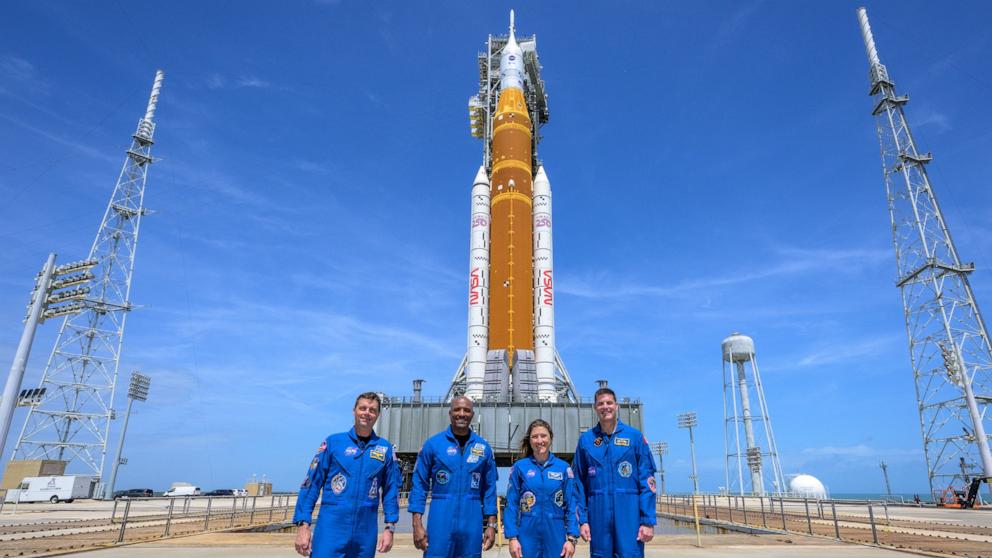
PHOTO: Astronauts Reid Wiseman, Victor Glover, Christina Koch and Jeremy Hansen stop for a group photo during a visit to NASA's Artemis II SLS rocket and Orion spacecraft, March 30, 2026, at Launch Complex 39B of NASA's Kennedy Space Center in Fla.
Bill Ingalls/NASA/AFP via Getty Images
Astronauts Reid Wiseman, Victor Glover, Christina Koch and Jeremy Hansen stop for a group photo during a visit to NASA's Artemis II SLS rocket and Orion spacecraft, March 30, 2026, at Launch Complex 39B of NASA's Kennedy Space Center in Fla.
Bill Ingalls/NASA/AFP via Getty Images

On day 5, Orion will enter the lunar sphere of influence, meaning the moon is the main gravitational pull. On day 6, the crew will come its closest to the moon while traveling the farthest from Earth, according NASA.

Days 7 through 10 will see the astronauts make their way back to Earth before re-entering Earth’s atmosphere at high speed, up to 25,000 miles per hour.

The Orion spacecraft will deploy a series of parachutes once through the heat of re-entry to slow down and it will splash down in the Pacific Ocean The U.S. Navy will recover the capsule.

-ABC News’ Mary Kekatos


Apr 01, 2026 10:00 AM

Who are the Artemis astronauts?

#Who are the Artemis astronauts?

Three Americans and one Canadian will be aboard the Orion spacecraft -- named "Integrity" -- over the course of 10 days.

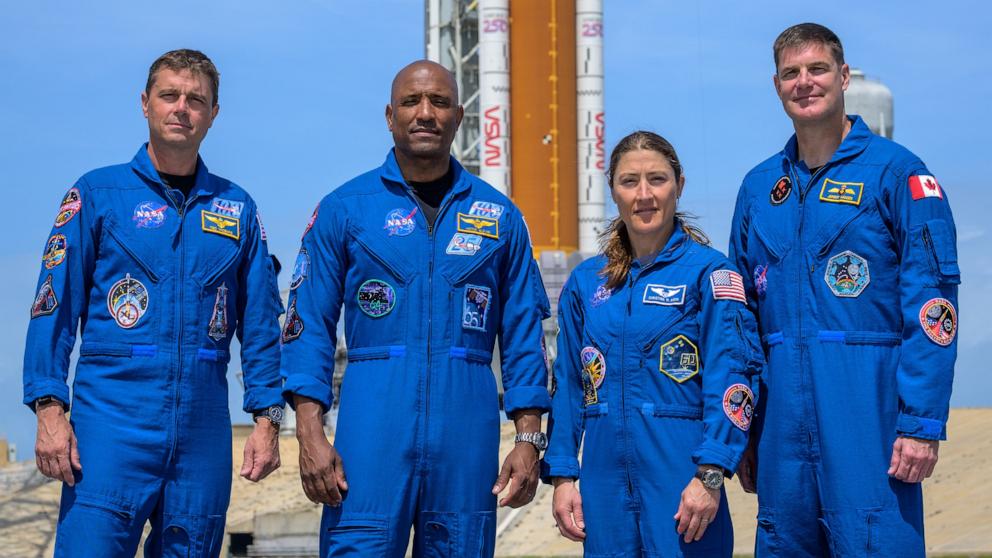
The team consists of Victor Glover, Christina Hammock Koch and Reid Wiseman of NASA and Jeremy Hansen of the Canadian Space Agency.

PHOTO: NASA astronauts Reid Wiseman, Victor Glover, Christina Koch and CSA astronaut Jeremy Hansen stop for a group photograph as they visit NASA's Artemis II SLS rocket and Orion spacecraft, March 30, 2026 at the Kennedy Space Center in Florida.
Bill Ingalls/NASA
NASA astronauts Reid Wiseman, Victor Glover, Christina Koch and CSA astronaut Jeremy Hansen stop for a group photograph as they visit NASA's Artemis II SLS rocket and Orion spacecraft, March 30, 2026 at the Kennedy Space Center in Florida.
Bill Ingalls/NASA

Wiseman is the commander of the Artemis II mission, Glover is the mission pilot, and Koch and Hansen are mission specialists.

Glover and Koch will also be the first person of color and first woman, respectively, to eventually step foot on the lunar surface in future Artemis missions.

-ABC News' Julia Jacobo


Apr 10, 2026 8:59 PM

What to know about NASA's Artemis II moon mission

Artemis II took astronauts around the moon for the first time in more than 50 years. The four-person crew launched from NASA's Kennedy Space Center on Merritt Island, Florida, on April 1 for a 10-day journey, with the splashdown set for Friday off the California coast.

The history-making trip will pave the way for future Artemis missions intended to eventually see astronauts set foot on the moon and the building of a permanent lunar base.

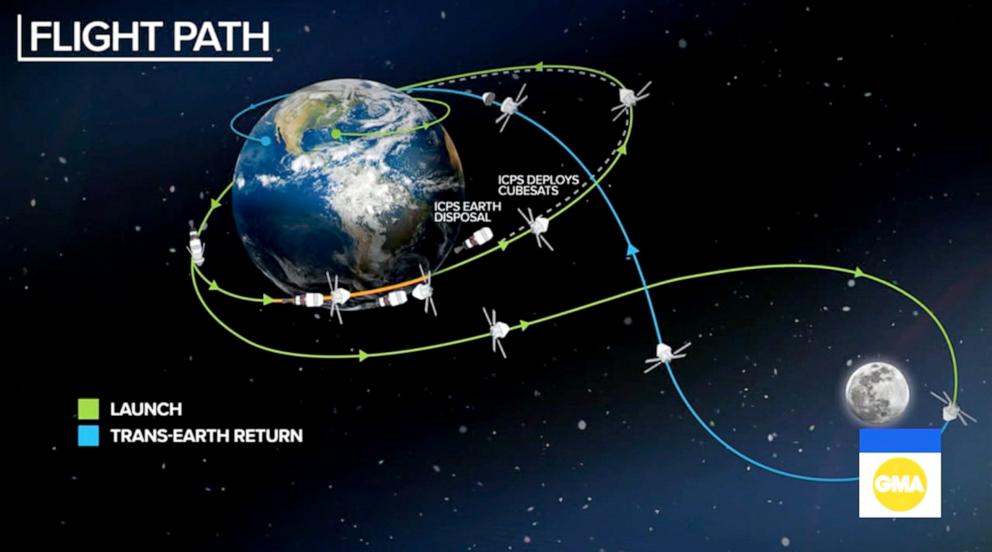
PHOTO: Artemis flight path graphic
ABC News
ABC News

Read more here about what you need to know regarding the Artemis II mission, including who the astronauts are and how to watch.


Apr 01, 2026 10:00 AM

Artemis II scheduled to launch today

NASA's Artemis II mission is scheduled to launch today between 6:24 p.m. ET and 8:24 p.m. ET from Florida's Kennedy Space Center Launch Complex 39B.

The crew of four astronauts – mission commander Reid Weisman, mission pilot Victor J. Glover Jr., and mission specialists Christina Koch and Jeremy Hansen – will board the Orion crew capsule, dubbed Integrity, atop the SLS (Space Launch System) rocket for a more than 600,000-mile, 10-day journey around the moon to test critical spacecraft systems ahead of the Artemis IV mission, which is intended to land astronauts near the moon's South Pole, a region never explored by humans, in 2028.

PHOTO: Astronauts Reid Wiseman, Victor Glover, Christina Koch and Jeremy Hansen stop for a group photo during a visit to NASA's Artemis II SLS rocket and Orion spacecraft, March 30, 2026, at Launch Complex 39B of NASA's Kennedy Space Center in Fla.
Bill Ingalls/NASA/AFP via Getty Images
Astronauts Reid Wiseman, Victor Glover, Christina Koch and Jeremy Hansen stop for a group photo during a visit to NASA's Artemis II SLS rocket and Orion spacecraft, March 30, 2026, at Launch Complex 39B of NASA's Kennedy Space Center in Fla.
Bill Ingalls/NASA/AFP via Getty Images

At mission's end, Orion will splash down in the Pacific Ocean, off the coast of San Diego, with recovery operations conducted by the U.S. Navy and NASA.


Apr 06, 2026 4:27 PM

'Welcome to my old neighborhood': Jim Lovell's message to the Artemis II crew

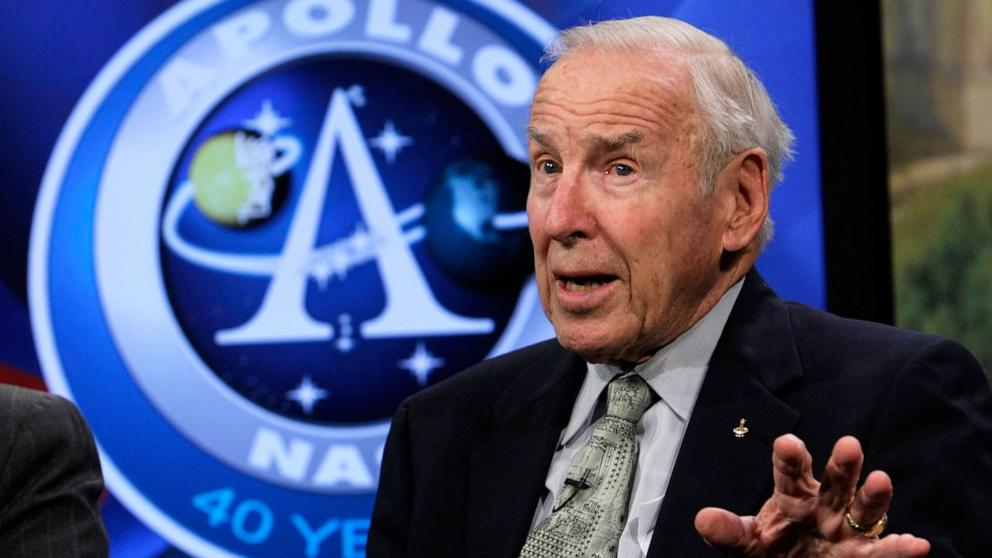
The Artemis II mission crew awoke Monday to a message from former astronaut Jim Lovell. Though perhaps best known as the commander of Apollo 13, Lovell also was the command module pilot of Apollo 8, which in December 1968 became the first crewed spaceflight to reach and orbit the moon.

PHOTO: Apollo 13 astronaut James Lovell speaks during a live taping of a NASA TV program at the Newseum, November 13, 2008 in Washington.
Alex Wong/Getty Images
Apollo 13 astronaut James Lovell speaks during a live taping of a NASA TV program at the Newseum, November 13, 2008 in Washington.
Alex Wong/Getty Images

"Welcome to my old neighborhood," Lovell begins the message. "When Frank Borman and Bill Anders and I orbited the moon on Apollo 8, we got humanity's first up-close look of the moon and got a view of the home planet that inspired and united people around the world."

"I'm proud to pass that torch on to you as you swing around the moon and lay the groundwork" for future missions, Lovell said.

PHOTO: The Earth rises above the moon in a picture known as Earthrise taken by Apollo 8 astronaut William Anders on December 24, 1968.
William Anders/NASA
The Earth rises above the moon in a picture known as Earthrise taken by Apollo 8 astronaut William Anders on December 24, 1968.
William Anders/NASA

"It's a historic day, and how busy you'll be. But don't forget to enjoy the view," the message concludes. "Good luck and Godspeed from all of us here on the good Earth."

Apollo 8, which launched Dec. 21, 1968, famously took the historic photograph of the first Earthrise over the lunar surface as seen by humans.

Lovell recorded his message to the Artemis II crew shortly before his death on Aug. 7, 2025, at age 97.


GMA Newsletters

Sign up for our newsletters to get GMA delivered to your inbox every morning!

Up Next in news

PHOTO: Gas station clerk Abdulrahman Abohatem speaks to ABC affiliate WXYZ.

Gas station clerk speaks out after foiling alleged kidnapping

April 15, 2026
PHOTO: Pauls Valley High School principal Kirk Moore took down a shooter in the halls after shots were fired.

Oklahoma high school principal takes down would-be shooter, hailed as hero

April 15, 2026
VIDEO: American influencer found dead in Tanzania

American influencer found dead in Tanzania

April 15, 2026

The latest lifestyle and entertainment news and inspiration for how to live your best life - all from Good Morning America.
  • Contests
  • Terms of Use
  • Privacy Policy
  • Do Not Sell My Info
  • Children’s Online Privacy Policy
  • Advertise with us
  • Your US State Privacy Rights
  • Interest-Based Ads
  • About Nielsen Measurement
  • Press
  • Feedback
  • Shop FAQs
  • ABC News
  • ABC
  • All Videos
  • All Topics
  • Sitemap

© 2026 ABC News
  • Privacy Policy— 
  • Your US State Privacy Rights— 
  • Children's Online Privacy Policy— 
  • Interest-Based Ads— 
  • Terms of Use— 
  • Do Not Sell My Info— 
  • Contact Us— 

© 2026 ABC News