Northern lights could be visible in parts of the US this week: Find out where and when

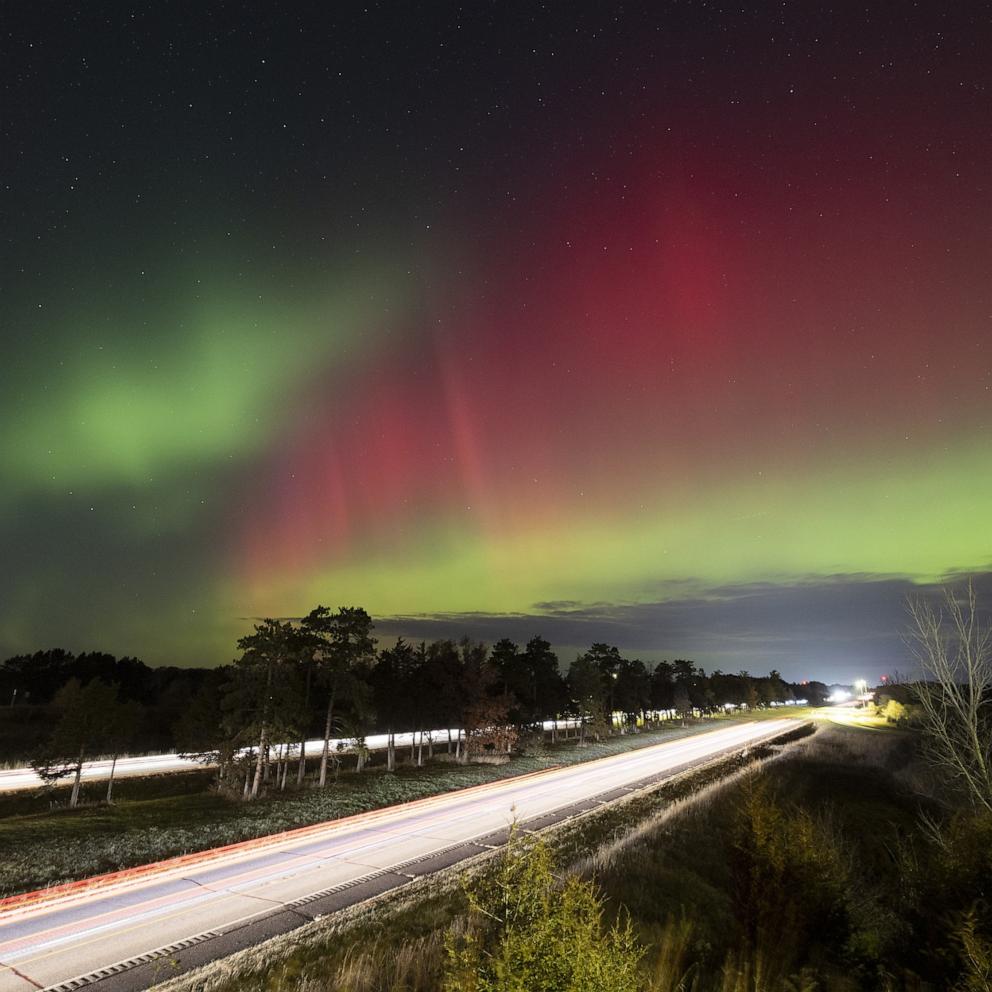
Skywatchers, get ready! The northern lights are expected to put on a rare show across parts of the U.S. this week.
According to the National Oceanic and Atmospheric Administration's Space Weather Prediction Center, the phenomenon -- also known as aurora borealis -- could be visible on two consecutive nights: late Tuesday into early Wednesday, and again Wednesday night.
Caused by charged particles from the sun interacting with Earth's atmosphere, these waves of luminous color have fascinated people for thousands of years.
Read on to learn what causes them, which states may get a view and the best times to watch.
What are the northern lights?

The northern lights, or aurora borealis, form when particles from space collide with Earth's upper atmosphere.
"The Sun continuously produces an outflow of charged particles into the solar system known as the solar wind," NASA explains. "When the solar wind reaches Earth, it can interact with Earth's magnetic shield, often depositing and accumulating energy there. When this energy is finally released, much of it rains down on our atmosphere, causing auroras."
According to NOAA, "even moderate solar wind creates aurora," meaning that "there is usually a weak aurora somewhere even when there isn't a big geomagnetic storm."
When the sun is especially active -- like it is now -- these storms become more frequent.
Since mid-2024, a series of geomagnetic storms has made the auroras visible much farther south than usual, even as far as northern Florida. According to NASA, this is due to the sun reaching its "solar maximum," the most active phase in its 11-year cycle.
While the lights are beautiful, they can also disrupt satellites, GPS, radio signals and even power grids here on Earth.
When are the best times to view the northern lights?

According to NOAA, people in Canada and parts of the northern U.S. may have a chance to see the northern lights on the nights of Tuesday, April 15, and Wednesday, April 16.
The display is expected to peak on Wednesday, possibly stretching across up to 18 states before decreasing to just four states on Thursday, April 17.
The best time to view the aurora is usually between 10 p.m. and 2 a.m. local time, with the most vibrant displays often happening within an hour or two of midnight.
While auroras can sometimes appear in the early evening or early morning, they tend to be less active and not as visually striking during those hours, NOAA states.
Which states are best for viewing the northern lights?
The best chances to see the northern lights in the U.S. are in the northernmost states, where auroral activity is strongest.
According to NOAA's latest projections, up to 18 states could offer visibility of the aurora borealis:
Alaska
Montana
North Dakota
Minnesota
Wisconsin
Michigan
Maine
Washington
Idaho
Oregon
Vermont
New Hampshire
New York
Pennsylvania
South Dakota
Iowa
Illinois
Nebraska
How to view the northern lights
To catch the northern lights, head out at night and get far away from city lights. Keep in mind that a full moon can wash out the view -- it doesn't make the aurora dimmer, but it does make it harder to see.
One thing people often overlook: high-latitude regions where auroras are common don't get truly dark in the summer. So, an Arctic summer trip isn't ideal for aurora viewing. The lights might still be there, but they're only visible in the dark, according to NOAA.


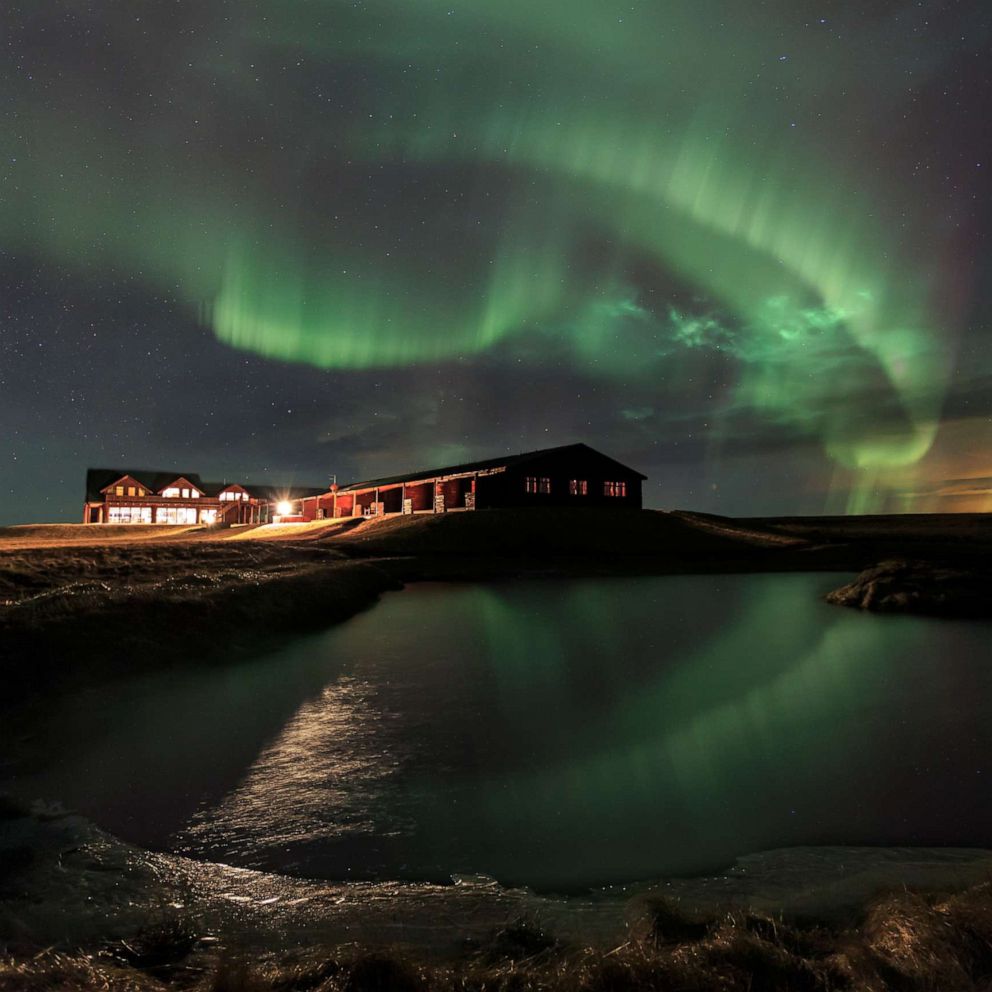
NASA notes that since auroras happen far above the clouds, you'll need clear skies and favorable space weather.
The higher and more polar your location, the better your chances. Patience (and a bit of luck) also goes a long way.
Your smartphone can be a handy tool, too. Its camera is more sensitive than your eyes and may pick up dim auroras you might otherwise miss.
To improve your odds, check out space weather data from the NOAA Space Weather Prediction Center. It's a great resource for planning your aurora hunt.