• Video
  • Shop
  • Culture
  • Family
  • Wellness
  • Food
  • Living
  • Style
  • Travel
  • News
  • Book Club
  • Newsletter
  • Privacy Policy
  • Your US State Privacy Rights
  • Children's Online Privacy Policy
  • Interest-Based Ads
  • Terms of Use
  • Do Not Sell My Info
  • Contact Us
  • © 2026 ABC News
ABC News

'Welcome home, Artemis': Crew celebrates historic 10-day moon mission

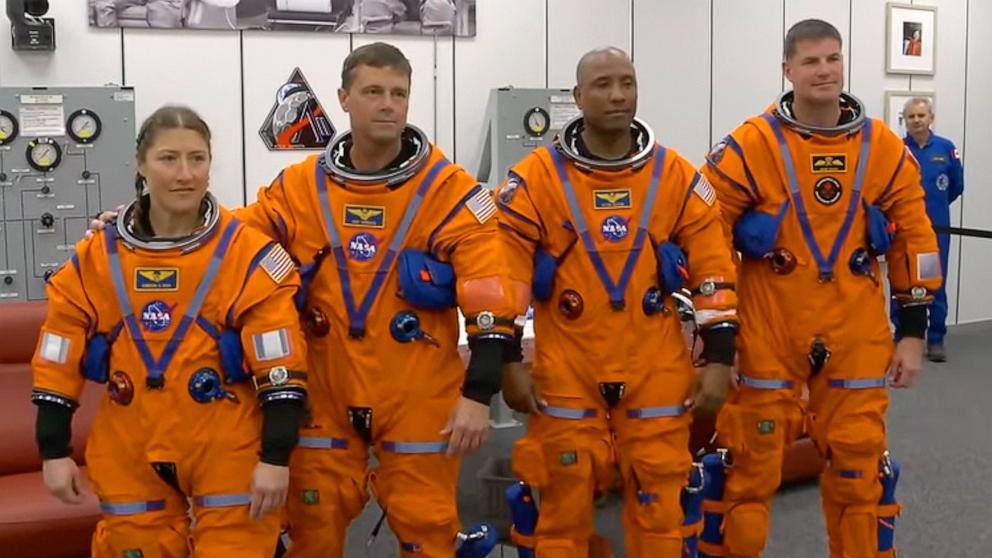
PHOTO: (L-R) NASA's Artemis II mission astronauts Canadian Space Agency's Jeremy Hansen, mission specialist Christina Koch, pilot Victor Glover and commander Reid Wiseman attend a welcoming ceremony in Houston, Texas, on April 11, 2026.
3:01
Ronaldo Schemidt/AFP via Getty Images
Artemis II crew arrives back to Houston after the dramatic Pacific splashdown
By Mary Kekatos, Julia Jacobo, Leah Sarnoff, Ivan Pereira, Meredith Deliso
Last Updated: April 10, 2026, 10:19 PM

NASA's Artemis II mission lifted off on April 1 at 6:35 p.m. ET from the Kennedy Space Center in Florida.

The four-person crew completed a 695,081-mile, 10-day journey around the moon, also known as a lunar fly-by.

A "textbook" splashdown took place at 8:07 p.m. ET on Friday, April 10.

Key Headlines

  • Crew makes 1st appearance since return from historic mission
  • 'Welcome home, Artemis': Jubilant and emotional, crew speaks out on historic moon mission
  • Trump says he will welcome Artemis II crew to White House 'soon'
  • NASA officials hail 'new era' of space exploration after successful mission
  • Crew members hoisted into helicopters
  • All 4 crew members out of the capsule
Here's how the news is developing.

Apr 10, 2026 10:19 PM

Timeline for Orion descent

Here's a look at the "carefully timed sequence" of the final stages of Orion's descent, according to NASA. All times Eastern.

7:33 p.m.: Orion's crew module will separate from the European Service Module, exposing the heat shield that will protect the spacecraft as it travels through the Earth's atmosphere.

7:37 p.m.: Orion will perform an 18-second raise burn that fine-tunes the reentry angle of the spacecraft to minimize the time the heat shield will experience high temperatures.

7:53 p.m.: Orion will make first contact with the upper atmosphere, beginning a planned 6-minute communications blackout. The crew is expected to experience up to 3.9 Gs as the spacecraft travels nearly 35 times the speed of sound.

7:59 p.m.: NASA will regain communications with the crew.

8:03 p.m.: At around 22,000 feet in altitude, drogue parachutes will deploy to help slow the capsule ahead of splashdown.

8:04 p.m.: Three main parachutes will deploy at around 6,000 feet, reducing Orion's speed to less than 136 mph.

8:07 p.m.: Orion will splash down in the Pacific Ocean, off the coast of San Diego, having slowed to 20 mph.

PHOTO: Artemis II splashdown corridor off the coast of California.
NASA
Artemis II splashdown corridor off the coast of California.
NASA

Apr 10, 2026 9:44 PM

USGS warns to expect sonic boom from reentry

The U.S. Geological Survey warned residents of Southern California that they should expect to hear a sonic boom from the Artemis II reentry in a few hours.

The sonic boom is expected between approximately 5-5:15 p.m. PT, it said.


Apr 10, 2026 9:36 PM

What the astronauts will be doing during reentry

It will take Orion about 14 minutes to travel the 400,000 feet from space to splashdown off the coast of San Diego.

Everyone inside the spacecraft will be laser-focused on monitoring the onboard systems during their descent through the atmosphere, according to retired NASA astronaut Barry "Butch" Wilmore.

PHOTO: Artemis II astronauts, Jeremy Hansen, Reid Wiseman and Victor Glover work at the controls of the Orion spacecraft as sunlight fills the capsule as it travels to Earth ahead of splashdown in the Pacific Ocean, April 10, 2026.
NASA
Artemis II astronauts, Jeremy Hansen, Reid Wiseman and Victor Glover work at the controls of the Orion spacecraft as sunlight fills the capsule as it travels to Earth ahead of splashdown in the Pacific Ocean, April 10, 2026.
NASA


The astronauts train for "all types of failures," so their mindset is just to concentrate on the jobs at hand, he said.

"You can't let apprehension involve you in those time frames," Wilmore told ABC News. "You have to focus on your task, whatever that might be, and you have to perform because if you don't, the consequences are pretty dire."

-ABC News' Briana Alvarado


Apr 10, 2026 7:34 PM

How Orion's heat shield can withstand up to 5,000 degrees on reentry

The Orion crew module will be falling to Earth at over 24,000 mph when it encounters the atmosphere. As the atmosphere thickens, friction will slow the spacecraft. It will also create a lot of heat -- up to 5,000 degrees Fahrenheit, which is more than twice as hot as lava from a volcano -- turning Orion into a fireball.

Orion's heat shield, located on the underside of the spacecraft, will protect the spacecraft and its crew from the intense temperatures of reentry. Onboard maneuvering jets ensure Orion maintains the orientation required to keep the heat shield pointed toward Earth during reentry.

"Importantly, there's this coating on the outside that's meant to melt upon being heated rather than absorbing that energy," ABC News contributor and astrophysicist Hakeem Oluseyi said. "So, it's much in the same way that a car is meant to crumple in an accident rather than being a stiff object. You want to dissipate that energy. You need the energy to go somewhere that is not inside the capsule."

VIDEO: How Orion’s heat shield can withstand up to 5,000 degrees on reentry
2:52
ABC News contributor and astrophysicist Hakeem Oluseyi discusses the physics and science behind the Artemis II crew’s reentry to Earth.

Apr 01, 2026 5:53 PM

Artemis II astronauts are suiting up

The four Artemis II astronauts are suiting up, officially stepping into their Orion Crew Survival System (OCCS) spacesuits as they prepare for their long-awaited launch.

These specialized suits are worn during the most critical phases of flight: liftoff and reentry.

PHOTO: NASA astronauts Christina Koch, Reid Wiseman, Victor Glover and CSA astronaut Jeremy Hansen pose together before the launch of the Artemis II SLS rocket and Orion spacecraft, April 1, 2026 at the Kennedy Space Center in Florida.
NASA
NASA astronauts Christina Koch, Reid Wiseman Victor Glover and CSA astronaut Jeremy Hansen pose together after being suited up before the launch of the Artemis II SLS rocket and Orion spacecraft, April 1, 2026 at the Kennedy Space Center in Florida.
NASA

The astronauts are also undergoing leak checks to ensure that their suits are airtight. They conduct a total of three leak checks in the suit-up room and then three more checks once in the Orion crew capsule, according to NASA.

-ABC News' Briana Alvarado


GMA Newsletters

Sign up for our newsletters to get GMA delivered to your inbox every morning!

Up Next in news

PHOTO: Sharks Now A Common Sight On The Cape

What to know about 'Lulu's Law' requiring emergency shark attack notifications

May 21, 2026
PHOTO: Bert Gor and his daughter are speaking out after they say they were victims of an AI scam by a Lyft driver.

Father, daughter speak after Lyft driver is accused of using AI-generated image for damage claim

May 20, 2026
PHOTO: Philadelphia Police Sgt. Thomas Cain is credited with saving a toddler who was choking in a March 2026 incident at FDR Park in Philadelphia.

Police officer speaks out after rescuing choking toddler in incident caught on camera

May 20, 2026

The latest lifestyle and entertainment news and inspiration for how to live your best life - all from Good Morning America.
  • Contests
  • Terms of Use
  • Privacy Policy
  • Do Not Sell My Info
  • Children’s Online Privacy Policy
  • Advertise with us
  • Your US State Privacy Rights
  • Interest-Based Ads
  • About Nielsen Measurement
  • Press
  • Feedback
  • Shop FAQs
  • ABC News
  • ABC
  • All Videos
  • All Topics
  • Sitemap

© 2026 ABC News
  • Privacy Policy— 
  • Your US State Privacy Rights— 
  • Children's Online Privacy Policy— 
  • Interest-Based Ads— 
  • Terms of Use— 
  • Do Not Sell My Info— 
  • Contact Us— 

© 2026 ABC News