• Video
  • Shop
  • Culture
  • Family
  • Wellness
  • Food
  • Living
  • Style
  • Travel
  • News
  • Book Club
  • Newsletter
  • Privacy Policy
  • Your US State Privacy Rights
  • Children's Online Privacy Policy
  • Interest-Based Ads
  • Terms of Use
  • Do Not Sell My Info
  • Contact Us
  • © 2026 ABC News
ABC News

'Welcome home, Artemis': Crew celebrates historic 10-day moon mission

PHOTO: (L-R) NASA's Artemis II mission astronauts Canadian Space Agency's Jeremy Hansen, mission specialist Christina Koch, pilot Victor Glover and commander Reid Wiseman attend a welcoming ceremony in Houston, Texas, on April 11, 2026.
3:01
Ronaldo Schemidt/AFP via Getty Images
Artemis II crew arrives back to Houston after the dramatic Pacific splashdown
By Mary Kekatos, Julia Jacobo, Leah Sarnoff, Ivan Pereira, Meredith Deliso
Last Updated: April 6, 2026, 1:39 PM

NASA's Artemis II mission lifted off on April 1 at 6:35 p.m. ET from the Kennedy Space Center in Florida.

The four-person crew completed a 695,081-mile, 10-day journey around the moon, also known as a lunar fly-by.

A "textbook" splashdown took place at 8:07 p.m. ET on Friday, April 10.

Key Headlines

  • Crew makes 1st appearance since return from historic mission
  • 'Welcome home, Artemis': Jubilant and emotional, crew speaks out on historic moon mission
  • Trump says he will welcome Artemis II crew to White House 'soon'
  • NASA officials hail 'new era' of space exploration after successful mission
  • Crew members hoisted into helicopters
  • All 4 crew members out of the capsule
Here's how the news is developing.

Apr 06, 2026 1:39 PM

Orion holding 'pinpoint trajectory' toward moon, NASA says

The Artemis II mission is now less than a day away from entering the pivotal lunar flyby part of the journey.

After days of travel, NASA leaders provided an update on Artemis II’s progress, along with new insight into what astronauts will be observing on the moon and beyond during Monday’s lunar flyby.

According to NASA flight director Rick Henfling, Orion is on an exceptionally precise trajectory toward the moon, which led to the cancellation of its first two planned course-correction burns.

PHOTO: This artist’s concept depicts the nominal trajectory for NASA’s Artemis II test flight, an approximately 10-day mission that will send four astronauts around the Moon and back.
Goddard/JSC/NASA
This artist’s concept depicts the nominal trajectory for NASA’s Artemis II test flight, an approximately 10-day mission that will send four astronauts around the Moon and back.
Goddard/JSC/NASA

“We found that Orion was on such a pinpoint trajectory that we didn't need to do the first two correction maneuvers,” Henfling said during Sunday’s news conference.

A third adjustment is still scheduled for Sunday at 11:03 p.m. ET. It is expected to be a brief, 14-second firing designed to keep the spacecraft perfectly aligned ahead of the flyby.

Just hours later, around 12:40 a.m. ET Monday, Orion will officially cross over into the lunar sphere of influence. This is the point where the moon’s gravity takes over from Earth’s. From there, the crew will begin a carefully choreographed sequence of observations as they pass by the lunar surface.

-ABC News' Briana Alvarado


Apr 05, 2026 8:52 PM

Artemis II astronauts practice donning, removing space suits

Artemis II astronauts Reid Wiseman, Victor Glover Jr., Christina Koch and Jeremy Hansen are now donning their Orion Crew Survival System (OCSS) suits and beginning their operational demo.

The crew will practicing donning and removing the suits quickly in the event of a depressurization emergency within the spacecraft.

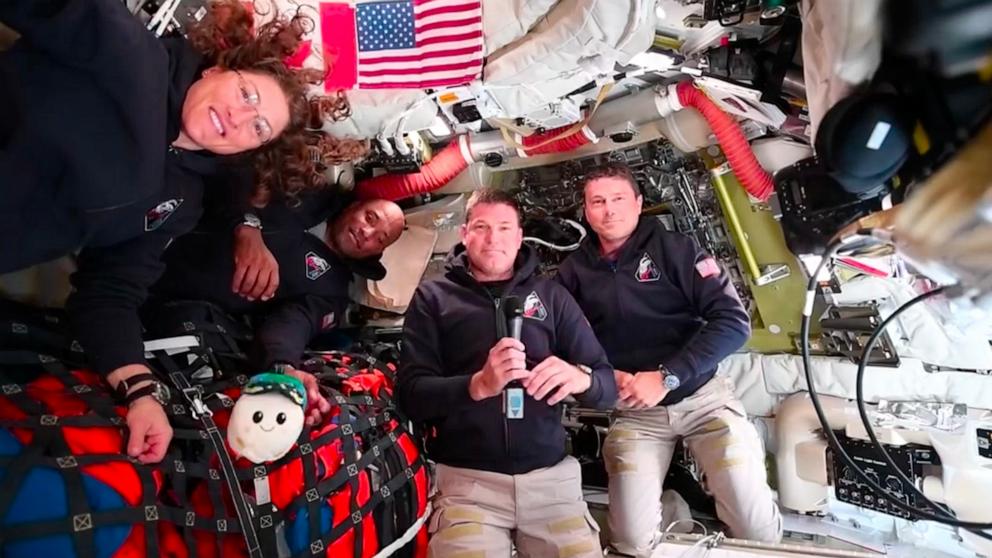
PHOTO: Crewmembers are shown on the Artemis II mission on flight day 3.
NASA
Crewmembers Christina Koch, mission specialist; Victor Glover, pilot; Reid Wiseman, commander; and Reid Wiseman, commander; and CSA (Canadian Space Agency) astronaut Jeremy Hansen, mission specialist; are shown on the Artemis II mission on flight day 3.
NASA

The demo affords an opportunity to see the Artemis II crew wearing their spacesuits as they travel ever closer to the moon ahead of Monday's lunar flyby.

-ABC News' Briana Alvarado


Apr 05, 2026 5:38 PM

Artemis II crew awakened by CeeLo Green song 'Work'

The Artemis II mission officially entered its fifth and final day before the highly anticipated lunar flyby as the crew awoke Sunday to the CeeLo Green song "Work."

The astronauts also heard from Apollo 16 astronaut Charlie Duke, who once landed on the moon on a different kind of Orion — a lunar module bearing the same name.

"I'm glad to see a different kind of Orion helping return humans to the moon as America charts the course to the lunar surface," Duke said in his message to the four-person crew.

PHOTO: Mission Specialist 1 Christina Koch gazing at Earth from Orion’s windows, a reminder of home as they travel toward the moon.
NASA
Mission Specialist 1 Christina Koch gazing at Earth from Orion’s windows, a reminder of home as they travel toward the moon.
NASA

"Below you, on the moon, is a photo of my family. I pray it reminds you that we in America and all of the world are cheering you on," Duke added. "Thanks to you and the whole team on the ground for building on our Apollo legacy with Artemis. Godspeed and safe travels home."

With the moon flyby just a day away, Sunday marks the final stretch of preparations before the big moment.

PHOTO: This artist’s concept depicts the nominal trajectory for NASA’s Artemis II test flight, an approximately 10-day mission that will send four astronauts around the Moon and back.
Goddard/JSC/NASA
This artist’s concept depicts the nominal trajectory for NASA’s Artemis II test flight, an approximately 10-day mission that will send four astronauts around the Moon and back.
Goddard/JSC/NASA

On Saturday, the crew received their full list of lunar targets, which includes 30 specific sites they’ll observe as they pass by the moon. During the observation period, the crew will go through a total of five shifts during what NASA is calling the lunar flyby sequence.

For the crew, the first four of those shifts are all about observing the lunar surface. This is when the windows will be pointing right at the moon. The astronauts will capture everything using their cameras and personal computers onboard the Orion crew module.

-ABC News' Briana Alvarado


Apr 05, 2026 9:53 AM

Artemis II crew conducts Orion control tests, NASA says

Overnight, the Artemis II crew wrapped up a busy stretch of work in deep space, including a hands-on test of Orion's controls and more prep for Monday's lunar flyby.

According to NASA, the crew began a manual piloting demonstration at 9:09 p.m. ET, with mission specialists Christina Koch and Jeremy Hansen taking turns flying the spacecraft.

For about 41 minutes, they tested how Orion responds in different thruster modes to see how it handles both full, free movement and more limited steering. The goal is to give engineers a better sense of how the spacecraft performs when astronauts are actively flying it, NASA said.

NASA said the test is part of a series of evaluations, with commander Reid Wiseman and pilot Victor Glover expected to run a similar demonstration later in the mission -- on April 9 -- to give teams on the ground more data from different pilots.

Earlier in the day, the crew also spent time going over their plan for the lunar flyby. According to NASA, they reviewed a list of specific features on the moon's surface that scientists want them to photograph and describe.

View this post on Instagram

A post shared by NASA (@nasa)

That work will come into play on Monday, when Orion begins its flyby at 2:45 p.m. ET.

All of this is setting the stage for one of the most anticipated parts of the mission: when astronauts will see the moon up close and help document it in real time for scientists back on Earth.

The crew shared a new photo of the moon during day 4 of their mission, capturing parts of the lunar far side including Orientale basin peeking through from the right side of the lunar disk.

"This mission marks the first time the entire basin has been seen with human eyes," NASA said in an Instagram post.

-ABC News' Briana Alvarado


Apr 10, 2026 11:41 PM

Major phase of final descent

Orion's crew module has separated from the European Service Module, exposing the heat shield that will protect the spacecraft during its high-speed travel through the Earth's atmosphere.

That shield will withstand temperatures of up to 5,000 degrees Fahrenheit during the high-speed entry.

PHOTO: The Orion crew module separates from the service module as the Artemis II crew prepares to reenter Earth's atmosphere, April 10, 2026.
NASA
The Orion crew module separates from the service module as the Artemis II crew prepares to reenter Earth's atmosphere, April 10, 2026.
NASA

GMA Newsletters

Sign up for our newsletters to get GMA delivered to your inbox every morning!

Up Next in news

PHOTO: In this screen grab from a video, Andon Market is shown in San Francisco, Calif.

This San Francisco shop is run completely by an AI agent

April 23, 2026
VIDEO: Trump orders Navy to 'shoot and kill' any boat laying mines in Strait of Hormuz

Trump orders Navy to 'shoot and kill' any boat laying mines in Strait of Hormuz

April 23, 2026
PHOTO: In this Aug. 12, 2016, file photo, the Orange County Courthouse is shown in Santa Ana, Calif.

Mother charged after teen son allegedly hits and injures 81-year-old veteran while riding e-motorcycle

April 23, 2026

The latest lifestyle and entertainment news and inspiration for how to live your best life - all from Good Morning America.
  • Contests
  • Terms of Use
  • Privacy Policy
  • Do Not Sell My Info
  • Children’s Online Privacy Policy
  • Advertise with us
  • Your US State Privacy Rights
  • Interest-Based Ads
  • About Nielsen Measurement
  • Press
  • Feedback
  • Shop FAQs
  • ABC News
  • ABC
  • All Videos
  • All Topics
  • Sitemap

© 2026 ABC News
  • Privacy Policy— 
  • Your US State Privacy Rights— 
  • Children's Online Privacy Policy— 
  • Interest-Based Ads— 
  • Terms of Use— 
  • Do Not Sell My Info— 
  • Contact Us— 

© 2026 ABC News