• Video
  • Shop
  • Culture
  • Family
  • Wellness
  • Food
  • Living
  • Style
  • Travel
  • News
  • Book Club
  • Newsletter
  • Privacy Policy
  • Your US State Privacy Rights
  • Children's Online Privacy Policy
  • Interest-Based Ads
  • Terms of Use
  • Do Not Sell My Info
  • Contact Us
  • © 2026 ABC News
ABC News

Climate and environment updates: 7 key measures of Earth's health in danger, report warns

PHOTO: Reef fishes swim over a reef affected by coral bleaching from high water temperature on May 08, 2024 in Trat, Thailand.
1:54
Sirachai Arunrugstichai/Getty Images
Summer temperatures stretching later into the season
By ABC Climate Unit
Last Updated: November 14, 2024, 4:25 PM

The climate crisis is not a distant threat; it's happening right now and affecting what matters most to us. Hurricanes intensified by a warming planet and drought-fueled wildfires are destroying our communities. Rising seas and flooding are swallowing our homes. And record-breaking heat waves are reshaping our way of life.

The good news is we know how to turn the tide and avoid the worst possible outcomes. However, understanding what needs to be done can be confusing due to a constant stream of climate updates, scientific findings and critical decisions that are shaping our future.

That's why the ABC News Climate and Weather Unit is cutting through the noise by curating what you need to know to keep the people and places you care about safe. We are dedicated to providing clarity amid the chaos, giving you the facts and insights necessary to navigate the climate realities of today -- and tomorrow.
Key Headlines

  • 7 key measures of the Earth's health are in now in danger: Report
  • Earth's oceans face 'triple planetary crisis,' new report warns
  • Climate change is straining America's health care system: Study
Here's how the news is developing.

Nov 14, 2024 4:25 PM

UN-backed carbon credits market gets greenlight, potentially revolutionizing the process

After a yearslong deadlock, delegates at COP29, the U.N. global climate conference, have finally reached an agreement on international carbon market standards, a critical step in launching a global carbon market.

The new global carbon market would standardize the issuing, trading and redeeming of carbon credits. A carbon credit is a voucher representing a specific amount of greenhouse gas reduction or removal from the atmosphere. Individuals, businesses, organizations and countries can use carbon credits to offset an action that produces emissions -- for example, paying for tree planting to offset the emissions from a factory or an airplane flight.

Presently, carbon trading markets are run by various organizations with little to no regulation or universal standards. However, a U.N.-backed global carbon market would provide the financial and regulatory support of the international governing body.

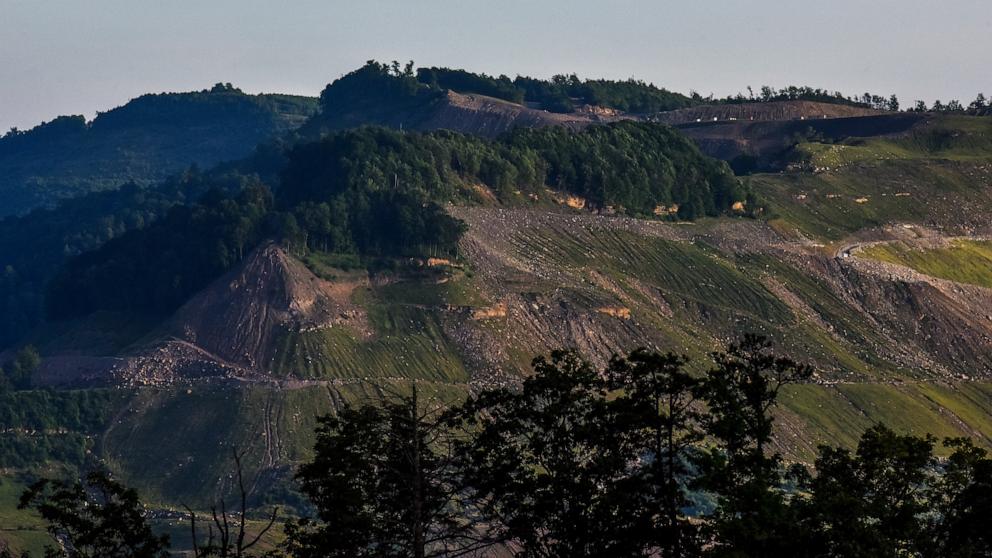
PHOTO: Mountainsides have been stripped of their trees and scarred by coal mining, May 23, 2019, in Oven Fork, KY.
The Washington Post via Getty Images, FILE
Mountainsides have been stripped of their trees and scarred by coal mining, May 23, 2019, in Oven Fork, KY.
The Washington Post via Getty Images, FILE

U.N. Climate Change Executive Secretary Simon Stiell said the new global carbon market will help countries implement their climate plans faster and cheaper, driving down emissions. Since this will be an open international market, companies, organizations and individuals could utilize the market to meet their voluntary climate targets, regardless of their nation’s participation.

A U.N.-backed global climate market would also bring significant financial benefits to the global market. Yalchin Rafiyev, COP29 lead negotiator, said this new market will be a game-changing tool that directs resources to the developing world and helps save up to $250 billion a year on climate plan implementation.

The International Emissions Trading Association, a nonprofit business group that supports global carbon markets, said that within a few years, the implementation of the U.N.-back carbon market not only has the potential to save the global economy billions of dollars per year, but could also cut approximately 5 billion metric tons of carbon output annually.

While a path has been cleared for this new carbon market to become operational, COP29 negotiators said there is still more work to do before it can be launched. Discussions will continue through the end of the conference to address any additional questions and concerns.

-ABC News meteorologist Dan Peck and ABC News Climate Unit's Matthew Glasser


Nov 13, 2024 10:00 PM

Day 3 at COP29 shows how hard it will be for the world to quit fossil fuels

Day three of COP29, the global U.N. climate conference, highlighted how challenging it will be for the world to transition away from fossil fuels. As some countries are making new commitments to reduce emissions and ramp up clean energy production, others are advocating for the continued use of fossil fuels.

Joining the United Kingdom and United Arab Emirates, Brazil announced its Nationally Determined Contribution (NDC) plans on Wednesday. NDCs are each country's plan for achieving the goals outlined in the Paris Climate Agreement. Brazil has pledged to reduce its carbon emissions by 59% to 67% by 2035.

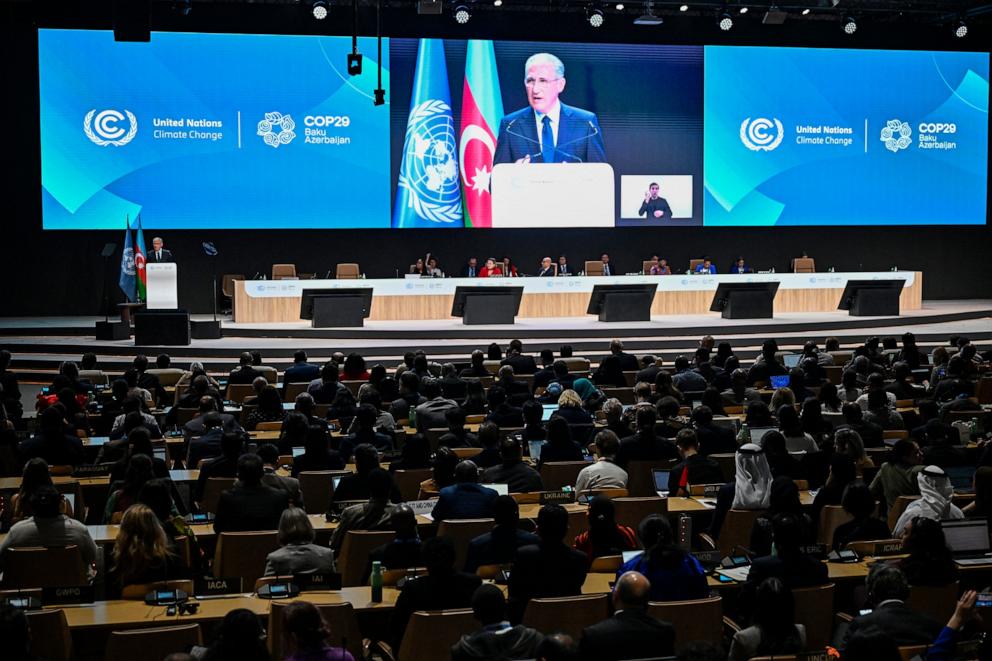
PHOTO: COP29 president Mukhtar Babayev delivers a speech during the opening of the 2024 United Nations Climate Change Conference in Baku on Nov. 11, 2024.
Alexander Nemenov/AFP via Getty Images
COP29 president Mukhtar Babayev delivers a speech during the opening of the 2024 United Nations Climate Change Conference in Baku on Nov. 11, 2024.
Alexander Nemenov/AFP via Getty Images

"Cutting emissions by 67% by 2035 could put Brazil on a pathway to reach net-zero by 2050," said Karen Silverwood-Cope, climate director of WRI Brasil.

Brazil is hosting next year's COP, and Silverwood-Cope said the country has "a responsibility to lead by example and aim high."

But Silverwood-Cope also pointed out that Brazil's NDC does not include a plan for reducing fossil fuel emissions. Instead, they are pledging to increase biofuel production. Biofuel is produced from renewable biological sources, including plants and algae. In Brazil, biofuel primarily comes from soybean oil. As a country with a history of mass deforestation, the loss of vegetation and forests for energy is controversial.

"Instead of saying that they're going to reduce oil consumption in the country, they are betting on biofuels," said Silverwood-Cope.

She said Brazil plans to use denigrated land for biofuel production. Deingrated land is land that has already been deforested.

As Brazil announced its new, stronger climate pledge, another South American country moved in the opposite direction by literally walking out of the conference.

Argentinian President Javier Milei ordered the country's COP29 representatives to withdraw from the conference and return home. Milei, the country's newly-elected, far-right president, has a history of climate change denial.

Despite the drama, delegates came to some agreements, including using more nuclear power as an alternative to fossil fuels.

The United States, El Salvador, Kazakhstan, Kenya, Kosovo, Nigeria and Türkiye endorsed a declaration calling for tripling the use of nuclear energy by 2050.

Italy also voiced its support for more nuclear energy and touted its ongoing investment in nuclear fusion research. Unlike current nuclear reactors, nuclear fusion doesn't create radioactive waste. Despite billions of dollars in research funding, the technology has yet to be developed commercially.

"We must use all available technologies. Not only renewables, but also gas, biofuels, hydrogen, CO2 capture, and, in the future, nuclear fusion," said Italian President Giorgia Meloni. "Italy is at the forefront on nuclear fusion."

-ABC News' Charlotte Slovin


Nov 13, 2024 3:56 PM

Fossil fuel emissions hit record highs in 2024, according to study

If negotiating international agreements to slow down and reverse the global climate crisis wasn't challenging enough, the delegates at COP29, the U.N. climate conference in Azerbaijan, are facing the grim reality that the world is moving in the wrong direction when it comes to fossil fuels.

According to the latest Global Carbon Budget report from the Global Carbon Project, carbon emissions from fossil fuels have hit a record high in 2024. The study projects that carbon dioxide (CO₂) emissions will reach 37.4 billion tonnes, up 0.8% from 2023.

For almost three decades, international leaders have been attending COP conferences and discussing the urgent need to reduce greenhouse gas emissions. However, despite these efforts, the Global Carbon Project says, "There is still no sign that the world has reached a peak in fossil CO2 emissions."

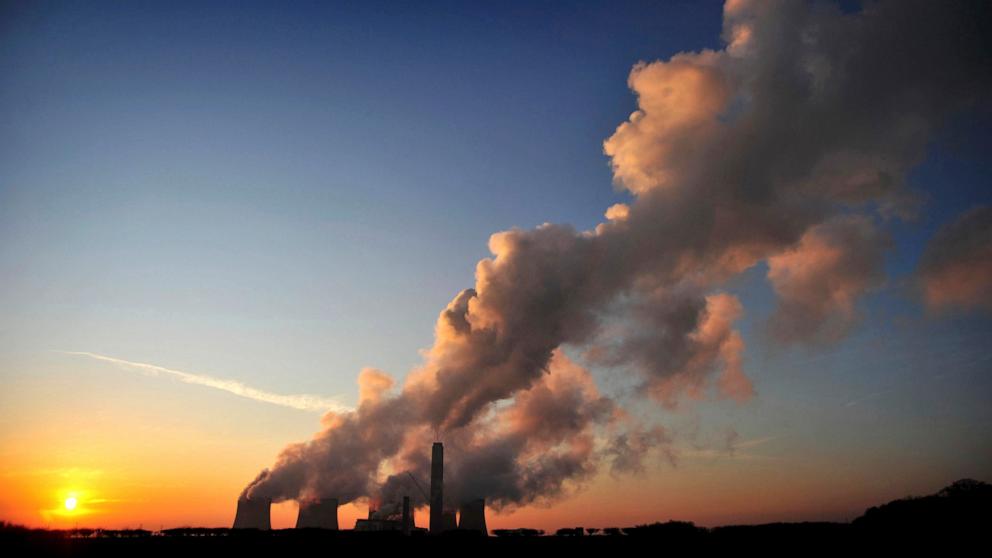
PHOTO: The sun sets over Ratcliffe on Soar Power Station near Nottingham, England.
Matthew Vincent/PA via AP
The sun sets over Ratcliffe on Soar Power Station near Nottingham, England.
Matthew Vincent/PA via AP

"The impacts of climate change are becoming increasingly dramatic, yet we still see no sign that burning of fossil fuels has peaked," wrote Pierre Friedlingstein of Exeter's Global Systems Institute in a press statement.

He added, "Until we reach net zero CO2 emissions globally, world temperatures will continue to rise and cause increasingly severe impacts."

Although the past decade has seen a decline in emissions from deforestation and land-use changes, emissions this year are rising compared to 2023, influenced by extreme drought conditions linked to the 2023-2024 El Niño climate event, according to the study. Despite this increase, land-use emissions have actually declined by 20% over the past decade thanks to reforestation and afforestation efforts.

Efforts to stop burning coal for energy are slowing down the year-over-year increase in those emissions, but they are still rising, albeit modestly. The study estimates that global coal emissions will increase by 0.2%. China and India are seeing increases of 0.2% and 4.5%, respectively, while the United States and the European Union are seeing declines of 3.5% and 15.8%.

Overall, the study found that China's emissions (32% of the worldwide total) for 2024 are expected to increase by 0.2% compared to 2023. India (8% of the worldwide total) is projected to grow emissions by 4.6% from the previous year. The European Union (7% of the worldwide total) should see a 3.8% decline year-to-year and the United States (13% of the worldwide total) is looking at a 0.6% decrease compared to 2023.

It's important to remember that many products purchased and used in the U.S. and Europe are made in places like China and India. Hence, their emissions reflect the manufacturing of goods for other countries.

According to the research, this trend worsens the cumulative impact of CO₂ in the atmosphere, projected to reach 422.5 parts per million (ppm) in 2024, representing a 52% increase compared to pre-industrial levels.

There is some good news in the data. The study finds that many countries have succeeded in reducing their fossil fuel carbon emissions or slowing down their growth. However, it's not enough to put the world on a path to net zero.

"There are many signs of positive progress at the country level, and a feeling that a peak in global fossil CO2 emissions is imminent, but the global peak remains elusive," wrote Glen Peters of the CICERO Center for International Climate Research in a statement. "Climate action is a collective problem, and while gradual emission reductions are occurring in some countries, increases continue in others."

-ABC News Climate Unit's Matthew Glasser


Nov 12, 2024 9:40 PM

World leaders send mixed messages about the climate crisis on Day 2 of COP29

If there was a theme for the second day of COP29, the U.N. climate conference in Azerbaijan, it would be mixed messaging from world leaders. As some nations announced ambitious new climate goals, others justified their continued reliance on fossil fuels. The developments come when the world is questioning the United States' future commitment to climate progress in light of President-elect Donald Trump's previous comments about climate change and his selection for EPA administrator.

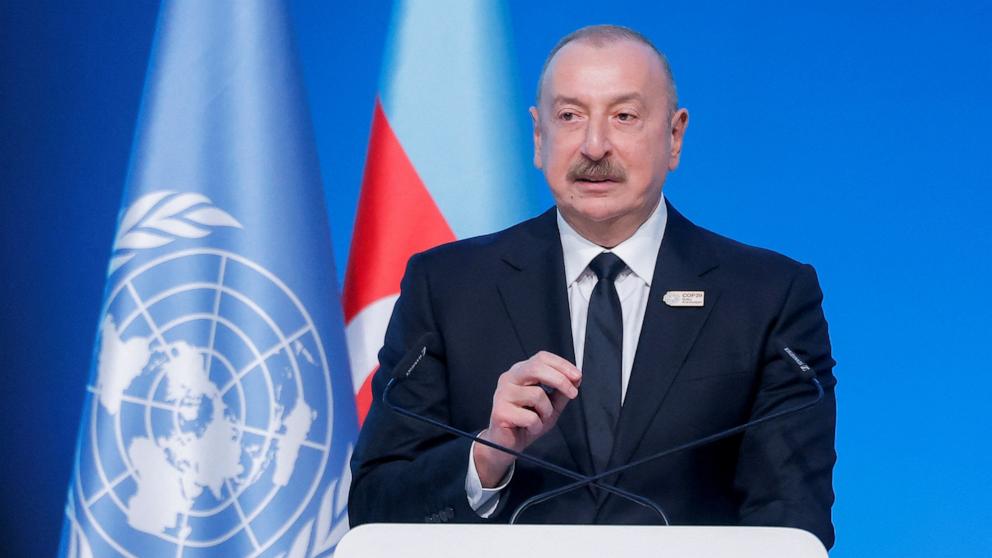
During his remarks, Azerbaijani President Ilham Aliyev, whose country is hosting the event, defended the use of fossil fuels, calling oil a "a gift of the God" and saying that it is just like any other natural resource. He added that countries "should not be blamed for bringing these resources to the market."

"To accuse us that we have oil is the same like to accuse us that we have more than 250 sunny days in Baku," said Aliyev.

PHOTO: Azerbaijan's President Ilham Aliyev speaks during the Opening Ceremony of the United Nations climate change conference COP29 in Baku, Azerbaijan, Nov. 12, 2024.
Maxim Shemetov/Reuters
Azerbaijan's President Ilham Aliyev speaks during the Opening Ceremony of the United Nations climate change conference COP29 in Baku, Azerbaijan, Nov. 12, 2024.
Maxim Shemetov/Reuters

Aliyev also called Western countries hypocrites for decrying oil production and calling for an end to fossil fuel use while still buying oil from countries like Azerbaijan. The European Commission signed an agreement with Azerbaijan in 2022 to receive oil from them when they stopped getting it from Russia. He said double standards are the "modus operandi" for climate talks.

Aliyev's pro-oil statements aren't expected to sidetrack the negotiations. David Waskow, director of international climate action at World Resources Institute, said statements from world leaders "in a sense float above the COP."

But Aliyev's comments added fuel to the criticism that oil-producing states shouldn't be hosting a global climate conference. The United Arab Emirates, another country with significant oil production, hosted last year's event.

Baku is also not an easy place to get to. Conference-goers had to travel by plane because all land routes are closed. A recent study identified that 291 private plane flights to COP28 in Dubai generated 3.8 kilotons of CO2.

How does a nation that touts the excellence of oil and gas end up as the host of an incredibly consequential climate conference?

The answer is entirely procedural. Each year, one of the five U.N. regional groups is selected on a rotational basis to host next year's conference. Group members choose which country will host based on logistics and ability. As a result, champions of climate progress and oil-rich countries are equally likely to host the global climate conference.

Unlike the Azerbaijani president's call to maintain the status quo, U.N. Secretary-General António Guterres stressed the urgency and stakes of controlling global emissions.

"We are in the final countdown to limit global temperature rise to 1.5 degrees Celsius and time is not on our side," the Secretary-General said, urging countries to commit legislatively and financially to the climate response.

He called 2024 "a masterclass in climate destruction," pointing out all of the climate records broken during the year, including the hottest day and months on record, adding that "this is almost certain to be the hottest year on record."

-ABC News' Charlotte Slovin and ABC News Climate Unit's Matthew Glasser


Jan 23, 2025 4:10 PM

Climate funders say they will cover US climate obligations after Paris Agreement withdrawal

On Monday, President Donald Trump announced his intention to withdraw the United States from the Paris Agreement, the U.N.-backed international climate treaty. Bloomberg Philanthropies announced Thursday that they, along with a coalition of climate charities, would step up and ensure that the U.S. meets its obligations under the Paris Agreement, including any financial and reporting requirements.

"While government funding remains essential to our mission, contributions like this are vital in enabling the UN Climate Change secretariat to support countries in fulfilling their commitments under the Paris Agreement and a low-emission, resilient, and safer future for everyone," said Simon Stiell, United Nations climate change executive secretary, in a press statement.

This is the second time Trump has withdrawn the country from the Paris Agreement. During his first term, Trump justified backing out of the treaty by claiming that participating in the agreement would result in the loss of jobs and cost the U.S. trillions of dollars. In reality, in 2023, clean energy jobs grew at more than twice the rate of the overall U.S. labor market and accounted for more than 8.35 million positions, according to a Department of Energy report. In terms of spending, the U.S. has committed several billion dollars to the effort, not trillions.

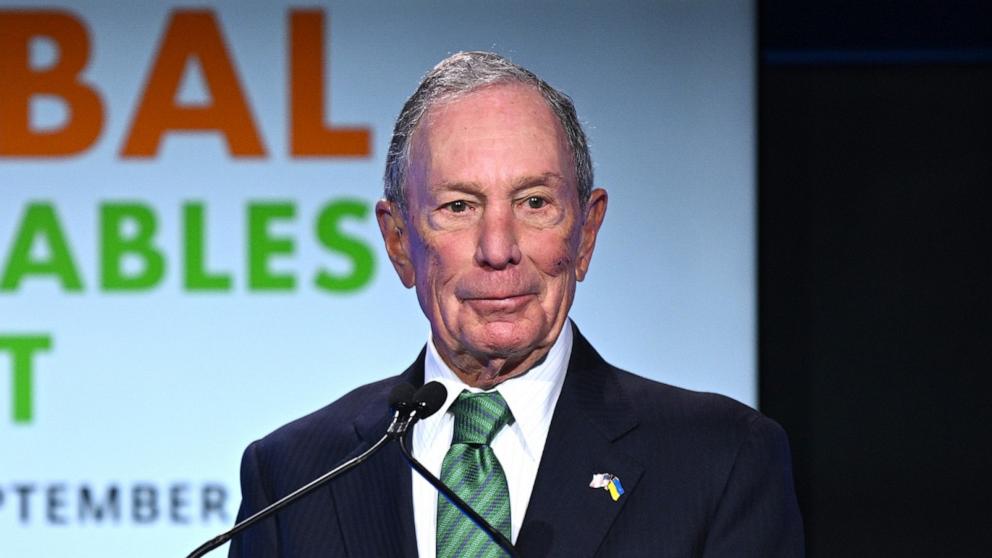
PHOTO: Michael R. Bloomberg speaks at the Global Renewables Summit, co-hosted by Bloomberg Philanthropies and the Global Renewables Alliance, Sept. 24, 2024, in New York
Bryan Bedder/Getty Images for Bloomberg Philanthropies
Michael R. Bloomberg speaks at the Global Renewables Summit, co-hosted by Bloomberg Philanthropies and the Global Renewables Alliance, Sept. 24, 2024, in New York
Bryan Bedder/Getty Images for Bloomberg Philanthropies

Michael Bloomberg, a billionaire businessman, founder of Bloomberg Philanthropies and a U.N. Secretary-General's Special Envoy on Climate Ambition and Solutions, said he also plans to continue supporting a coalition of states, cities and businesses that are working to reduce U.S. greenhouse gas emissions by 61-66% below 2005 levels by 2035.

"More and more Americans have had their lives torn apart by climate-fueled disasters, like the destructive fires raging in California. At the same time, the United States is experiencing the economic benefits of clean energy, as costs have fallen and jobs have grown in both red and blue states. The American people remain determined to continue the fight against the devastating effects of climate change," Bloomberg said.


GMA Newsletters

Sign up for our newsletters to get GMA delivered to your inbox every morning!

Up Next in news

PHOTO: Nick Reiner appears with Deputy Public Defender Kimberly Greene during his arraignment in Los Angeles County Superior Court on February 23, 2026 in Los Angeles.

Nick Reiner demands trust fund money to pay for his defense, court filing shows

June 9, 2026
VIDEO: Flash flood threat as dangerous weather on the move

Flash flood threat as dangerous weather on the move

June 9, 2026
PHOTO: At WWDC26, Apple unveiled the next generation of Apple Intelligence, Siri AI, powerful parental controls, and an expansive set of software improvements across iOS, iPadOS, macOS, watchOS, visionOS, and tvOS.

Apple announces Siri AI and more at Tim Cook's last Worldwide Developers Conference

June 9, 2026

The latest lifestyle and entertainment news and inspiration for how to live your best life - all from Good Morning America.
  • Contests
  • Terms of Use
  • Privacy Policy
  • Do Not Sell My Info
  • Children’s Online Privacy Policy
  • Advertise with us
  • Your US State Privacy Rights
  • Interest-Based Ads
  • About Nielsen Measurement
  • Press
  • Feedback
  • Shop FAQs
  • ABC News
  • ABC
  • All Videos
  • All Topics
  • Sitemap

© 2026 ABC News
  • Privacy Policy— 
  • Your US State Privacy Rights— 
  • Children's Online Privacy Policy— 
  • Interest-Based Ads— 
  • Terms of Use— 
  • Do Not Sell My Info— 
  • Contact Us— 

© 2026 ABC News