ANALYSIS: Obama Plays Catch-Up With Public and Himself
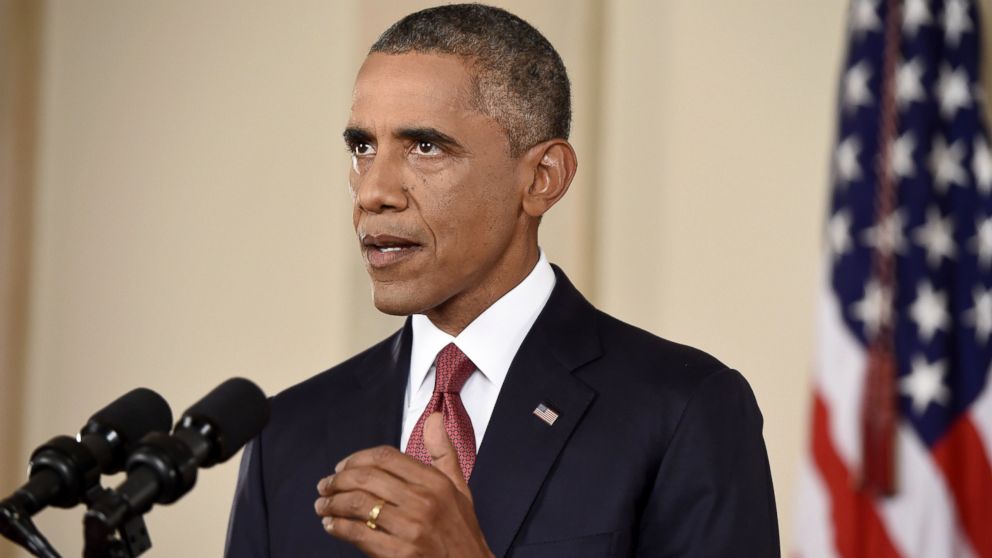
— -- President Obama on Wednesday night entered a new phase of his presidency -- and he did it in a most Obama of ways.
First, to what’s changed: He’s announcing a war, not ending one. He’s preparing to act without Congress, almost exactly a year after deferring to the legislative branch on a question of whether to use American military force.
Obama Pledges to 'Degrade and Ultimately Destroy' ISIS: What You Need To Know
Terror Threat Top Concern on Eve of 9-11 Anniversary, With ISIS Top Concern
Dick Cheney’s Foreign Policy Advice Is ‘Terrifying,’ Harry Reid Says
The president is rushing to catch up with and soothe an anxious, even frightened, public. He’s doing it while looking to reverse perceptions that he’s been slow to respond to metastasizing crises in the Middle East and beyond.
“I can announce that America will lead a broad coalition to roll back this terrorist threat,” the president declared. “Our objective is clear: we will degrade, and ultimately destroy, ISIL through a comprehensive and sustained counter-terrorism strategy.”
That last word – “strategy” – appeared four times in the president’s prime-time address. The repetition was an implicit follow-up to an already infamous quote from two weeks ago, when the president said “We don’t have a strategy yet” to confront ISIS in Syria.
Yet the president did not announce any new actions, beyond sending fewer than 500 new service members to Iraq, and repeated request for Congress to fund training of Syrian opposition forces. He said “I will not hesitate to take action against ISIL in Syria,” but cautioned that “it will take time to eradicate a cancer like ISIL.”
It’s worth noting the tortuous path he took to get to even this point. Back at the beginning of the year, he famously compared the al Qaeda group that had taken over Fallujah, Iraq, to the “jayvee team” in Los Angeles Lakers’ uniforms.
By summer, as ISIS’ terrorist army marched across Iraq and into Syria, the American public was shaken by gruesome images of an American journalist beheaded by ISIS. The president angrily condemned the killing, then returned to his vacation, going golfing that afternoon.
As things stand, the public is scared of the threat posed by ISIS, and seemingly ready for the president to act.
This week’s ABC News/Washington Post poll found that nine in 10 Americans see ISIS as a serious threat to vital US interests, with nearly two-thirds of the public supporting air strikes in Syria. More than half of those polled said the president has been too cautious in responding to the threats posed by ISIS.
There was a calming tone to the president’s remarks: “America is safer,” he said, on the eve of the anniversary of 9/11.
Looking ahead, Obama is now looking to lead internationally. The White House would claim there’s nothing new there, but the fact is that “leading from behind” has competed with “don’t do stupid stuff” as functional definitions -- albeit usually derisive ones -- of the Obama Doctrine.
In an odd piece of timing, it was precisely a year ago where the president went in front of far more skeptical public to argue for airstrikes in Syria. He offered caveats that he could not and would not make Wednesday night:
“I will not pursue an open-ended action like Iraq or Afghanistan. I will not pursue a prolonged air campaign like Libya or Kosovo,” Obama said Sept. 10, 2013.
A year after not conducting those threatened air strikes, the president used a White House speech to prepare the nation for a fight that seems open-ended and can easily become prolonged.
For a president who sought to build a legacy around ending wars, not starting them, it’s a startling course correction. The public -- starting with some of his strongest supporters -- is only beginning to come to terms with the shift.