Antarctica's Ozone Hole Is Shrinking, Study Shows
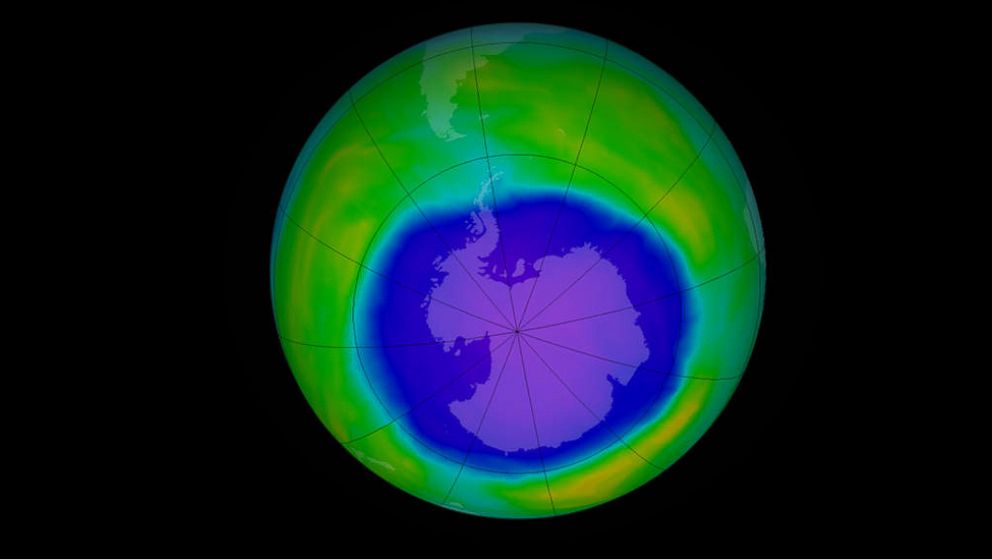
— -- Scientists say Antarctica’s ozone layer is finally showing signs of healing.
A study published in the journal Science on Thursday found that the ozone hole in the Antarctic is getting smaller, having shrunk by more than 1.5 million square miles (or 4 million square kilometers) -- about about half the area of the contiguous United States -- since its peak in 2000.
“We can now be confident that the things we’ve done have put the planet on a path to heal,” the study’s lead author Susan Solomon of the Massachusetts Institute of Technology said in a statement. “Which is pretty good for us, isn’t it? Aren’t we amazing humans, that we did something that created a situation that we decided collectively, as a world, ‘Let’s get rid of these molecules’? We got rid of them, and now we’re seeing the planet respond.”
The hole is formed each year during the Southern Hemisphere spring from September to early December, when there is a sharp decline in the total ozone layer over Antarctica. The dark, cold Antarctic winter brings nacreous clouds that support the chlorine and bromine in chlorofluorocarbon (CFCs), a compound once emitted by aerosols and insulation foam, to become chemically active. When sunlight returns to Antarctica in the spring, these chemicals are released and rapidly damage the ozone layer, resulting in a gaping hole, according to the National Oceanic Atmospheric Administration.
While the ozone is certainly on a path to healing, scientists say the hole won’t completely close until mid-century. Volcanic eruptions as well as changes in temperatures and wind speed contribute to ozone loss.
"It all works in combination with the CFCs," the study's co-author Ryan Neely of the University of Leeds told ABC News. "So the hole could close as early as 2040 maybe, as late as 2070. There are a lot of factors that go into it."
Almost every country in the world signed the Montreal Protocol in 1987 to ban the use of CFCs in manufacturing as part of a concerted effort to repair the ozone layer, which shields life on Earth from the sun’s ultraviolet rays, which have been linked to skin cancer.
“What’s exciting for me personally is, this brings so much of my own work over 30 years full circle,” said Solomon, whose research on chlorine and ozone prompted the international treaty. “Science was helpful in showing the path, diplomats and countries and industry were incredibly able in charting a pathway out of these molecules, and now we’ve actually seen the planet starting to get better. It’s a wonderful thing.”