Asteroid Set to Whiz Past Earth Next Week, Precise Flyby Distance Unclear
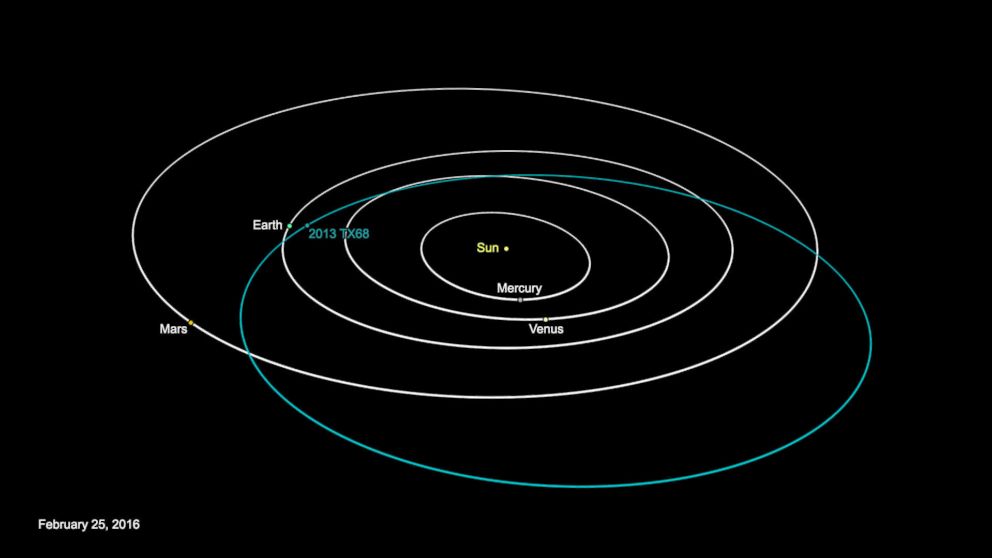
— -- A basketball court-sized asteroid is set to whiz past Earth next week -- but astronomers are unsure of just how close the asteroid will come or precisely when the flyby will happen.
However, you can breathe a sigh of relief: Astronomers say there's no chance the rock will hit Earth. NASA's team at the Center for Near Earth Object Studies (CNEOS) predict Asteroid 2013 TX68 will come within 3 million miles of our planet, but have also left open the possibility it could pass as close as 15,000 miles. It's expected the flyby will happen around March 8.
"There is no concern whatsoever regarding this asteroid -- unless you were interested in seeing it with a telescope," Paul Chodas, manager of CNEOS, said in a statement. "Prospects for observing this asteroid, which were not very good to begin with, are now even worse because the asteroid is likely to be farther away, and therefore dimmer than previously believed."
NASA predictions last month said the rock could come as close as 11,000 miles to our planet or could fly past as far away as 9 million miles and said the flyby would likely happen on March 5.
The asteroid first passed by Earth two years ago -- where NASA was able to gather some information about the rock. However, the reason for such a large window is because NASA was only able to track the asteroid for three days after it began its approach on Oct. 6, 2013.
"Because it was not tracked for very long, scientists cannot predict its precise orbit around the sun, but they do know that it cannot impact Earth during its flyby next month," a NASA blog post explained.
When the object flies past Earth this time, it's possible it will be picked up by NASA telescopes, allowing scientists to better define the asteroid's orbit around the sun and predict future flybys.