August's full blue moon will be first of 4 supermoons in a row: What to expect

On the heels of the Perseid meteor shower earlier this month, August is offering another great astronomical sight -- the rare combination of a supermoon and blue moon.
Beginning on Monday, Aug. 19, the super blue moon will reach peak fullness at 2:26 p.m. ET. Since that's daylight hours in the U.S., Americans will have to wait for the evening to see the moon slightly past its peak, while still being noticeably larger and brighter than a typical moon view.
The super blue moon will appear full for three days, according to NASA.
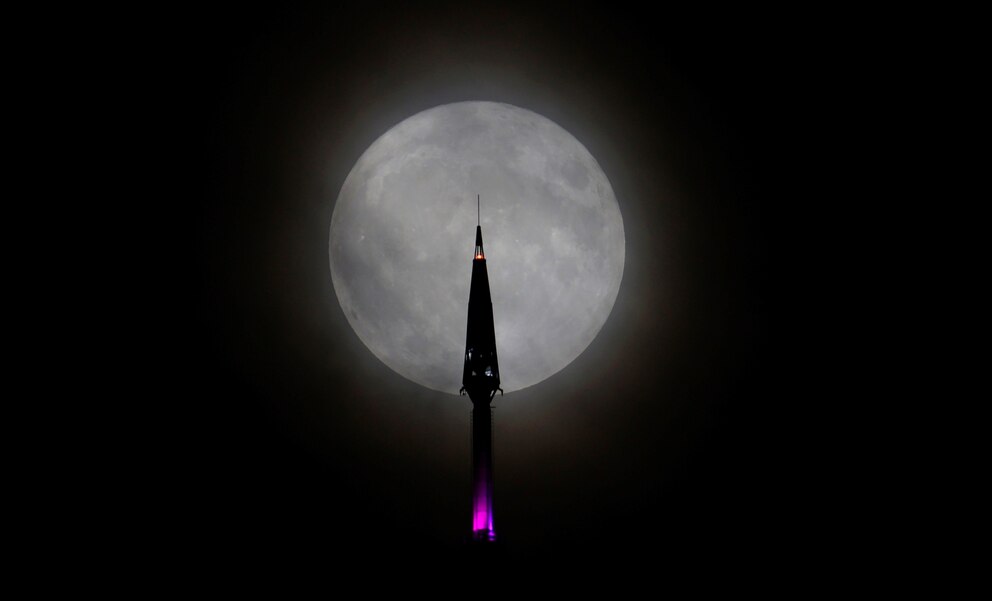
A supermoon coinciding with a blue moon is exceptionally rare, the space agency reports, with the next pairing happening in January and March 2037.
What is a supermoon?
Supermoons are the biggest and brightest lunar views of the year. They occur when the moon's orbit is within 90% of its closest approach to Earth, according to NASA.
During the moon’s closest approach to Earth, it can appear approximately 14% larger and shine 30% brighter than when it's at the point in its obit that's farthest from Earth, approximately 226,000 miles away.
The term "supermoon" was originally coined by astrologer Richard Nolle in 1979.
Supermoons appear three to four times annually and always appear consecutively, according to NASA, which notes that starting this month, the next three full moons will be supermoons, occurring on Sept. 17, Oct. 17 and Nov. 15.
What is a blue moon?
Despite its name, blue moons have little to do with color and everything to do with timeliness. There are two types of blue moons – seasonal and monthly – and the blue moon on Monday will be seasonal.
A seasonal blue moon is the third full moon in an astrological season with four full moons, while a monthly blue moon refers to the second of two full moons in the same month.
The next seasonal blue moon is expected in May 2027, according to NASA.
While the super blue moon on Monday won't be blue, on rare occasions the moon has appeared to be that color. NASA reports that this occurs when tiny particles in the air, typically of smoke or dust, scatter red wavelengths of light and so cause the moon to appear blue.
How rare is a super blue moon?
While supermoons and seasonal blue moons are more common in the night sky individually, the combination of the two is quite irregular, according to NASA.
The time between super blue moons can be as long as 20 years but 10 years is the average. However, 2023 also saw a super blue moon in August.
Following Monday, the next super blue moons will occur in a pair, in January and March 2037.