Looking back at the landmark SCOTUS same-sex marriage ruling: Throwback Thursday
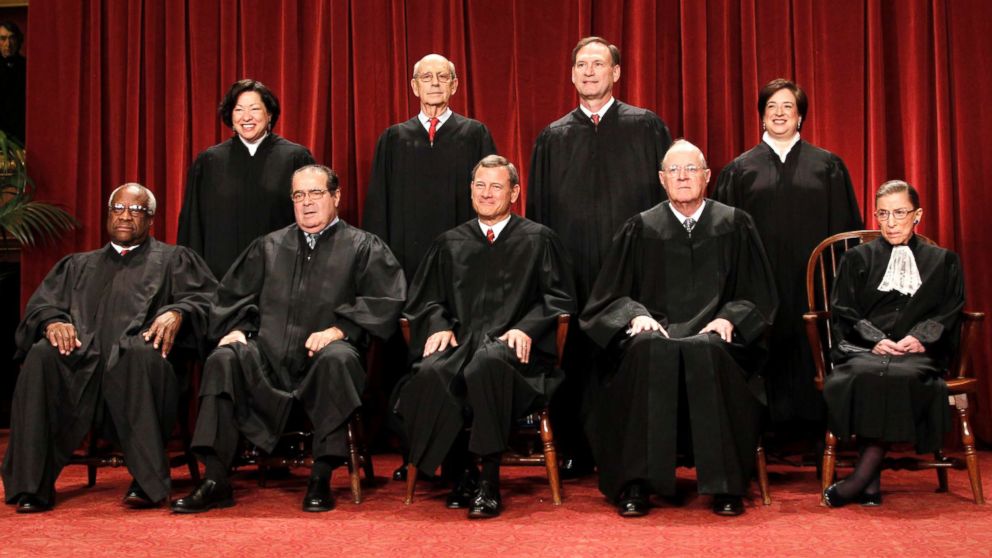
Thursday marks exactly three years to the day that the Supreme Court made what is now hailed as a landmark civil rights ruling in the case Obergefell v. Hodges, opening the door to nationwide recognition of same-sex marriages. This Throwback Thursday, ABC News takes a look back at a decision that sent shockwaves through American society.
Since that 2015 decision, support for same-sex marriage nationwide has gone up to 67 percent, according to a recent Gallup poll. And Gallup says that rising number shows that opposition to same-sex marriage might be softening among those previously opposed.
Retiring Justice Anthony Kennedy authored the court’s opinion. Writing for the majority, he said: “The Constitution promises liberty to all within its reach, a liberty that includes certain specific rights that allow persons, within a lawful realm, to define and express their identity.”
The court found that the Fourteenth Amendment protected the right of same-sex couples to marry, and ruled that state laws banning same-sex marriage ran afoul of the Constitution. The decision said the amendment ensures citizens’ right to due process and equal protection of the laws for all persons.
“The generations that wrote and ratified the Bill of Rights and the Fourteenth Amendment did not presume to know the extent of freedom in all of its dimensions, and so they entrusted to future generations a charter protecting the right of all persons to enjoy liberty as we learn its meaning,” wrote Justice Kennedy. “When new insight reveals discord between the Constitution’s central protections and a received legal structure, a claim to liberty must be addressed.”
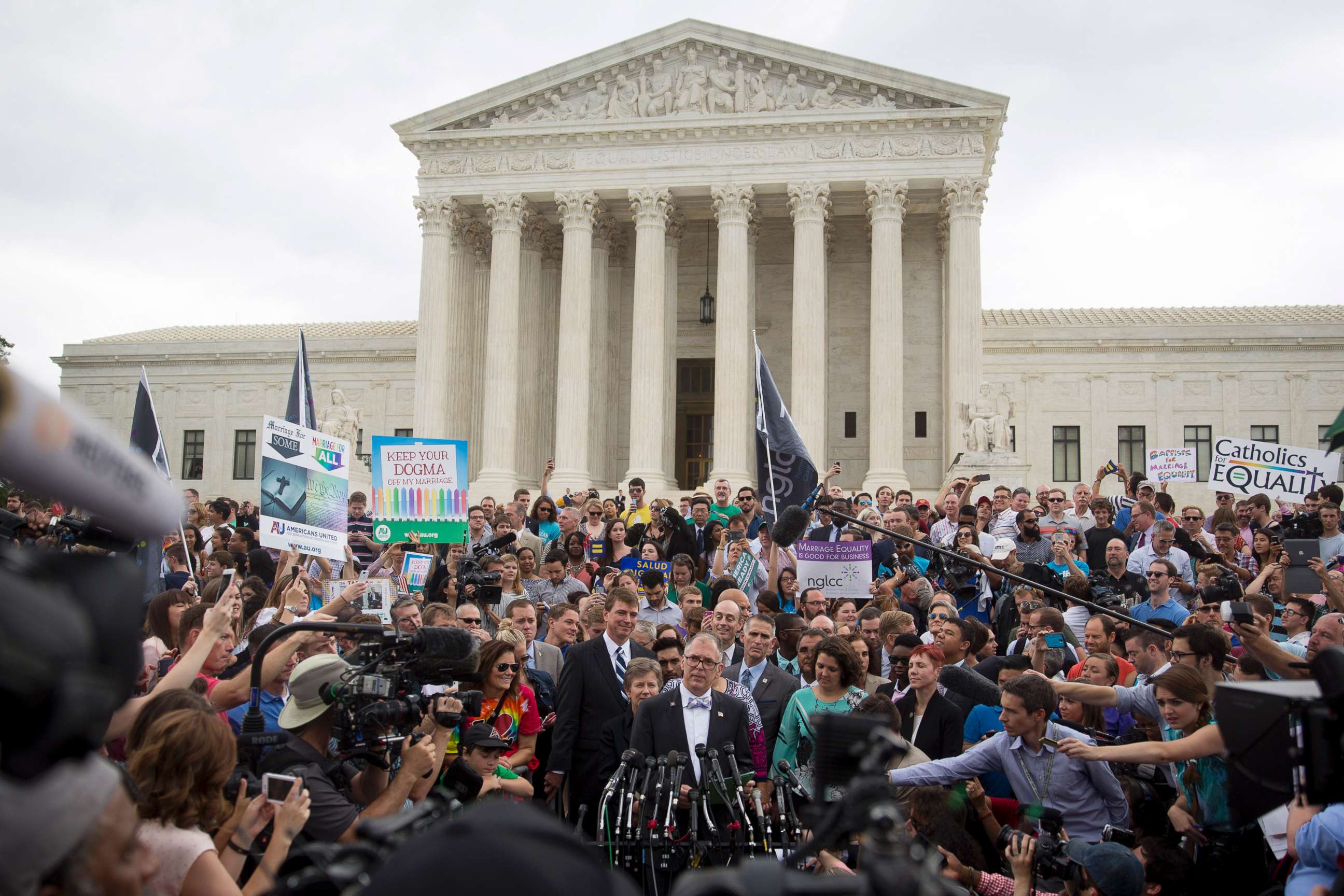
Kennedy’s oft-quoted majority opinion was joined by the four justices considered to be in the liberal wing of the court: Justices Kagan, Ginsburg, Sotomayor, and Breyer. But much like public opinion, the nine jurists were divided on the subject, with the four members of the conservative wing of the court each writing their own dissenting opinion, parts of which echo in recent Supreme Court decisions.
In his dissent, the late Justice Antonin Scalia called the court’s decision “a threat to American democracy,” and called Kennedy’s writings “an opinion lacking even a thin veneer of law,” and a “judicial Putsch.” He joined Chief Justice John Roberts, who wrote in a separate dissenting opinion that “Many people will rejoice at this decision, and I begrudge none their celebration. But for those who believe in a government of laws, not of men, the majority’s approach is deeply disheartening.”
Each of the dissenting justices took issue with Kennedy and the majority’s finding that the Fourteenth Amendment granted the right to same-sex marriage.
Justice Samuel Alito alluded to an issue that came up during a court argument this term.
“…The majority attempts, toward the end of its opinion, to reassure those who oppose same-sex marriage that their rights of conscience will be protected,” Alito wrote. “We will soon see whether this proves to be true. I assume that those who cling to old beliefs will be able to whisper their thoughts in the recesses of their homes, but if they repeat those views in public, they will risk being labeled as bigots and treated as such by governments, employers, and schools.”
The court’s recent ruling in Masterpiece Cakeshop v. Colorado Civil Rights Commission found that Jack Phillips, a baker who refused to make a cake for a same-sex wedding, was discriminated against by the state agency based on his religious beliefs.
Given that decision, and the recent retirement announcement from Justice Kennedy, many beneficiaries of the Obergefell decision are left wondering whether the legacy of Kennedy’s decision can endure a potential ideological shift of the Court. Writing for Time magazine Thursday, Jim Obergefell expressed his concern for the future.
“To say I feel it in the pit of my stomach now that he is leaving the bench is an understatement,” he wrote. “I feel despondent.”