2 billion-year-old water in South Africa may hold answers to Mars mysteries
This is an Inside Science story.
(Inside Science) -- Two miles under a grassy plain in South Africa, pockets of water lie trapped in the rock. Scientists think the pockets might have been isolated from the surrounding environment for 2 billion years. These liquid time capsules are hot, salty, and devoid of nutrients from the surface, and they may be chemically similar to water deposits on Mars.
Now, researchers think they may have found things living in this long-sequestered water.
"There is a potential that [the pockets] were isolated over that long time scale. So this would be a unique opportunity to see life, essentially, evolving in a bubble," said Devan Nisson, a graduate student at Princeton University in New Jersey, who conducted the research with colleagues, including Esta van Heerden from North-West University in South Africa. Nisson presented preliminary findings from the ongoing research project this week at a meeting of the American Geophysical Union in San Francisco.
Supported by funding from NASA and the National Science Foundation, the researchers collected samples in 2018 and 2019 by descending into a gold and uranium mine operated by Harmony Gold. The water lies in rock fractures accessed through boreholes, allowing the researchers to release some of the pressurized water and filter out material for analysis.
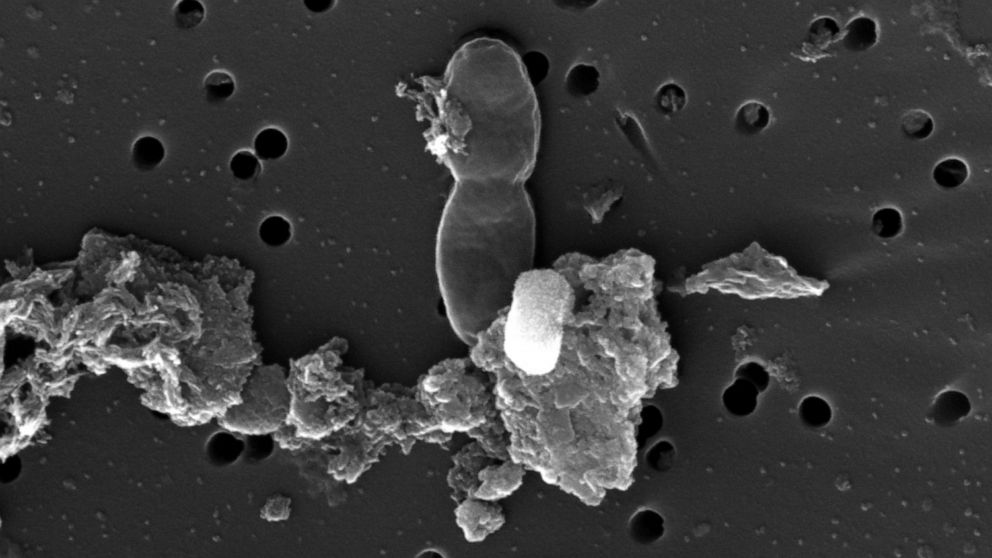
When they examined the material under a scanning electron microscope, they saw rodlike shapes that appeared to be bacteria or similar-looking microbes called archaea. One of the cells was pinched in the middle, apparently in the process of dividing.
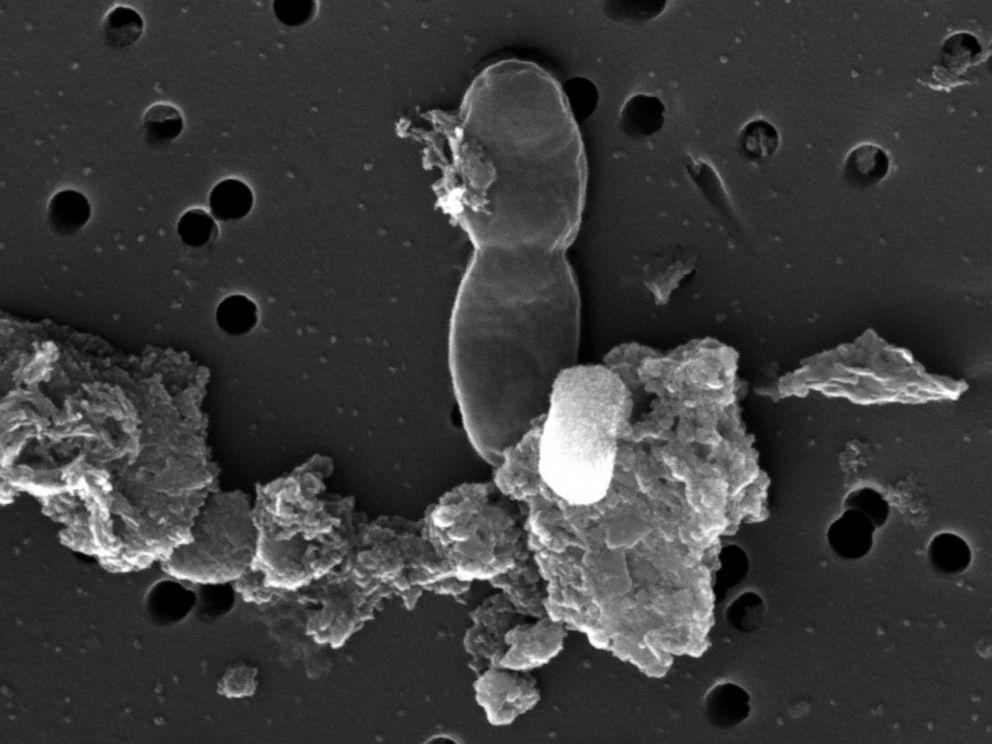
It’s possible the shapes were minerals, noted Nisson. To determine for sure whether the water contains living cells, Nisson and her colleagues plan to try to extract and sequence DNA. Genetic data would also help reveal whether the cells are indeed creatures that have been isolated for billions of years, or whether they are more familiar microbes introduced when miners drilled into the chamber.
But even without DNA, the researchers can still get clues about whether life might be able to survive there. Water in the pockets is about seven times saltier than seawater and reaches temperatures of up to 129 degrees Fahrenheit, right at the edge of what life is thought to tolerate. But Nisson and her colleagues have found an abundance of small organic acids that could supply the carbon required to build and maintain cellular structures. They have also found ions such as nitrate and sulfate, which some microbes can use in metabolic processes to generate energy.
Together, the findings suggest that life could survive in extreme environments such as deep under South Africa -- adding hope that it could survive on Mars and other extraterrestrial bodies as well.
Inside Science is an editorially-independent nonprofit print, electronic and video journalism news service owned and operated by the American Institute of Physics.