• Video
  • Shop
  • Culture
  • Family
  • Wellness
  • Food
  • Living
  • Style
  • Travel
  • News
  • Book Club
  • Newsletter
  • Privacy Policy
  • Your US State Privacy Rights
  • Children's Online Privacy Policy
  • Interest-Based Ads
  • Terms of Use
  • Do Not Sell My Info
  • Contact Us
  • © 2026 ABC News
  • News

Cassiopeia A: The Surprise Inside an Exploding Star
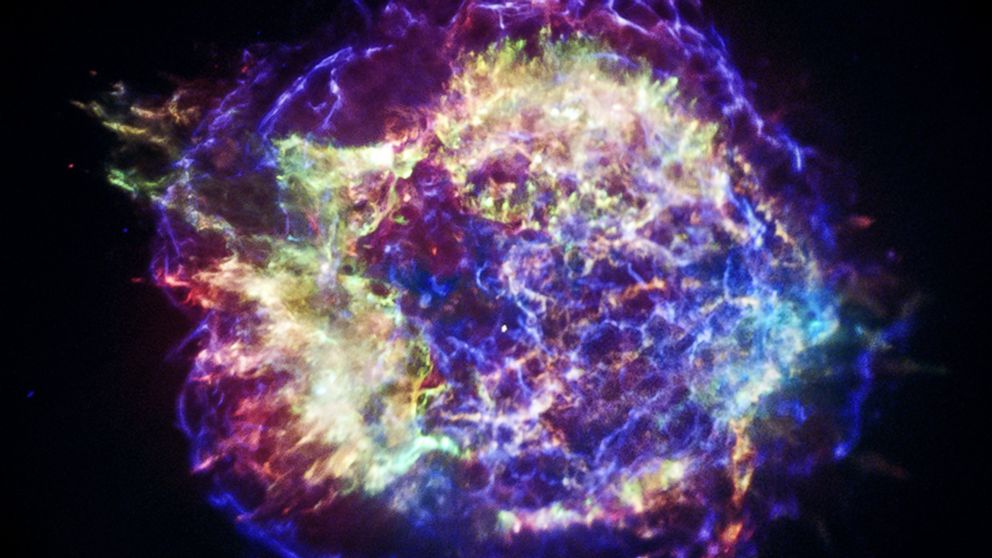
Exploding Stars - New study sheds light on how stars blow up
NASA
ByALYSSA NEWCOMB
January 30, 2015, 4:40 PM

— -- Supernovas, the violent explosions of massive stars after they have exhausted their nuclear fuel, have long been one of the most fascinating mysteries of the universe.

Now, a new 3-D map of one of the most well-known supernovas, Cassiopeia A, reveals a bubbly interior, which could shed new light on the spectacular way these stars die, according to research published today in the journal "Science."

Related Articles

Massive Asteroid 2004 BL86 to Pass Within 745,000 Miles of Earth

Related Articles

Astronomers Discover Ancient Solar System With 5 Earth-Like Planets

Related Articles

Space Pictures from Far Reaches of Universe

Rather than having uniform layers of ejected material, the new 3-D map found the supernova remnant has frothy cavities that were possibly created by radioactive nickel during the explosion that decays to form iron. In a star that is massive enough, the star explodes in a supernova when it runs out of nuclear fuel, combining lighter elements through fusion reactions until it reaches iron, at which point the star's inner core collapses. Elements heavier than iron are thought to be formed during the explosion.

A supernova is so violent and bright that many can be observed with the naked eye and are a common occurrence in our universe. Having exploded some 340 years ago, Cassiopeia A is relatively young and close to Earth, making it an ideal case study, researchers said.

"We’re sort of like bomb squad investigators. We examine the debris to learn what blew up and how it blew up," Dan Milisavljevic of the Harvard-Smithsonian Center for Astrophysics told Smithsonian Science. "Our study represents a major step forward in our understanding of how stars actually explode."

Moving forward, scientists hope technological advances in telescopes will allow them to better study the bubbly interior -- including the presence of iron.


Up Next in News—

Pilot killed in Florida plane crash hailed as hero

April 21, 2026

Athlete drowns during Ironman Texas triathlon

April 20, 2026

Skydiver speaks out after crashing into Virginia Tech stadium scoreboard

April 20, 2026

Gas station clerk speaks out after foiling alleged kidnapping

April 15, 2026

Shop GMA Favorites

ABC will receive a commission for purchases made through these links.

Sponsored Content by Taboola

The latest lifestyle and entertainment news and inspiration for how to live your best life - all from Good Morning America.
  • Contests
  • Terms of Use
  • Privacy Policy
  • Do Not Sell My Info
  • Children’s Online Privacy Policy
  • Advertise with us
  • Your US State Privacy Rights
  • Interest-Based Ads
  • About Nielsen Measurement
  • Press
  • Feedback
  • Shop FAQs
  • ABC News
  • ABC
  • All Videos
  • All Topics
  • Sitemap

© 2026 ABC News
  • Privacy Policy— 
  • Your US State Privacy Rights— 
  • Children's Online Privacy Policy— 
  • Interest-Based Ads— 
  • Terms of Use— 
  • Do Not Sell My Info— 
  • Contact Us— 

© 2026 ABC News