• Video
  • Shop
  • Culture
  • Family
  • Wellness
  • Food
  • Living
  • Style
  • Travel
  • News
  • Book Club
  • Newsletter
  • Privacy Policy
  • Your US State Privacy Rights
  • Children's Online Privacy Policy
  • Interest-Based Ads
  • Terms of Use
  • Do Not Sell My Info
  • Contact Us
  • © 2026 ABC News
  • News

Closest black hole to Earth discovered 1,000 light-years away
6:27
News headlines today: Dec. 23, 2020
European Southern Observatory via AP
ByBill Hutchinson
May 06, 2020, 5:18 PM

The closest black hole to Earth's solar system has been discovered by a team of astronomers who say it was hiding in plain sight only about 1,011 light-years away.

The black hole -- which NASA defines as a great amount of matter packed into a very small area with a gravitational field so strong that nothing, not even light, can escape -- was discovered in a star system called HR 6819 and is about four times the mass of the sun, according to the findings published on Wednesday in the scientific journal Astronomy & Astrophysics.

"We were totally surprised when we realized that this is the first stellar system with a black hole that can be seen with the unaided eye," Petr Hadrava, co-author of the study and emeritus scientist at the Academy of Sciences of the Czech Republic in Prague, said in a statement.

Related Articles

MORE: UFO sightings in North America jumped to nearly 6,000 in 2019

Scientists stumbled upon the out-of-this-world discovery in the Telescopium constellation while tracking two stars orbiting each other just outside the gravitational pull of the black hole, with the help of a super telescope at the European Southern Observatory's La Silla Observatory in Chile.
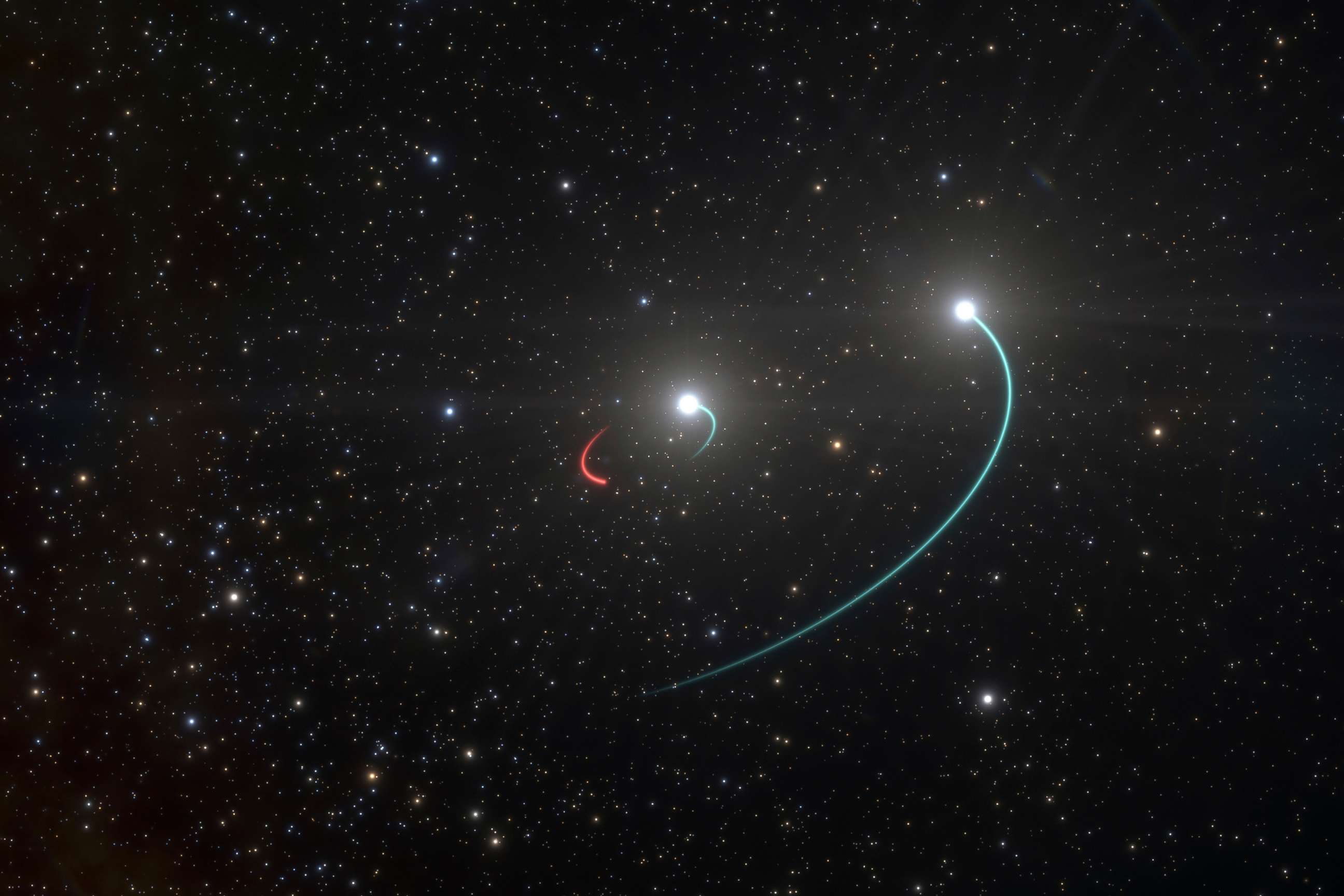
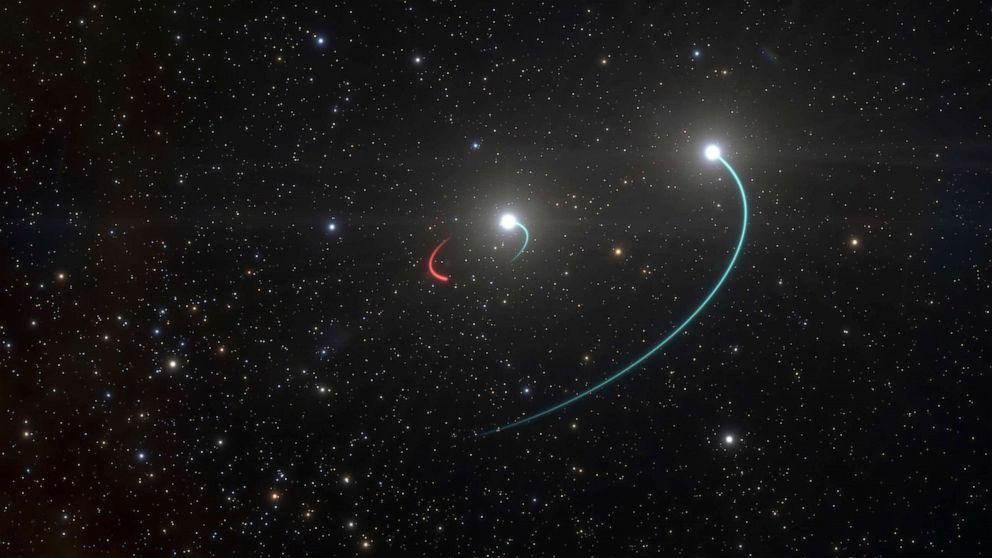
PHOTO: This illustration provided by the European Southern Observatory in May 2020 shows the orbits of the objects in the HR 6819 triple system where observers recently discovered a black hole - the closest ever found to earth.
An illustration shows the orbits of the objects in the HR 6819 triple system. The group is made up of an inner binary with one star, orbit in blue, and a newly discovered black hole, orbit in red, as well as a third star in a wider orbit, blue. The team originally believed there were only two objects, but as they analyzed their observations, they revealed a third, previously undiscovered body - a black hole, the closest ever found to Earth. The black hole is invisible, but it makes its presence known by its gravitational pull, which forces the luminous inner star into an orbit.
European Southern Observatory via AP

The HR 6819 black hole is similar in size to ones found in the Milky Way, which is about 25 million light-years from Earth's solar system in the constellation Canes Venatici, according to researchers. Based on the cosmic distance scale, one light-year equals about 6 trillion miles.

Related Articles

MORE: Deep space radio waves baffle astronomers; aliens not ruled out

"Usually when you have a black hole with a star around it, we can't actually see the star go around the black hole," study co-author Marianne Heida, a postdoctoral fellow at the European Southern Observatory, told National Geographic. "This one is so close by, we should be able to to see the motion ... and that means you could get a much better handle on the black hole's mass, if it all works out."

Other stargazers were buzzing about the major discovery that could give astronomers their best chance at unlocking the mysteries of the galactic phenomenon.

Related Articles

MORE: New York teen discovers new planet while interning with NASA

"It seems like it's been hiding in plain sight," astronomer Kareem El-Badry, a Ph.D. student at the University of California, Berkeley, who wasn't involved with the study, told National Geographic. "It's a bright enough star [system] that people have been studying it since the 80s, but it seems like it's had some surprises."

While most black holes are invisible, scientist managed to capture the first image of one last year. The never-before-seen black hole is in a galaxy far, far away called Messier 87. Located near the center of that galaxy, it's about 53 million light-years from Earth.

The image was captured by the Event Horizon Telescope, a network of observatories spanning the globe.


Up Next in News—

This San Francisco shop is run completely by an AI agent

April 23, 2026

Mother charged after teen son allegedly hits and injures 81-year-old veteran while riding e-motorcycle

April 23, 2026

UK bill banning smoking products for those born after 2008 is one step away from becoming law

April 22, 2026

Pilot killed in Florida plane crash hailed as hero

April 21, 2026

Shop GMA Favorites

ABC will receive a commission for purchases made through these links.

Sponsored Content by Taboola

The latest lifestyle and entertainment news and inspiration for how to live your best life - all from Good Morning America.
  • Contests
  • Terms of Use
  • Privacy Policy
  • Do Not Sell My Info
  • Children’s Online Privacy Policy
  • Advertise with us
  • Your US State Privacy Rights
  • Interest-Based Ads
  • About Nielsen Measurement
  • Press
  • Feedback
  • Shop FAQs
  • ABC News
  • ABC
  • All Videos
  • All Topics
  • Sitemap

© 2026 ABC News
  • Privacy Policy— 
  • Your US State Privacy Rights— 
  • Children's Online Privacy Policy— 
  • Interest-Based Ads— 
  • Terms of Use— 
  • Do Not Sell My Info— 
  • Contact Us— 

© 2026 ABC News