Comet ISON May Be Gone, But Not Forgotten to Scientists
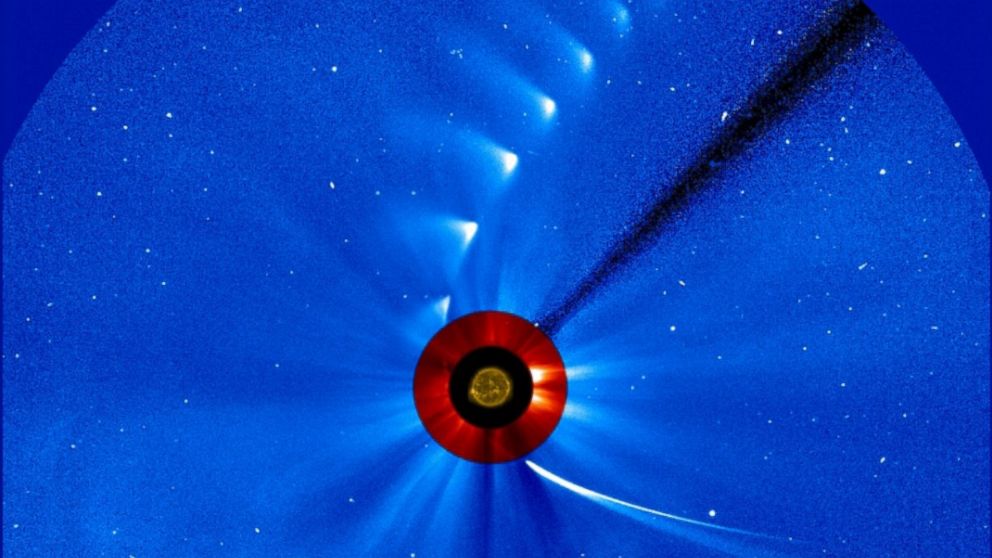
Dec. 3, 2013 -- Comet ISON may no longer be streaking across the sky, but that doesn't mean it's completely obliterated.
Dean Pesnell, Project Scientist at the Solar Dynamics Observatory at NASA, said there's still something to be learned from the comet's remains.
"It's a dead comet, and we don't get a lot of those," Pesnell told ABC News today. "Even as it moves away, people are still trying to look at it and see if there's still something there."
ISON was a sun-grazing comet, one that comes within a few million kilometers of the sun before turning around and heading in the other direction. "The Solar and Heliospheric Observatory coronagraphs see one every couple of days," said Pesnell. "Several thousand comets come very close to the sun, but Comet ISON was unique."
Unlike all other sun-grazing comets, ISON originated from outside the solar system.
There was some initial confusion as to what happened to the comet after it reached perihelion, the closest point in the comet's orbit to the sun. "There was a bright knot of material moving away from the sun," said Pesnell. "But people had to wait another day before they saw that it wasn't growing a new tail."
The comet may have been done for even before it made its close approach to the sun, he noted. "It appears that all of the water [in the comet] evaporated before it even got to perihelion," Pesnell said. "The ice is the cement that holds the comet together."
Without anything to keep the sand, dust and other materials glued together, Comet ISON started to fall apart. "It's not a big chunk of material, but more like a bee swarm," said Pesnell. "It's a bunch of pieces slowly drifting apart from each other."
But even in its dehydrated state, Comet ISON can still provide scientists valuable data. "People will be getting spectra from that knot of material," said Pesnell. Those spectra "can tell us what [the comet] is made out of."