Constitutional checks on interim US attorneys are central to Comey and James' challenge: Analysis
From the beginning of the Republic, presidents have sought the Senate's advice and consent when appointing U.S. attorneys. The practice reflects a shared understanding that these officials wield extraordinary authority over individual liberty.
As Franklin D. Roosevelt's attorney general and later Supreme Court Justice Robert Jackson once observed, the prosecutor has more control "over life, liberty, and reputation than any other person in America."
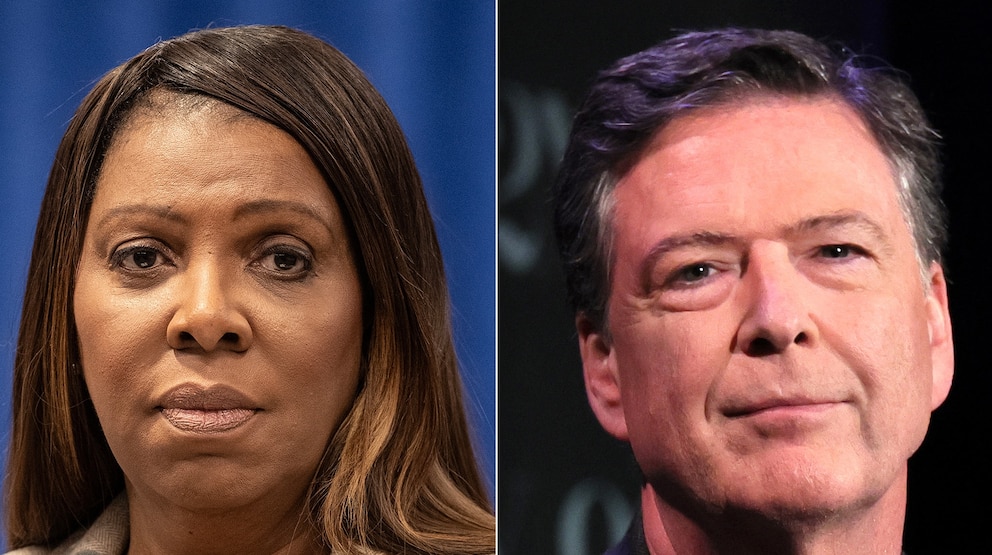
In 2025, the Eastern District of Virginia is the testing ground for efforts to bypass many of the legal norms that date back to the nation's founding, centered around the indictments against former FBI Director James Comey and New York Attorney General Letitia James. Comey has pleaded not guilty to allegedly making false statements to Congress, while James has pleaded not guilty to mortgage fraud-related charges.
When an interim U.S. attorney, Erik Siebert, removed himself from office after resisting pressure to bring legally dubious indictments, the sequence of events that followed tested the boundaries of both constitutional and statutory structure. Less than two days after President Donald Trump publicly urged prosecutions of former officials and announced his former personal attorney, Lindsey Halligan, was his preferred replacement for Siebert, Halligan was sworn in as interim U.S. attorney for the Eastern District of Virginia.
Halligan, who had no prior prosecutorial experience, sought a grand jury indictment against Comey within her first week in office. No other prosecutor in the U.S. Attorney's Office participated in the presentation. Only Halligan signed the indictment.
The constitutional framework governing such appointments is rooted in the Appointments Clause, which no less a conservative judicial icon than the late Justice Antonin Scalia called "among the most significant structural safeguards of the constitutional scheme." Congress has long limited the attorney general's authority to make interim appointments. Under 28 U.S.C. § 546, the attorney general "may appoint" an interim U.S. attorney to serve for 120 days.
Once that period expires, the authority to fill the vacancy shifts to the district court, which may appoint a U.S. attorney "to serve until the vacancy is filled." This design ensures that the executive branch cannot bypass the Senate indefinitely by stacking one temporary appointment atop another.

The text and logic of § 546 make the limit clear. The statute's 120-day clock begins with the attorney general's initial appointment. To allow back-to-back interim appointments would effectively erase the limit, enabling perpetual evasion of the confirmation process that Congress required. The 120-day cap thus marks a deliberate boundary -- one that Congress intended to preserve Senate oversight and the judiciary's backstop role.
Congress briefly disrupted this balance in 2006, when it amended § 546 to remove both the 120-day limit and the district court's appointment authority. That change, inserted into the reauthorization of the PATRIOT Act, permitted interim U.S. attorneys to serve indefinitely without Senate confirmation. The ensuing controversy prompted bipartisan concern that the law enabled the executive branch to sidestep the confirmation process entirely.
Congress is not known for moving quickly, much less in nearly unanimous fashion, but that's exactly what it did when it realized the error of its 2006 change. Accordingly, in 2007, Congress passed the Preserving United States Attorney Independence Act, restoring the earlier framework. The bill passed the Senate by a vote of 94-2. Lawmakers from both parties emphasized that the reform was necessary to guard against politicization and to ensure accountability in the nation's prosecutorial offices.
The recent events in the Eastern District of Virginia have again brought into focus the same structural questions that Congress initially resolved during the presidency of George Washington, and then re-resolved 18 years ago after a one-year detour: who may appoint a prosecutor, how long that prosecutor may serve without Senate confirmation, and what safeguards prevent the use of perpetual interim appointments to advance political ends.
The answers, grounded in text, history, and purpose, are neither partisan nor novel. They reflect a constitutional equilibrium that successive generations have worked to maintain -- a reminder that even temporary appointments can test the permanence of the rule of law.
James Sample is an ABC News legal contributor and a constitutional law professor at Hofstra University. The views expressed in this piece do not necessarily reflect those of ABC News or The Walt Disney Company.