Fact-Checking President Donald Trump's Inaugural Address
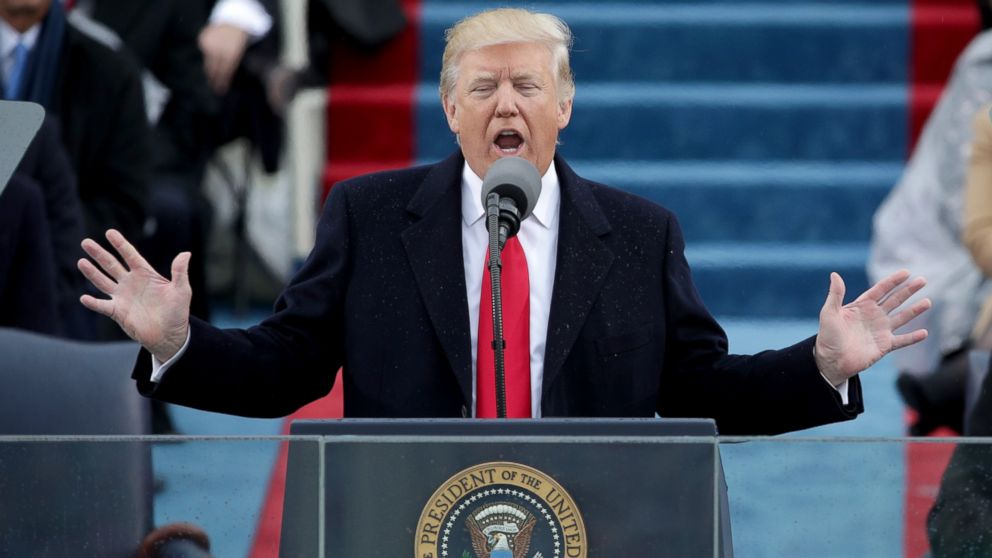
— -- During his inaugural address, President Donald Trump made a number of claims about the state of the nation as he takes office.
Trump echoed themes from his campaign, painting a bleak picture of some aspects of American life, but also offering his presidency as a way forward for those who he says have been forgotten.
ABC News dug into his inaugural address and broke down the facts behind some of Trump's claims.
Trump: "For many decades we've enriched foreign industry at the expense of American industry, subsidized the armies of other countries while allowing for the very sad depletion of our military.”
Question: Has the U.S. enriched foreign business and hurt its own?
Answer: This is difficult to quantify and experts disagree on the issue. Data from the Bureau of Labor Statistics shows that the number of manufacturing jobs has declined since the late 1990s (although they have rebounded slightly since 2010). And data from the U.S. International Trade Commission shows the U.S. negative trade balance with China growing significantly over the last decade. Still, the correlation between trade agreements that Trump disapproves of -- NAFTA and the Trans-Pacific Partnership -- and the economy is disputed by experts.
Question: Has the U.S. subsidized other countries' militaries while depleting its own?
Answer: It is true that the United States government provides military assistance to some foreign allies (around $5.6 billion in 2015, much of which goes to Israel). But it is difficult to argue that the U.S. military is “depleted,” given the U.S. defense budget is larger than any other department in government ($582.7 billion in 2017, although spending has fluctuated under President Obama). Defense sequestration mandated under the Budget Control Act of 2011 created a dip in spending, as did the withdrawals from Iraq and Afghanistan, but in 2016 defense spending actually went up from 2015. Some of the cuts in manpower were related to sequestration, which Gen. Daniel Allyn, vice chief of staff of the Army last year called "our No. 1 readiness risk." Those mandatory cuts, combined with the post-war era, led Obama’s military to decide it had to shrink the Army to 450,000 by the end of 2018. The Army reached its highest force level of President Barack Obama's tenure in 2011 -- 570,000. The word “depletion” is subjective.
Trump described "an education system flush with cash but which leaves our young and beautiful students deprived of all knowledge."
Question: Is the education system financially "flush with cash?"
Answer: According to the Department of Education, expenditures on elementary and secondary schools in the United States totaled $620 billion in the 2012-13 school year. Spending per student has increased 5 percent over the last decade -- $10,455 to $11,011 spent on the operations of schools, adjusted for inflation, according to the agency. But over the last five years, operations spending has dropped roughly $500 per student, according to the department. The American people invest slightly more of the country's GDP in education compared to the 35 member nations of the Organisation for Economic Co-operation and Development, the agency says. The United States spends 6.4 percent of its GDP on education vs. an average of 5.3 percent for comparable nations. The U.S. is the fifth-highest spending among those almost three dozen comparable countries.
Question: How do our students rank compared to others around the world?
Answer: The Program for International Student Assessment has measured the performance of American students compared to those in other countries. The U.S. average score in mathematics was lower than the average for all countries in the 35 member nations of the Organisation for Economic Co-operation and Development -- ranked behind 29 of the 35 comparable member countries. The country's science and reading scores were average among nations of the organization -- ranked behind 13 and 19 of the 35 comparable countries respectively, according to the Department of Education.
Trump: "And the crime and the gangs and the drugs that have stolen too many lives and robbed our country of so much unrealized potential."
Question: Is crime going up or down?
Answer: Crime did increase slightly nationwide from 2015 to 2016, according to data from the FBI, but it's been trending down for the last couple of decades. According to data from the Bureau of Justice's National Crime Victimization Survey, the rate of both violent crime and property crime has declined dramatically since the early 1990's. The number of arrests for drug-related crime has also decreased over the last decade, from 1.8 million arrests in 2007 to 1.5 million arrests in 2015, according to data from the FBI. Still, Chicago ended 2016 with the city's highest number of homicides in two decades -- averaging more than two per day. Shootings in the city nearly doubled since 2013 to roughly 10 per day, according to the Chicago Police Department.
Trump: "We’ve defended other nation's borders while refusing to defend our own."
Question: How much foreign military assistance does the U.S. give?
Answer: In 2015, the U.S. gave $5.65 billion in foreign military assistance, according to the State Department. Over $3 billion of the fiscal year 2015 foreign military assistance went to Israel, with the remaining funds distributed among nations all over the world, including in Africa, Asia, Europe, the Middle East, and South America, the State Department said.
Question: What about defending our borders?
Answer: The U.S. spends $18 billion a year on border control -- more spent on agents, technology, and weapons than ever before, according to analysis from the Immigration Policy Institute. Some 700 miles of fence already exist along the 2,000-mile southern border, compared to only 77 in 2000, according to the Department of Homeland Security. The government has also has more than 11,000 underground sensors, 107 aircraft, 175 mobile surveillance units and 273 remote video surveillance cameras, allowing the border patrol to monitor more effectively, according to the National Immigration Forum and Department of Homeland Security. There are more than 8,000 cameras watching the border wall, watching the ports of entry and watching above from helium balloons.