Fear in Madaya Rises After Suspension of Syrian Aid
— LONDON -- When Halla Yousef, a teacher in Madaya, sees one of her young students cry of hunger, she cannot do anything to help.
“I can’t feed him,” she told ABC News. "He says, 'I’m hungry' and I can’t do anything."
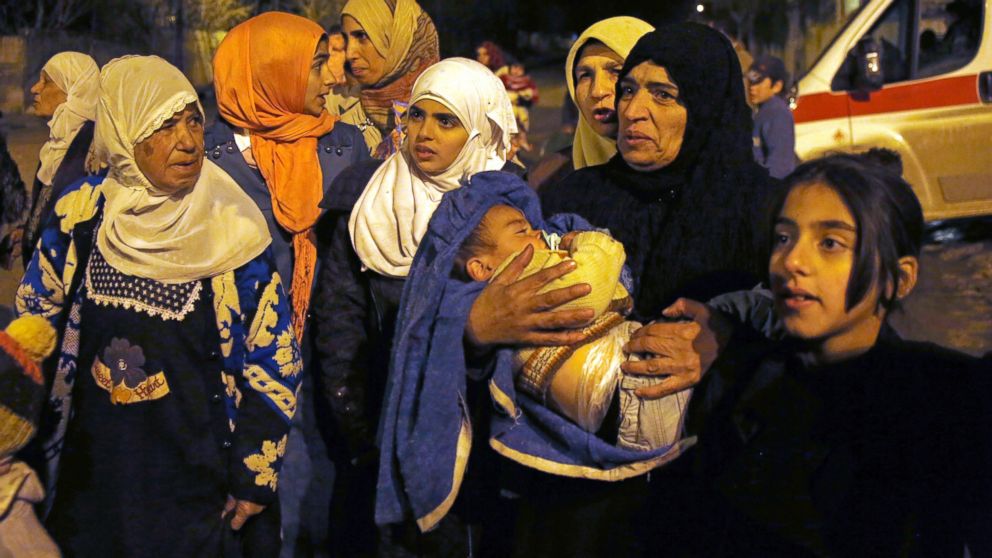
The estimated 40,000 people who live in the besieged Syrian town of Madaya have not received any aid since April. Humanitarian assistance was supposed to reach Madaya and three other war-torn Syrian towns yesterday -- but after an attack on an aid convoy in western Aleppo on Monday, the United Nations suspended all aid deliveries to Syria.
Yousef, who uses a pseudonym out of safety concerns, says she now fears the situation will get much worse without the aid delivery that was expected.
“We are on the verge of famine. Many people don’t have any food supplies left,” she said. “People are weak and have no energy. They get sick very easily. I haven’t had protein in a very long time and I haven’t had milk for over a year.”
Madaya is facing a meningitis epidemic and residents live without basic food such as flour, vegetables, fruit and meat. Their main diet is bulgur and rice, which Yousef says they mix in order to bake bread.
“There is almost never meat and almost never any kind of fresh fruit or vegetables. We have heard of children who were 4 or 5 years old who saw pictures of an apple and didn’t know what it was because they had never seen one in their memory,” Misty Buswell, Save the Children's regional advocacy director for the Middle East, told ABC News. "Many parents are afraid to send their children to school because of the meningitis epidemic."
Lack of food means that locals -- especially children -- are more at risk of catching diseases, said Buswell. Yousef, 40, is one of many residents who suffer from meningitis.
“My body is very weak,” she said. “I always have a headache and fever. In the morning, I feel like I don’t want to get up, like I didn’t get enough sleep and my body is tired. I have no energy.”
Many people are out of work. Others, including her husband, don’t get paid, she said. At the same time, prices of food are extremely high -- Yousef says that the normal price for two pounds of cucumbers or tomatoes is $20. Yousef makes $200 a month, but sends all the money to her sister in Lebanon who takes care of her three children who were able to leave Madaya over a year ago. Yousef and her husband couldn’t leave because they are wanted by the Syrian government for doing aid work, she said.
“The worst thing is being away from my children. My oldest daughter is engaged and I don’t know her fiancé. Because my children aren't here, I feel like I have a lot of affection that I want to give others. Today I played with the children at the school and we laughed loud," she said, adding that she used to have a lot of money and live a nice life before she was forced to flee to Madaya, which had not yet been affected by the war.
“I never thought I would end up like this,” she said. “I want to see life and cars in the streets and I want to see a supermarket with good food, meat, yogurt and cookies. The other day, I was speaking with my children in Lebanon. They sent me photos from the supermarket and it made me cry.”
An estimated 13.5 million people, including six million children, are in need of humanitarian assistance in Syria, according to the United Nations. Of these, 5.47 million people are in hard-to-reach areas, including close to 600,000 people in 18 besieged areas.