Hubble vs. James Webb telescope images: See the difference
These images are out of this world.
Since releasing the first images from its new James Webb Space Telescope earlier this week, NASA has been revealing the differences between Webb and its predecessor, the Hubble Space Telescope.
The images by Webb, which launched in December 2021, are the deepest and highest resolution ever taken of the universe, according to NASA. Using powerful infrared technology, the new telescope reveals details that have never been seen before, like the gas and dust around stars. With the capability to peer back over 13.5 billion years, Webb will help scientists study the formation of the universe's earliest galaxies, how our solar system developed and if there is life on other planets.
Hubble was optimized for shorter ultraviolet and visible wavelengths of light. The farthest observation it has made to date is of the galaxy GN-z11, about 13.4 billion light-years away. Since first launching in 1990, the telescope has charted the evolution of galaxies, discovered moons around Pluto, confirmed the existence of black holes in galaxy cores and verified the accelerating expansion of the universe.
NASA said it plans to operate both observatories at the same time to "give us a more complete view and understanding of our universe."
Here's a look at how images captured by the two telescopes compare.
Galaxy cluster SMACS 0723
Thousands of galaxies make up this cluster in the distant universe 4.6 billion light-years away. Hubble's composite image took weeks to achieve, while Webb's only took 12.5 hours, NASA said.
Southern Ring Nebula
This giant cloud of dust and gas expelled by dying stars is approximately 2,500 light-years away. Webb revealed for the first time that the dimmer star at the center is cloaked in dust.
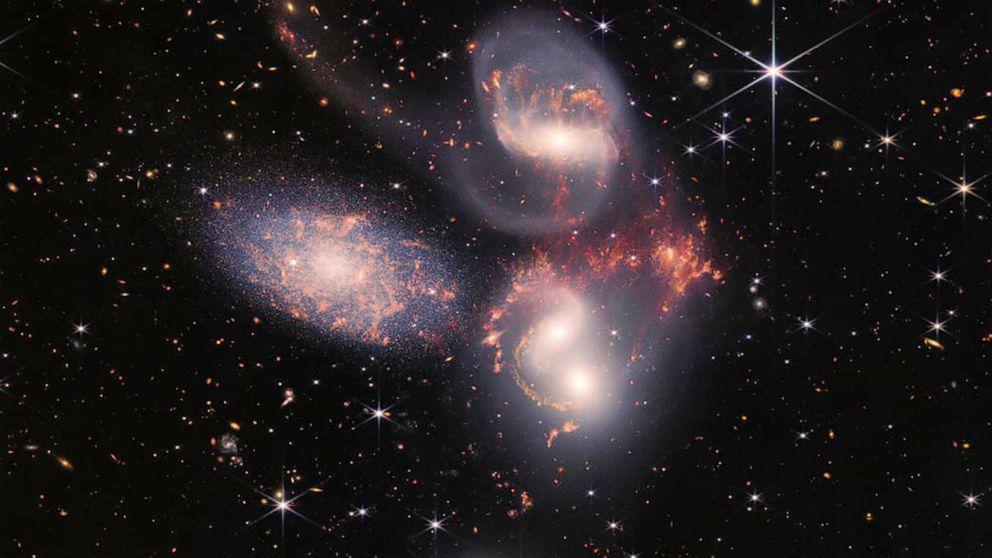
Stephan's Quintet
The five galaxies in this visual grouping are between 40 million and 290 million light-years away. Covering about one-fifth of the moon’s diameter, this marks Webb's largest image so far. Webb's composite, which is made from almost 1,000 separate image files, shows new details of the galaxies interacting.
Carina Nebula
The edge of a star-forming region called NGC 3324 in the Carina Nebula, roughly 7,500 light-years away, is captured here. Webb's image "reveals for the first time previously invisible areas of star birth," NASA said.