Ideological divides among partisans deepen: ABC News polling analysis
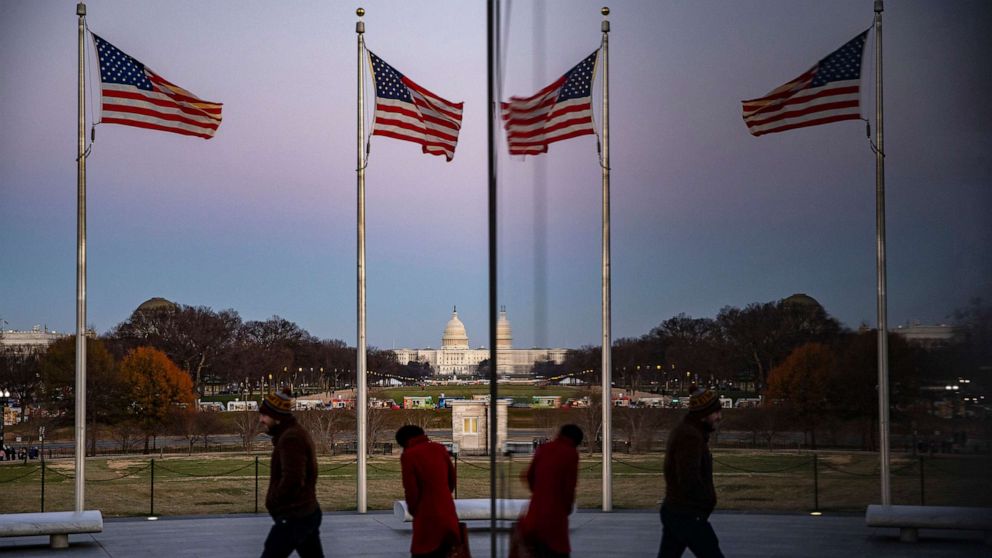
A long-term rise in political polarization is heading full steam into the 2020 election, with conservatism among Republicans accelerating to its highest level in ABC News/Washington Post polls back 22 years and liberalism among Democrats near its record, set last year.
As the country grapples with questions about political discourse, disinformation and partisan echo chambers, this analysis demonstrates Americans’ sharpening ideological divide. Given vast partisan and ideological differences in public attitudes on politics and policy – from social justice issues to responses to the COVID-19 pandemic and beyond – the results indicate the shrinking space for a political middle ground.
On average in 2001 and 2002, 50% of Republicans called themselves conservatives. On average this year, 71% do so, up 21 percentage points, with a 10-point rise in just the past three years. Far fewer Democrats are liberals, 43%, but that’s up 12 points from its low in 2000 and 2001, and just off its peak of 46% in 2019.
This analysis was produced for ABC by Langer Research Associates, which directs the ongoing ABC News/Washington Post poll for the network. It’s based on 217,489 interviews in 22 years of ABC News and ABC/Post polls, grouped into annual averages. The large sample sizes mean that even small changes on an annual basis are statistically significant.
Increased polarization among adults under age 50 is a striking component of the rise in ideological/partisan sorting. The share of under-50 Democrats who identify themselves as liberal is up 16 points since 2001, from 33% to 49%, compared with a 9-point increase among those 50 and older. (Liberalism peaks among Democrats age 18-29, at 57%, up 22 points.)
Across the way, the share of Republicans younger than 50 who say they’re conservative has gained 23 points since 2001, compared with 14 points among those 50 and older. Conservatism among younger Republicans now matches that of their older peers, at 70%.
While age stands out, the growth in conservatism is largely consistent across groups, up 16 to 24 points from its overall low in 2002.
Conservatism among Republicans peaks at 76% of evangelical white Protestants and 76% of those with some college education but no four-year degree. It’s 72% among white Republicans, compared with 62% among those of other racial or ethnic backgrounds.
On the flip side, liberalism among Democrats reaches 60% of post-graduates and62% of those with no religious affiliation – up 18 points since 2002, compared with 5 points among Democrats who are religiously affiliated. This partly reflects the change by age; younger people are less apt to express a religious preference.
The rise in liberalism among Democrats also differs by race and ethnicity. It's up 16 points since 2001 among whites, from 32% to 48%, and 13 points among Hispanics, from 27% to 40%. That compares with essentially no gain among Black Democrats, 35% liberals this year.
The rise of polarization in each party is evident in the strengthening relationship between ideology and partisanship. Expressed in a correlation, in which 1 is a perfect fit and 0 is a perfect miss, the link between one’s party and one’s ideology has grown in ABC/Post polls from .39 in 1999 to .61 in 2020 so far, its strongest on record. Exit polls, dating farther back, tell the same story, from .32 in 1976 to .65 in 2018.
Notably, ideological/partisan sorting has risen as expressed allegiance to political parties continues a gradual decline. A plurality of Americans, 37%, identify themselves as independents, up from a low of 30% in 2004 to essentially match its peak in 2009, 2010 and 2014. Twenty-nine percent are Democrats, down from a high of 36% in 2008; and 24% are Republicans, roughly steady since 2009, down from 31% in 2003.
Adults younger than 50 are especially apt to call themselves independents, up 10 points since 2008 to 42%. That compares with 37% of those 50-64 and 26% of seniors, each with little clear trend over time.
In terms of ideology alone, 22% of Americans are liberals, down from a peak of 25% in 2018, albeit largely steady the past two decades. A larger share, 35%, are conservatives, again largely stable, though down from a high of 38% in 2010. The rest, 39%, are moderates.