Jupiter's X-Ray Aurora Glimmers During Solar Storm
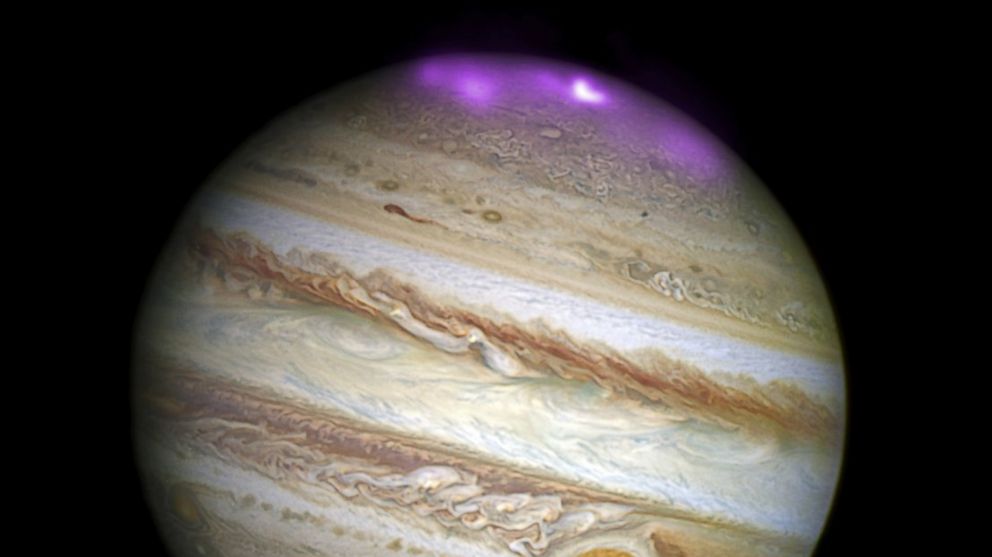
— -- Scientists have unveiled images of a brilliant X-ray aurora on Jupiter triggered by a massive solar storm slamming into the solar system's largest planet. In the color-enhanced images, the purple areas show emissions of X-rays, which are invisible to the human eye, with the white areas showing the strongest emissions.
A new study published this week in the Journal of Geophysical Research determined the unique X-ray auroras are caused by coronal mass ejections, which are giant solar storms characterized by strong winds.
The solar storms produce an aurora on Jupiter that is eight times brighter than normal and hundreds of times more energetic than the northern lights on Earth, according to researchers.
A solar storm compresses Jupiter's magnetosphere -- the area where the planet has the greatest magnetic force -- and shifts its boundary inward by a million miles, according to researchers. An interaction at the boundary is what scientist believe creates the incredible emissions captured in a 2011 composite photo.
"There's a constant power struggle between the solar wind and Jupiter's magnetosphere," William Dunn, lead author of the study, said in a statement. "We want to understand this interaction and what effect it has on the planet. By studying how the aurora changes, we can discover more about the region of space controlled by Jupiter's magnetic field, and if or how this is influenced by the sun. Understanding this relationship is important for the countless magnetic objects across the galaxy, including exoplanets, brown dwarfs, and neutron stars."
Jupiter will have its moment in the spotlight when NASA's Juno probe reaches the Jovian world this summer. Juno is set to begin orbiting Jupiter in July, and the hope is that it will yield new insights about the largest planet in our solar system and its formation.