LAPD, US Customs Battle Counterfeit Goods Market, Multi-Billion Dollar Industry More Lucrative Than Drugs
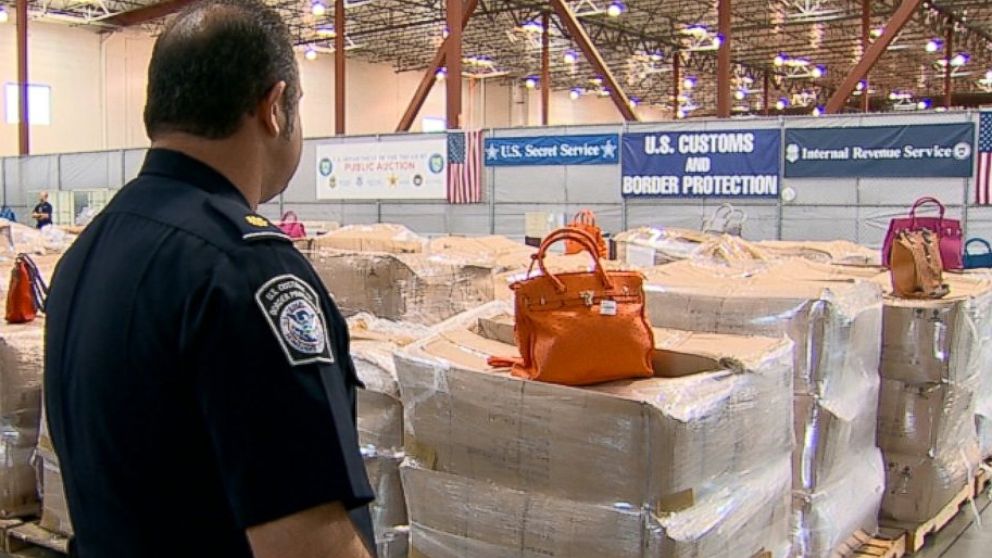
Oct. 21, 2013— -- In an era when terrorism and illegal narcotics pose a clear and present danger in urban America, why should U.S. law enforcement spend precious resources policing luxury handbags?
Because, authorities say, those fake handbags -- and other counterfeit goods -- are practically an ATM machine for organized crime.
"More than likely it's going to finance some other illicit activity, whether it be terrorism, human trafficking, drugs or some such," said Customs and Border Protection (CBP) supervisor Bryan Nahodil as he surveyed some 16,000 fake Hermes bags seized in Los Angeles.
Counterfeit goods are more lucrative than drugs, according to officers with the Los Angeles Police Department's Vice Division and the CBP, who allowed "Nightline" to embed with them to see firsthand the efforts to combat the problem.
Counterfeit goods account for nearly 10 percent of worldwide trade, an estimated $500 billion annually, according to the World Customs Organization.
U.S. Customs officers said the black market for fake handbags, shoes, purses and other luxury goods helps fund other crime rings, including drugs and human trafficking.
The Port of Los Angeles in Long Beach is the first stop for almost everything the U.S. imports from China, Japan and South Korea. More goods come through L.A. and Long Beach than the other major U.S. maritime seaports combined.
"We're the largest seaport in the country by far," said Todd Owen, the director of field operations in L.A. for U.S. Customs. "Approximately 40 percent of all the maritime cargo that enters the United States does so through this complex here."
With a tsunami of goods coming into the U.S. every day, it is a significant challenge to find contraband. On average, a container arrives in L.A. every six seconds, on massive ships that take days to unload.
Before a vessel can set sail from China, a manifest describing the contents of each of the dozens of containers it has onboard arrives in Los Angeles. Ken Price, a senior import specialist with CBP, has the task of searching for the needle before the haystack reaches American shores.
"I look at container freight coming into the U.S. to make sure it is what they say it is," Price said.
Armed with a computer monitor and 20 years experience, Price has a good eye for things that are out of the ordinary just on the paperwork.
Days, even weeks, before the cargo ship arrives in Los Angeles, Price and other officers comb through shipping records, looking for anything that seems amiss and cross reference the import manifests against familiar crime patterns.
When the ships finally arrive, U.S. immigration agents clear the captain and crew's credentials and customs officers do preliminary searches of the cargo.
Among the most urgent priorities are checking for items that might pose a health or safety threat.