'Massive' Venezuelan oil reserve would pose challenges for US firms, experts say
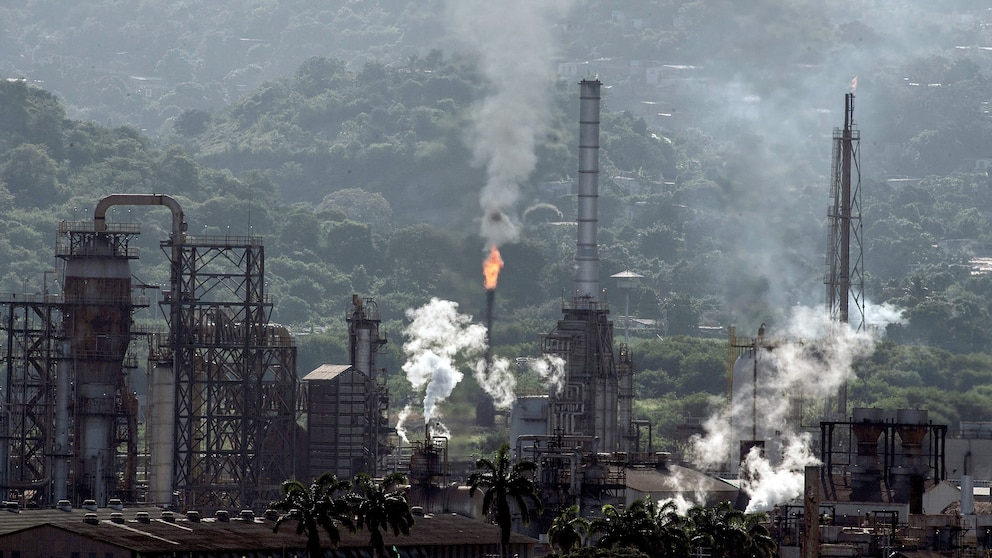
Shares of major U.S. oil companies climbed on Monday in the first trading since the U.S. military removed former Venezuelan President Nicolas Maduro.
Following the operation, President Donald Trump said that the U.S. would "run" Venezuela for an unspecified "period of time." Trump also touted plans to take a U.S. role in the Venezuelan oil industry.
"We're going to be taking out a tremendous amount of wealth out of the ground," Trump said on Saturday, suggesting U.S. oil companies would benefit.
Maduro and his wife, Cilia Flores, are among six defendants named in a four-count superseding indictment that accused them of conspiring with violent, dangerous drug traffickers for the last 25 years. Maduro was indicted on related charges in 2020. He has long denied all the allegations, and he pleaded not guilty on Monday. Flores also pleaded not guilty.
In a statement on Monday, United Nations Secretary-General António Guterres cast doubt on the legality of the U.S. operation under international law.
"I remain deeply concerned that rules of international law have not been respected," Guterres said, citing the United Nations Charter ratified by the U.S.
The Trump administration has defended the operation, describing it as a law enforcement function rather than a military attack.
Venezuela holds the largest proven oil reserves in the world, but any effort to extract the potentially lucrative resource faces financial and political hurdles, experts told ABC News.
Here's what to know about the Venezuelan oil industry:
How much oil does Venezuela have?
Venezuela boasts the biggest proven oil reserve of any country, amounting to roughly 303 billion barrels or about 17% of the world's reserves, according to the U.S. Energy Information Administration, a government agency.
"Venezuela is a massive player in the oil industry in terms of reserves," Jorge León, the head of geopolitical analysis at consulting firm Rystad Energy, told ABC News.
For decades, however, the nation has struggled to match those holdings with similarly stratospheric output, León noted.
Venezuela exported about 749,000 barrels per day last year, totaling less than 1% of global supply, according to data and analytics company Kpler. Production topped out at 3.5 million barrels per day in the 1990s, Kpler said.
Venezuela's oil reserve is made up primarily of heavy crude, making it more expensive to extract than lighter alternatives, even as it commands a lower sale price than those options, according to León.
"That's the slightly negative aspect of heavy crude," he added.
Still, U.S. refineries in the Gulf Coast and elsewhere are equipped to refine the oil, making it potentially lucrative for U.S. firms, some analysts said.
Could U.S. companies gain access to Venezuelan oil?
A potential effort to extract and sell Venezuelan oil could prove a financial boon for major U.S. oil firms but it would run up against formidable challenges, according to some analysts.
The infrastructure necessary to ramp up oil production would require billions of dollars of investment over several years, Denton Cinquegrana, chief oil analyst at the Oil Price Information Service, told ABC News. At the same time, Cinquegrana noted, Venezuela would need to establish political stability.
"The government used oil produced there as a little bit of a piggy bank, and let the industry fall into disrepair," Cinquegrana said. "It will take a significant amount of capital to bring it back."
The venture would require about $110 billion in order to increase output to about 2 million barrels per day by the early 2030s, León said.
Oil prices are hovering near their lowest levels since 2021, meaning U.S. companies may find less potential upside in the venture than they would if prices were higher, some analysts said. The U.S. West Texas Intermediate futures price -- a key measure of U.S. oil prices -- stood at about $58 on Monday.
Low oil prices stem from a glut of oil alongside relatively slow global economic growth, which has constricted demand for fossil fuels.
U.S. firms involved in the effort would face risks, León and Cinquegrana said. Chevron is currently the only U.S. oil firm operating in Venezuela, as part of a joint venture with the country's state-owned oil outfit.
ExxonMobil and ConocoPhillips stopped doing business in Venezuela in 2007, after former President Hugo Chavez nationalized the sector. Citing the unlawful seizure of assets belonging to the two oil giants, the World Bank's International Center for Settlement of Investment ordered Venezuela to pay the firms billions of dollars. Venezuela has only paid a small share of the debt it owes to ExxonMobil and ConocoPhillips.
"Companies won't rush back into the country until the political situation is stable enough," León said.
Shares of the U.S. oil companies jumped in midday trading on Monday. Chevron soared about 5%, while ConocoPhillips climbed 3%. Exxon increased 2%.
What are U.S. oil companies saying?
After the military operation, Trump outlined a role for U.S. oil companies in Venezuela, saying the firms would spend money to improve the nation's infrastructure and output.
"We're going to have our very large United States oil companies -- the biggest anywhere in the world -- go in, spend billions of dollars, fix the badly broken infrastructure, the oil infrastructure," Trump said during a press conference on Saturday at his Mar-a-Lago residence in Palm Beach, Florida.
So far, the major oil firms have yet to speak publicly about the plan.
In a statement to ABC News, ConocoPhillips said the firm is keeping tabs on the ongoing situation.
"ConocoPhillips is monitoring developments in Venezuela and their potential implications for global energy supply and stability. It would be premature to speculate on any future business activities or investments," the company said.
Chevron said it continues to focus on its current operations.
"Chevron remains focused on the safety and wellbeing of our employees, as well as the integrity of our assets. We continue to operate in full compliance with all relevant laws and regulations," it said in a statement.
Exxon Mobil did not respond to a request for comment.