Mystery of Massive Black Holes May Be Answered by NASA Telescopes
— -- Scientists may have unraveled the mystery of what creates supermassive black holes.
Giant black holes are at the heart of almost every large galaxy and are so large some are billions of times the mass of the sun. They were formed around 13 billion years ago, less than one billion years after the formation of the universe, according to NASA.
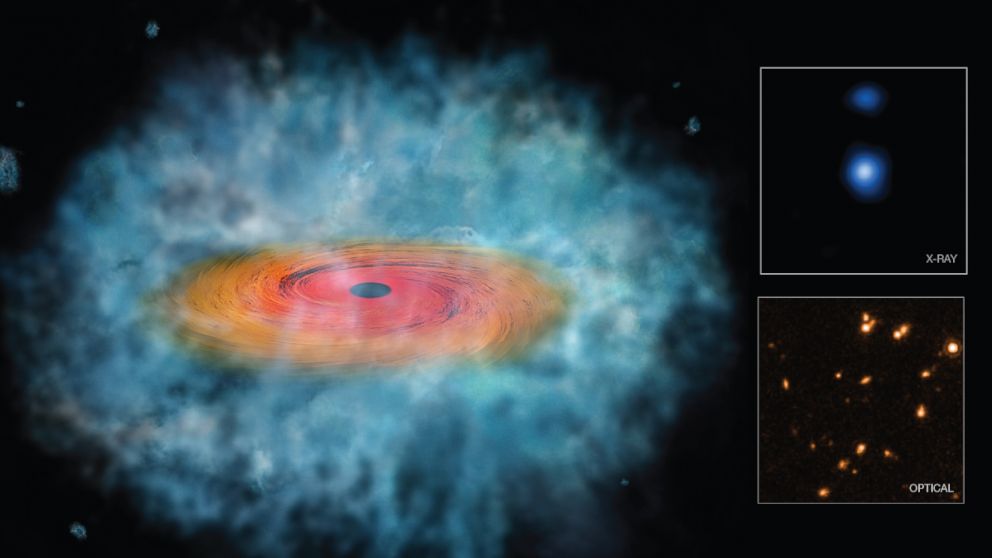
Using data from NASA’s Chandra X-ray Observatory, and the Hubble and Spitzer space telescopes, scientists determined a collapsing cloud of gas may have been the catalyst for forming supermassive black holes, creating black hole seeds. As a result, the black holes were able to skip the intermediate steps in the growth process.
If the new research holds up, it would provide the clearest explanation yet as to how black holes may have come into existence and another possible mechanism for how the mysterious celestial objects came to be. Other theories for growth include smaller black holes merging and pulling in gas from surrounding objects.
Fabio Pacucci, a researcher from the Scuola Normale Superiore in Pisa Italy, led the study. Pacucci said his team was able to use long-exposure images from the space observatories to pinpoint the locations of two probable black hole seeds estimated to have formed within the first billion years following the Big Bang.
The research suggests supermassive black holes were simply born big and grew at a normal rate as opposed to another theory that black holes start small and quickly expand.
"Our discovery, if confirmed, explains how these monster black holes were born," Pacucci, a said in a statement. “We found evidence that supermassive black hole seeds can form directly from the collapse of a giant gas cloud, skipping any intermediate steps."
While the development is exciting, the researchers need more time to validate their findings and will now focus on getting more data on the two black hole seeds and hope to pinpoint more black holes that may be the result of a direct collapse.
“Black hole seeds are extremely hard to find and confirming their detection is very difficult,” Andrea Grazian, a co-author of the paper said in the same statement. “However, we think our research has uncovered the two best candidates to date.”
The complete findings of the study will be published in an upcoming issue of the Monthly Notices of the Royal Astronomical Society.