• Video
  • Shop
  • Culture
  • Family
  • Wellness
  • Food
  • Living
  • Style
  • Travel
  • News
  • Book Club
  • Newsletter
  • Privacy Policy
  • Your US State Privacy Rights
  • Children's Online Privacy Policy
  • Interest-Based Ads
  • Terms of Use
  • Do Not Sell My Info
  • Contact Us
  • © 2026 ABC News
  • News

NASA's Kepler Mission Discovers Earth's Bigger, Older Cousin
1:16
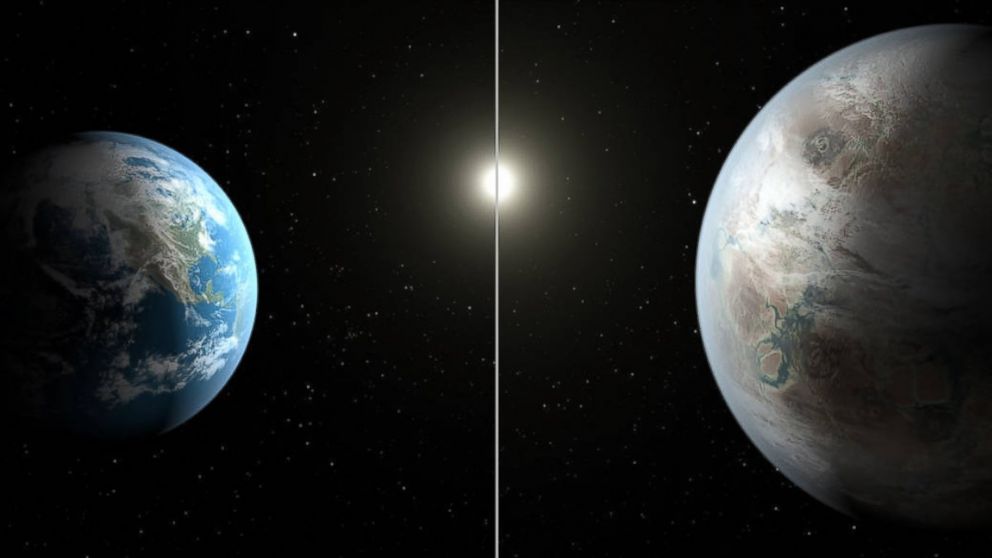
NASA Releases New Planet Discovery
NASA/Ames/JPL-Caltech/T. Pyle
ByALYSSA NEWCOMB
July 23, 2015, 5:07 PM

— -- NASA says we're on our way to discovering Earth 2.0.

The Kepler Space Telescope has located a planet and star closely resembling Earth and the Sun, NASA officials said. The newly discovered planet, which NASA has named Kepler-452b, is believed to be 6 billion years old -- making it about 1.5 billion years older than the Earth and our sun. NASA said the star, Kepler-452, also has the same temperature as our Sun and has a diameter 10 percent larger.

Related Articles

New Horizons: 5 Discoveries the Space Probe Made on Its Journey to Pluto

Related Articles

Pluto Flyby: New Horizons Carrying Ashes of Astronomer Who Discovered Dwarf Planet

The system is located 1,400 light-years from Earth in the constellation Cygnus. What makes the discovery especially intriguing is that the planet is orbiting the habitable zone of the solar system, the "Goldilocks" region where it's not too hot or too cold, so that the surface of the planet could sustain liquid water.

"It’s awe-inspiring to consider that this planet has spent 6 billion years in the habitable zone of its star; longer than Earth," said Jon Jenkins, Kepler's data analysis lead. "That’s substantial opportunity for life to arise, should all the necessary ingredients and conditions for life exist on this planet."

While the planet's mass and composition are still unknown, scientists have determined the planet is 60 percent larger in diameter than Earth and has a slightly longer orbit around its star -- clocking in at 385 days.

Kepler began its quest to find Earth-like planets in 2009. Today's announcements comes as NASA completed an initial analysis of data from the telescope, which has discovered more than 4,600 planets and planet candidates.


Up Next in News—

This San Francisco shop is run completely by an AI agent

April 23, 2026

Mother charged after teen son allegedly hits and injures 81-year-old veteran while riding e-motorcycle

April 23, 2026

UK bill banning smoking products for those born after 2008 is one step away from becoming law

April 22, 2026

Pilot killed in Florida plane crash hailed as hero

April 21, 2026

Shop GMA Favorites

ABC will receive a commission for purchases made through these links.

Sponsored Content by Taboola

The latest lifestyle and entertainment news and inspiration for how to live your best life - all from Good Morning America.
  • Contests
  • Terms of Use
  • Privacy Policy
  • Do Not Sell My Info
  • Children’s Online Privacy Policy
  • Advertise with us
  • Your US State Privacy Rights
  • Interest-Based Ads
  • About Nielsen Measurement
  • Press
  • Feedback
  • Shop FAQs
  • ABC News
  • ABC
  • All Videos
  • All Topics
  • Sitemap

© 2026 ABC News
  • Privacy Policy— 
  • Your US State Privacy Rights— 
  • Children's Online Privacy Policy— 
  • Interest-Based Ads— 
  • Terms of Use— 
  • Do Not Sell My Info— 
  • Contact Us— 

© 2026 ABC News