NASA's Kepler Space Telescope Discovers Youngest Planet Observed
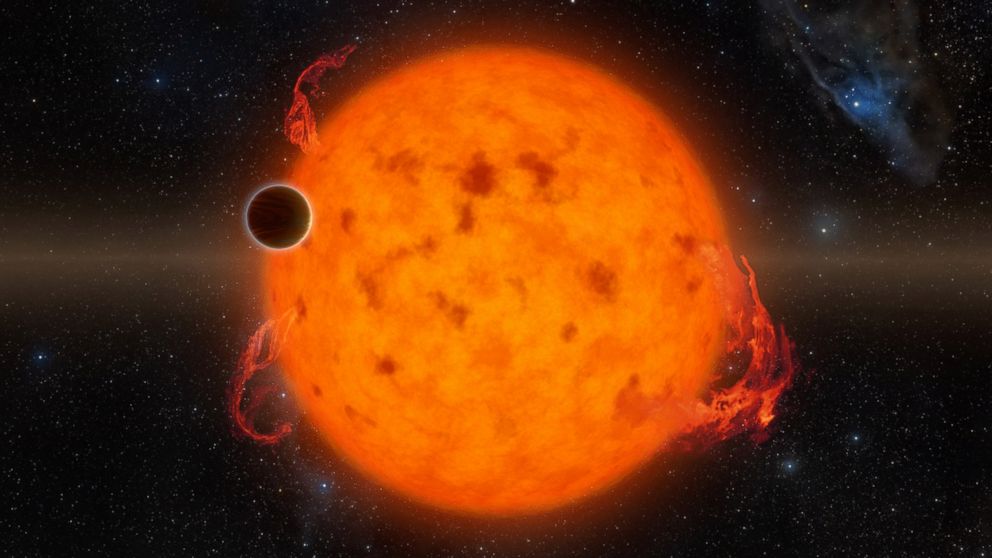
— -- Kepler, NASA's planet-hunting space telescope, has discovered what is believed to be the youngest fully-formed exoplanet ever detected, shedding new light on the early stages of planet formation.
The Neptune-sized newborn exoplanet, known formally as K2-33b, is estimated to be 5 to 10 million years old, according to NASA. Exoplanets are planets that orbit a star outside of our solar system and this one is locked in a tight embrace with the star it orbits, circling every five days. The star is about 500 light years from the Earth.
The proximity of K2-33b to its star (it's ten times closer than Mercury is to the sun) is prompting astronomers to consider new theories about early planet formation. Older exoplanets are usually observed in close orbit with their home star, but it's unusual to see a planet in its infancy so close.
"The question we are answering is: Did those planets take a long time to get into those hot orbits, or could they have been there from a very early stage? We are saying, at least in this one case, that they can indeed be there at a very early stage," Trevor David, lead author of the study, said in a statement.
Kepler has had tremendous success in space despite a hiccup in April that sent the probe into emergency mode.
Last year, NASA announced it had located a planet and star closely resembling Earth and the sun. The newly discovered planet, which NASA has named Kepler-452b, is believed to be 6 billion years old -- making it about 1.5 billion years older than the Earth and our sun. NASA said the star, Kepler-452, also has the same temperature as our sun and has a diameter 10 percent larger.
What makes that discovery especially intriguing is that the planet is orbiting the habitable zone of the solar system, the "Goldilocks" region where it's not too hot or too cold, so that the surface of the planet could sustain liquid water.
During its prime mission, which ended in 2012, Kepler detected nearly 5,000 exoplanets -- more than 1,000 of which have been confirmed.