• Video
  • Shop
  • Culture
  • Family
  • Wellness
  • Food
  • Living
  • Style
  • Travel
  • News
  • Book Club
  • Newsletter
  • Privacy Policy
  • Your US State Privacy Rights
  • Children's Online Privacy Policy
  • Interest-Based Ads
  • Terms of Use
  • Do Not Sell My Info
  • Contact Us
  • © 2026 ABC News
  • News

NOAA issues statement supporting Trump's claim Hurricane Dorian threatened Alabama
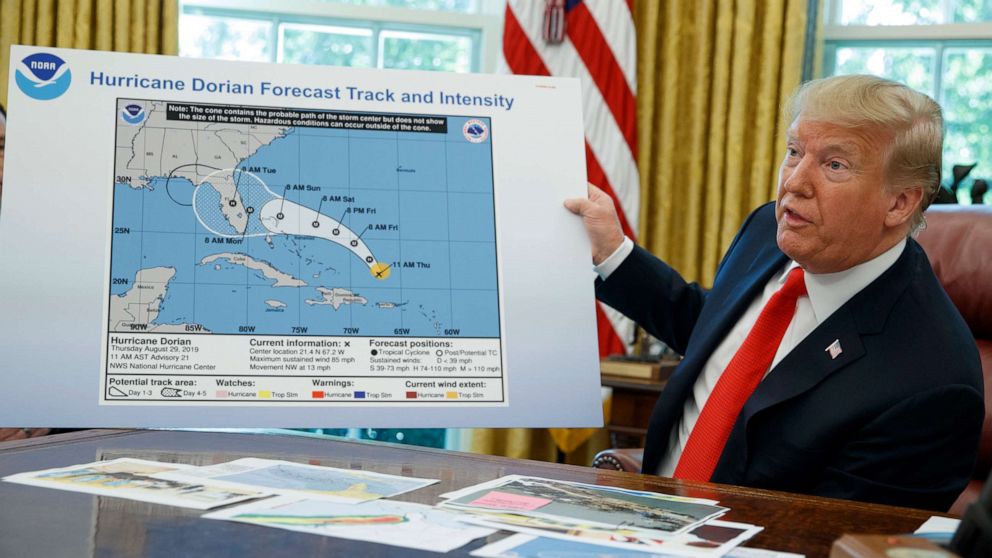
2:20
Hurricane Dorian brings heavy rain, dangerous winds in Carolinas
Evan Vucci/AP
ByMatthew Vann, Ben Gittleson, and Justin Doom
September 07, 2019, 12:00 AM

Five days after Donald Trump said Hurricane Dorian threatened Alabama, the National Oceanic and Atmospheric Association issued a statement late Friday supporting the president's claim and chastising a local branch of the National Weather Service.

NOAA said the NWS Birmingham office was wrong to speak "in absolute terms" on Sunday when it tweeted: "Alabama will NOT see any impacts from #Dorian."

That tweet, at 11:11 a.m. EDT, followed 20 minutes after Trump's.

A NOAA spokesperson said: "From Wednesday, August 28, through Monday, September 2, the information provided by NOAA and the National Hurricane Center to President Trump and the wider public demonstrated that tropical-storm-force winds from Hurricane Dorian could impact Alabama. This is clearly demonstrated in Hurricane Advisories #15 through #41, which can be viewed at the following link. The Birmingham National Weather Service's Sunday morning tweet spoke in absolute terms that were inconsistent with probabilities from the best forecast products available at the time."

That statement is technically correct. According to the map to which NOAA links, there was a 5% to 10% probability that a tiny part of southeastern Alabama would experience winds of at least 39 mph. That also was true for the entire eastern seaboard.

Related Articles

(MORE: Trump displays altered weather map showing Dorian could have hit Alabama)

Related Articles

(MORE: Trump not backing down on claim that Alabama could have been hit by Hurricane Dorian)

Trump tweeted on Thursday, referring to various weather forecasts, that "certain models strongly suggested that Alabama & Georgia would be hit" after on Sunday he'd written a tweet including that "Alabama, will most likely be hit (much) harder than anticipated."

Trump on Wednesday was photographed holding a National Hurricane Center map that included a drawn-on semicircle extending the hurricane's "cone of uncertainty" well into Alabama.
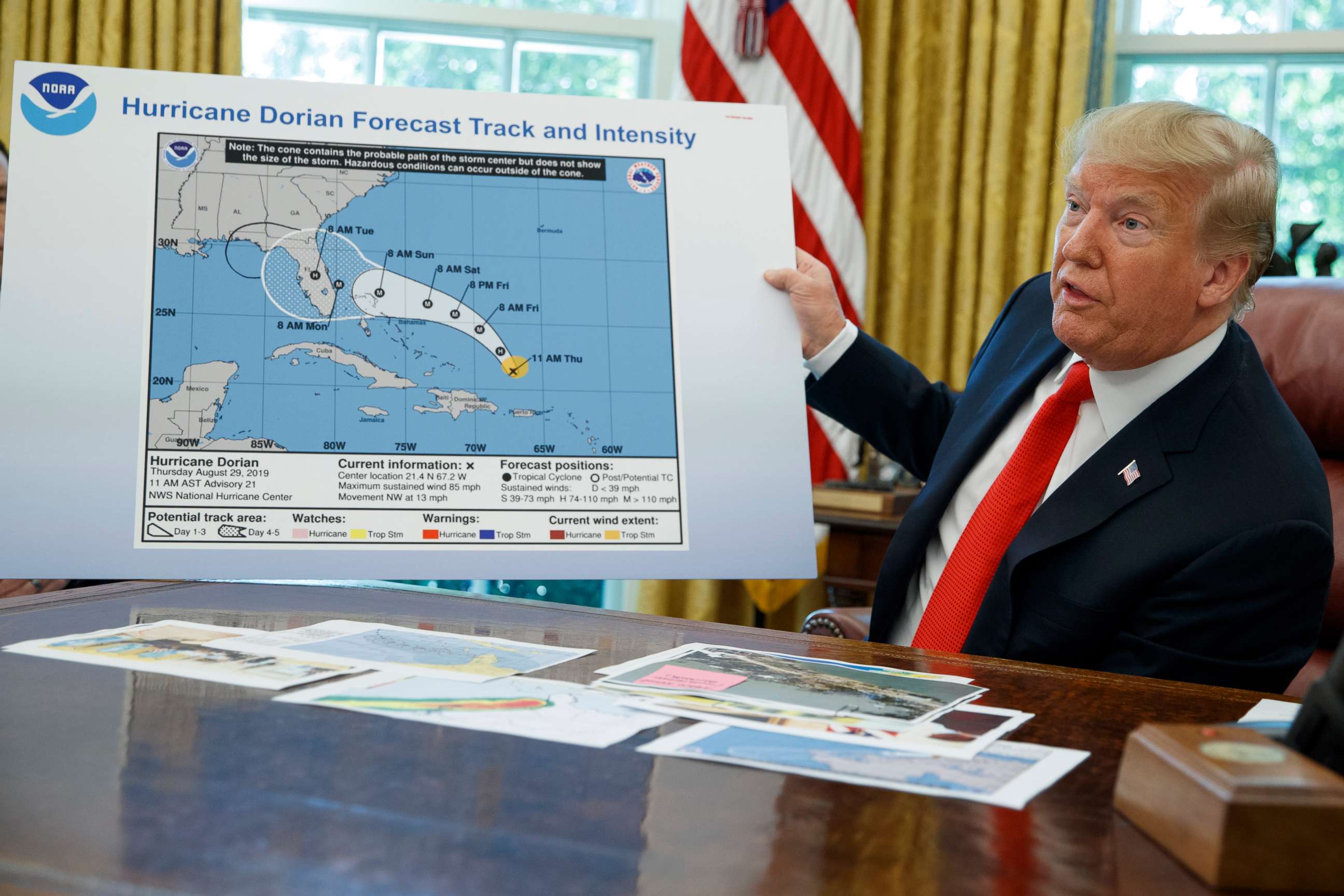
President Donald Trump talks with reporters after receiving a briefing on Hurricane Dorian in the Oval Office of the White House, Sept. 4, 2019, in Washington.
Evan Vucci/AP

A White House deputy spokesman later wrote on Twitter that it was "a black sharpie mark."

The White House did not immediately respond to a request for comment from ABC News following NOAA's statement on Friday.
Up Next in News—

What to know about 'Lulu's Law' requiring emergency shark attack notifications

May 21, 2026

Father, daughter speak after Lyft driver is accused of using AI-generated image for damage claim

May 20, 2026

Police officer speaks out after rescuing choking toddler in incident caught on camera

May 20, 2026

Google DeepMind CEO says AI could unlock breakthroughs in medicine, energy and more

May 20, 2026

Shop GMA Favorites

ABC will receive a commission for purchases made through these links.

Sponsored Content by Taboola

The latest lifestyle and entertainment news and inspiration for how to live your best life - all from Good Morning America.
  • Contests
  • Terms of Use
  • Privacy Policy
  • Do Not Sell My Info
  • Children’s Online Privacy Policy
  • Advertise with us
  • Your US State Privacy Rights
  • Interest-Based Ads
  • About Nielsen Measurement
  • Press
  • Feedback
  • Shop FAQs
  • ABC News
  • ABC
  • All Videos
  • All Topics
  • Sitemap

© 2026 ABC News
  • Privacy Policy— 
  • Your US State Privacy Rights— 
  • Children's Online Privacy Policy— 
  • Interest-Based Ads— 
  • Terms of Use— 
  • Do Not Sell My Info— 
  • Contact Us— 

© 2026 ABC News