• Video
  • Shop
  • Culture
  • Family
  • Wellness
  • Food
  • Living
  • Style
  • Travel
  • News
  • Book Club
  • Newsletter
  • Privacy Policy
  • Your US State Privacy Rights
  • Children's Online Privacy Policy
  • Interest-Based Ads
  • Terms of Use
  • Do Not Sell My Info
  • Contact Us
  • © 2026 ABC News
  • News

Nobel Prize for Physics awarded to 3 scientists for contributions to understanding evolution of the universe
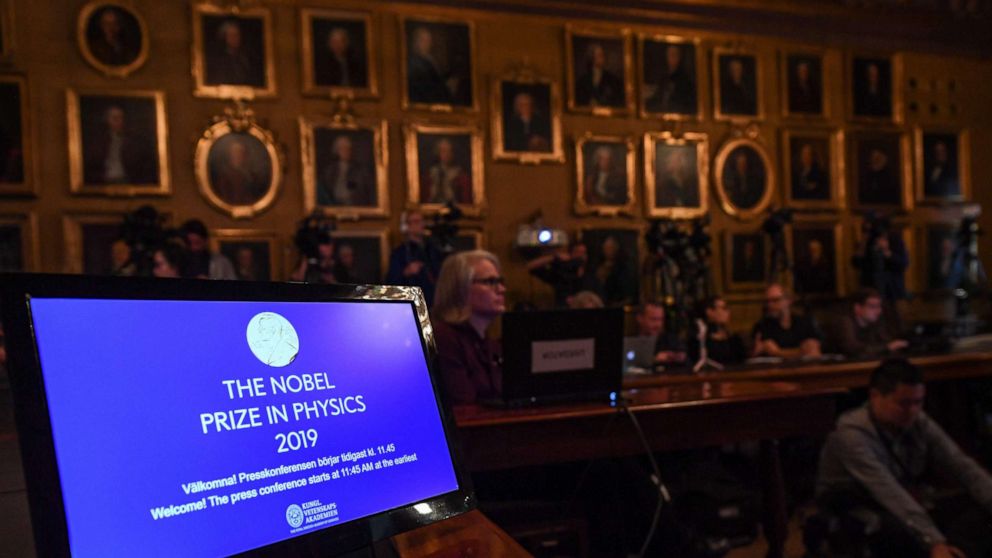
0:36
Nobel Prize for Physics awarded to 3 scientists
Jonathan Nackstrand/AFP via Getty Images
ByJon Haworth and Erin Schumaker
October 08, 2019, 1:45 PM

Three scientists have won the 2019 Nobel Prize in Physics for their work on understanding "Earth's place in the cosmos" and the evolution of the universe.

One half of the award was given to James Peebles, of the United States, "for theoretical discoveries in physical cosmology."
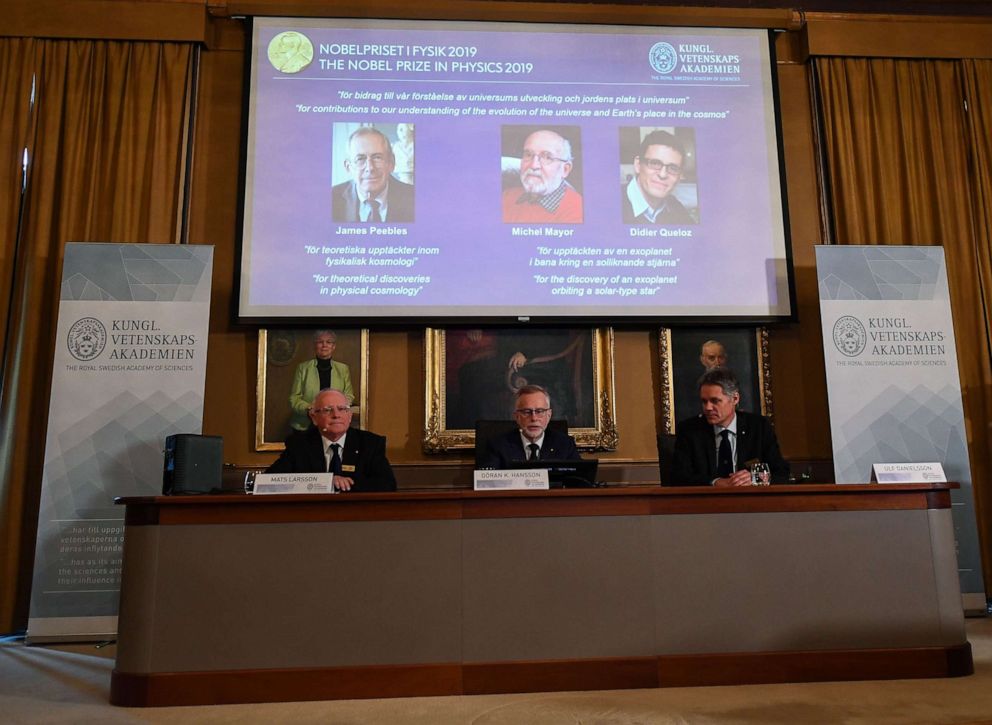
PHOTO: Members of the Nobel Committee for Physics sit in front of a screen displaying the names of the winners of the 2019 Nobel Prize in Physics at the Royal Swedish Academy of Sciences in Stockholm on Oct. 8, 2019.
Members of the Nobel Committee for Physics sit in front of a screen displaying the names of the winners of the 2019 Nobel Prize in Physics, James Peebles, Michel Mayor and Didier Queloz, at the Royal Swedish Academy of Sciences in Stockholm on Oct. 8, 2019.
Jonathan Nackstrand/AFP via Getty Images

The other half was awarded jointly to Swiss astronomers Michel Mayor and Didier Queloz "for the discovery of an exoplanet orbiting a solar-type star."

Related Articles

(MORE: Nobel Prize for Medicine awarded to 3 scientists)

The three men will share a 9-million kronor ($918,000) award, a gold medal and a diploma that the laureates will receive at a ceremony in Stockholm on Dec. 10.

Their work helps us better understand how the universe was formed and what it's made of, changing how we understand the universe.

In particular, Peebles' theoretical framework, which formed the basis of our modern-day ideas about the universe, enriched the field of cosmology at large, transforming it from "from speculation to science," according to the Royal Swedish Academy of Sciences, which awarded the prize.

Related Articles

(MORE: 3 win Nobel Prize for showing how cells sense low oxygen )

Last year's Nobel Prize in Physics was awarded to Donna Strickland of Canada, Arthur Ashkin of the United States and Gerard Mourou of France, for their work on harnessing laser light, which led to the invention of Lasik eye surgery. Strickland was the third woman in history awarded the Nobel Prize in Physics.

Nobel prizes in chemistry and literature will continue to be announced this week, with the most famous prize, the Nobel Peace Prize, announced Friday.


Up Next in News—

Woman loses thousands to scammer using what she suspects was AI voice mimicking daughter

May 26, 2026

Couple recounts close encounter with shark while kayaking

May 26, 2026

Forest ranger details dramatic cave rescue of man stuck in crevice

May 25, 2026

Rip current risk at onset of Memorial Day Weekend: How to stay safe

May 22, 2026

Shop GMA Favorites

ABC will receive a commission for purchases made through these links.

Sponsored Content by Taboola

The latest lifestyle and entertainment news and inspiration for how to live your best life - all from Good Morning America.
  • Contests
  • Terms of Use
  • Privacy Policy
  • Do Not Sell My Info
  • Children’s Online Privacy Policy
  • Advertise with us
  • Your US State Privacy Rights
  • Interest-Based Ads
  • About Nielsen Measurement
  • Press
  • Feedback
  • Shop FAQs
  • ABC News
  • ABC
  • All Videos
  • All Topics
  • Sitemap

© 2026 ABC News
  • Privacy Policy— 
  • Your US State Privacy Rights— 
  • Children's Online Privacy Policy— 
  • Interest-Based Ads— 
  • Terms of Use— 
  • Do Not Sell My Info— 
  • Contact Us— 

© 2026 ABC News