Rosetta Probe Reveals Weird Facts About Comet 67P
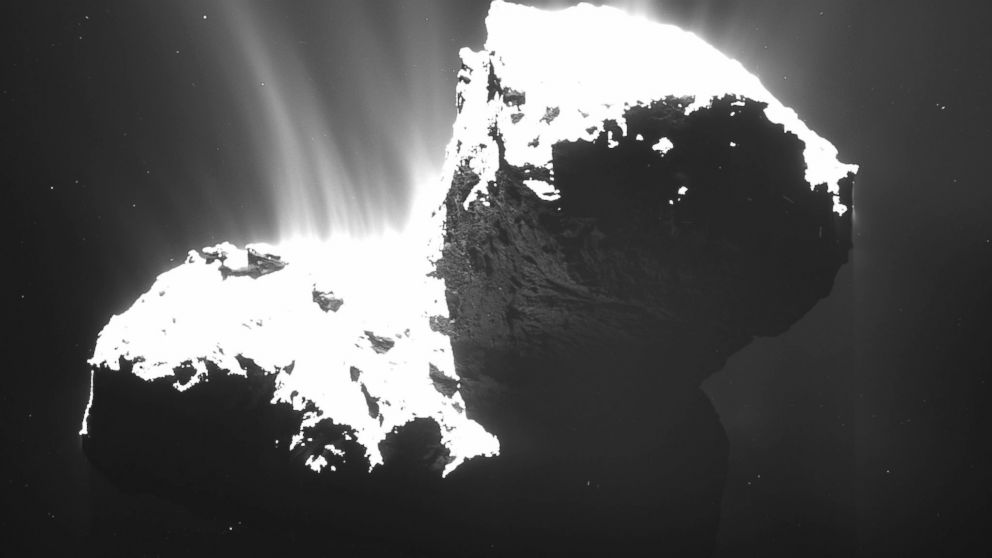
— -- After a decade long journey to intercept a speeding comet, the real work is just beginning for the Rosetta probe.
The spacecraft made history in November when it sent its Philae lander to the surface of 67P, a comet that is whizzing through space at speeds as fast as 80,000 miles per hour.
After a less than ideal landing that included a few bounces, the Philae lander came to rest in an area where it could not get good, direct sunlight, forcing the European Space Agency to rely on batteries that have since been depleted.
Since then, the Rosetta probe has continued to orbit the 2.5-mile wide comet, collecting data and making observations to send back to the team on Earth.
Several reports published in the journal "Science" today shed new light on the comet's composition and behavior as it continues to approach the sun.
The rubber-duck shaped planet was leaking 1.2 liters of water per second into space through the "neck" area of the comet in August. Researchers estimate the rate has increased since Philae landed in November.
Samuel Gulkis, the principal investigator at NASA's Jet Propulsion Laboratory, who worked on Rosetta's instruments, said the comet is incredibly active.
"That situation may be changing now that the comet is getting warmer," Gulkis said.
Perhaps the most exciting discovery: Rosetta has the building blocks of life.
Researchers expected to find organic molecules in the comet's halo, however "the molecules Rosetta has detected are more complex than those seen on other comet," they wrote.
The comet also emits a diverse variety of gases in certain areas, while other parts of the oddly shaped mass only leak water.
Gulkis said there's plenty more to learn as Rosetta continues its "up close and personal" orbit around 67P.
Rosetta "has provided us with an unprecedented opportunity to see how comets transform from cold, icy bodies to active objects spewing out gas and dust as they get closer to the sun," he said.