Sen. Kaine says ceasefire should be extended after U.S.-Iran talks fail: 'We need to find a way'
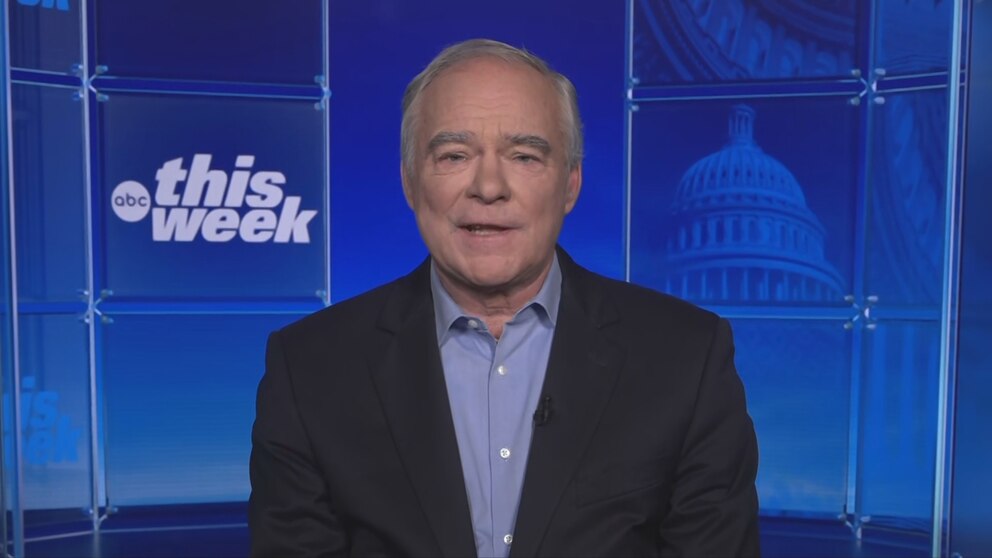
Democratic Sen. Tim Kaine said Sunday he believes the U.S. ceasefire with Iran should be extended beyond the current two-week timeline after peace talks between the two countries failed over the weekend.
"The ceasefire, while it is not perfectly holding, we need to find a way to extend it past April 21," Kaine told ABC News' "This Week" co-anchor Martha Raddatz. "Both parties, when they left the negotiation in Pakistan said the door wasn't closed to additional negotiation, and so even an imperfect ceasefire is better than resuming full war."
Talks between the U.S. and Iran went for 21 hours Saturday and Sunday in Islamabad, but both parties emerged saying they were unable to reach an agreement. Vice President JD Vance, who represented the U.S. in negotiations, said that a core goal of the talks was to prevent Iran from seeking a nuclear weapon, which he said they did not agree to.
Iranian Foreign Ministry spokesperson Esmail Baghaei said that while the U.S. and Iran were able to reach "understanding on a number of issues," there were "two or three" issues which the two countries had "distant" views on. Baghaei did hint that talks could continue, saying "diplomacy never ends."
When asked about the President Donald Trump's "red line" of preventing Iran from having nuclear weapons, Kaine criticized the president for backing out of the Joint Comprehensive Plan of Action (JCPOA), or what's often referred to as the Iran nuclear deal that aimed at preventing Iran from having nuclear weapons.
"Iran entered into an agreement with the United States and other nations ... reaffirming that they would never purchase, seek or acquire a nuclear weapon," Kaine said. "Donald Trump tore that up ... so JD Vance says now that while Iran won't agree to what they agreed to 10 years ago, I'm sure Iran wonders, if we agree to it, will the United States tear it up again?"
Trump has frequently trashed the JCPOA, and President Barack Obama for negotiating it.
Kaine has opposed the war with Iran from the start, calling it a "war of choice" and saying Iran did not pose an imminent threat.
When the U.S. and Israel attacked Iran Feb. 28, Trump said he was doing so because Iran was an imminent threat by developing its nuclear program. Kaine again Sunday disputed the suggestion that Iran was an imminent threat to the U.S.
"They are a regional threat, but they posed no imminent threat to the United States," Kaine said. "I'm on both the Armed Services and Foreign Relations Committees. I'm in the classified facility at the at the Capitol all the time, and there was zero evidence of an imminent threat to the homeland from Iran."
Trump said that the ongoing two-week ceasefire was contingent on the Iranians reopening the Strait of Hormuz, but the Iranians said that they did not reach an agreement with the U.S. on the strait.
On Sunday morning, Trump announced on his social media platform a blockade of all traffic in the Strait of Hormuz. The U.S. Central Command announced Saturday the U.S. Navy is conducting mine-clearing operations in the strait.
"Effective immediately, the United States Navy, the Finest in the World, will begin the process of BLOCKADING any and all Ships trying to enter, or leave, the Strait of Hormuz," Trump wrote.
Trump added that at "an appropriate moment," the military will "finish up the little that is left of Iran."
Kaine said Sunday that he would force another war powers resolution vote this week to halt any additional military action without congressional approval. He has forced votes on war powers resolutions to halt the war in the past, but they have gotten little Republican support and have failed so far.