Sharks Swarm, Reporter Kicks and Cameras Roll
— -- When a great white shark attacked swimmer Steve Robles just off a Los Angeles beach last year all he could hear was "everything crunch. I was staring at this shark eyeball to eyeball, literally right here.”
He jabbed the shark hard in the nose and the great white fortunately let go. “It’s the most frightening experience,” recalls Robles.
Robles is not alone. In 2013 there were 53 shark attacks along the U.S. coastline. Despite that number, the probability is about 1 in 250 million that a swimmer will die of a shark attack.
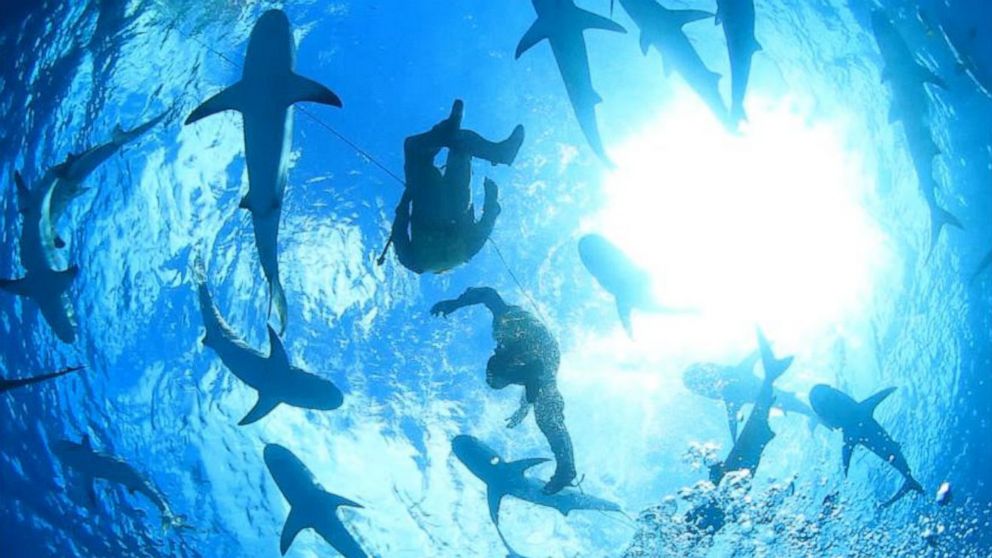
To learn how to survive an encounter with a shark we enlisted special forces operator and survival expert Terri Schappert who took ABC News to a shark infested reef off the Bahamas.
The waters are gin clear, offering a perfect lens to watch the predators beneath, dozens of Caribbean reef sharks.
We first took a quick scuba dive in all black wet suits. Underwater we are protected in the sharks world because we are large black figures and not giving off a signal associated with prey or food.
But to properly learn how to fend off sharks, we pulled on 15 pounds of chain mail, and then put clothes on top to simulate real people finding themselves stuck in shark infested waters following a plane or a boat crash.
We were doing what experts say not to do: flapping around in waters where sharks were feeding, wearing regular clothing.
First Schappert tells me to slow down my movements. Fast movements give off the signal of prey. Also conserving energy is key to survival.
If there are two people in the water, he recommends treading water back to back to limit of our spheres of control by half to 180 degrees each.
But sharks, up to 9 feet long, are in a feeding frenzy. They bump up against us as they eat, but they do not bite.
Schappert says if the sharks begin attacking to fight them off. “If they come in, and it becomes an attack, he says, 'You’re going to strike them. Using quick, fast downward punching motions. All you can do is fight and let them know 'I am not going down easy.'"
I quickly discovered my own method. Leaning on my back and kicking off the sharks, which seemed to have little regard for anyone’s personal space, yet remarkably weren’t biting. It’s a testament, said Schappert, to their often underestimated intelligence.