• Video
  • Shop
  • Culture
  • Family
  • Wellness
  • Food
  • Living
  • Style
  • Travel
  • News
  • Book Club
  • Newsletter
  • Privacy Policy
  • Your US State Privacy Rights
  • Children's Online Privacy Policy
  • Interest-Based Ads
  • Terms of Use
  • Do Not Sell My Info
  • Contact Us
  • © 2026 ABC News
  • News

'Spanish Stonehenge' has reemerged amid Europe's sizzling drought

0:38
Spanish 'Stonehenge' emerges amid drought
Susana Vera/Reuters
ByKyla Guilfoil
August 18, 2022, 5:53 PM

A Spanish "stonehenge" has reemerged amid the country's devastating drought, officials said.

The historic marvel, officially called the Dolmen of Guadalperal, has only been visible four times, according to officials.

Experts believe the striking circle of dozens of megalithic stones has existed since 5000 BC. However, it was first discovered by German archaeologist Hugo Obermaier in 1926 before it became flooded in 1963 due to a rural development project under Francisco Franco's dictatorship.

The dolmen of Guadalperal, also known as the Spanish Stonehenge, is revealed due to the receding waters of the Valdecanas reservoir in the outskirts of El Gordo, Spain, Aug, 3, 2022.
Susana Vera/Reuters

Now, the structure sits in a corner of the Valdecanas reservoir located in the country's central province of Caceres.

As Spain faces its worst drought in 60 years, officials say the water level in the reservoir has dropped to 28% capacity.

Related Articles

MORE: Where wildfires are raging across Europe

"It's a surprise, it's a rare opportunity to be able to access it," archaeologist Enrique Cedillo from Madrid's Complutense University told Reuters.

The structure itself has an unknown creator, experts say.

The dolmen of Guadalperal, also known as the Spanish Stonehenge, is revealed due to the receding waters of the Valdecanas reservoir in the outskirts of El Gordo, Spain, Aug, 3, 2022.
Susana Vera/Reuters

Dolmens are vertically arranged stones that usually support a flat boulder or capstone, according to the New World Encyclopedia. How they became erected, however, remains a mystery.

Because it is common to find human remains near or in dolmens across Europe, it is believed that the structures served as tombs, New World Encyclopedia said.

The dolmen was last visible in 2019, when Europe was facing a drought, NASA said. This 2019 drought was the first time the entire structure became visible since it was flooded in 1963, according to NASA.
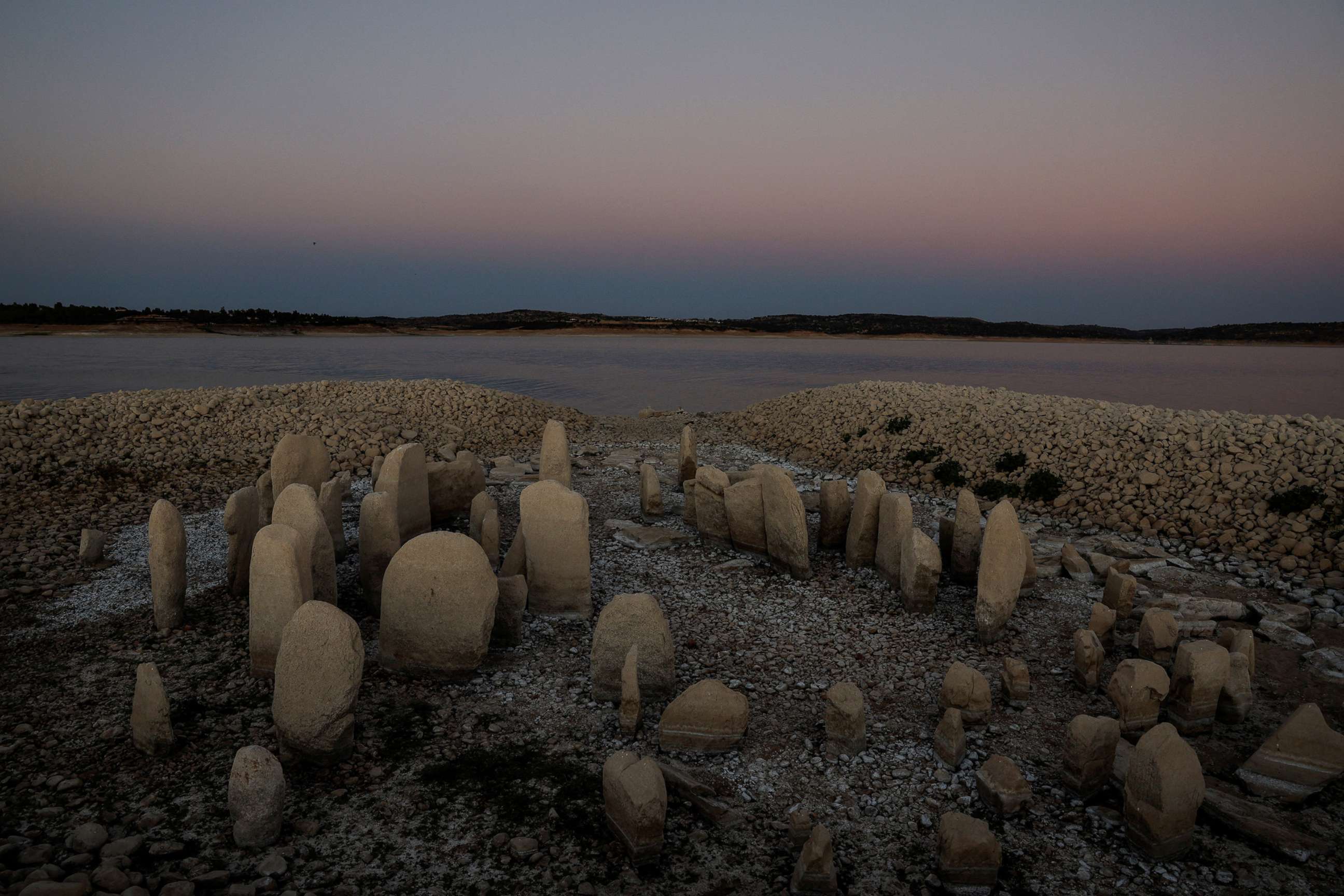
The dolmen of Guadalperal, also known as the Spanish Stonehenge, is revealed due to the receding waters of the Valdecanas reservoir in the outskirts of El Gordo, Spain, Aug, 3, 2022.
Susana Vera/Reuters

Related Articles

MORE: Heat wave forecast: Dangerous, triple-digit temps slam much of US as Europe bakes

A petition by Asociación Raíces de Peraleda was posted on Change.org in 2019 to have the structure moved from the reservoir. As of Thursday, it has over 45,000 signatures.

"It is a megalithic dolmen of great value that is now, for the first time, and who knows if it will be the last, fully accessible," the petition reads.

The petition continues to read that the association launches a "voice of alarm" to officials to move the dolman, in order to "rescue" it and take "advantage of the current circumstances since it is still well preserved."

Related Articles

MORE: Record-breaking heat waves in US and Europe prove climate change is already here, experts say

PHOTO: Amalie Garcia picks up her dog next to The Dolmen of Guadalperal, a megalithic monument that emerged due to drought at the Valdecanas reservoir in El Gordo, western Spain, Aug. 13, 2022.
Amalie Garcia picks up her dog next to The Dolmen of Guadalperal, a megalithic monument that emerged due to drought at the Valdecanas reservoir in El Gordo, western Spain, Aug. 13, 2022. In the wake of three heatwaves and little rain in sight, Spain's reservoirs are getting emptier by the week, and not just in traditionally more arid southern part of the country.
Manu Fernandez/AP

The petition states that the structure is deteriorating, as the rock has become porous and is cracking in some areas. It warns that if the structure is not moved, it may not be strong enough to move in the future.

The Iberian peninsula where the dolman lives is at its driest in 1,200 years, with winter rains expected to diminish further, a study published by the Nature Geoscience journal stated.

Up Next in News—

This San Francisco shop is run completely by an AI agent

April 23, 2026

Mother charged after teen son allegedly hits and injures 81-year-old veteran while riding e-motorcycle

April 23, 2026

UK bill banning smoking products for those born after 2008 is one step away from becoming law

April 22, 2026

Pilot killed in Florida plane crash hailed as hero

April 21, 2026

Shop GMA Favorites

ABC will receive a commission for purchases made through these links.

Sponsored Content by Taboola

The latest lifestyle and entertainment news and inspiration for how to live your best life - all from Good Morning America.
  • Contests
  • Terms of Use
  • Privacy Policy
  • Do Not Sell My Info
  • Children’s Online Privacy Policy
  • Advertise with us
  • Your US State Privacy Rights
  • Interest-Based Ads
  • About Nielsen Measurement
  • Press
  • Feedback
  • Shop FAQs
  • ABC News
  • ABC
  • All Videos
  • All Topics
  • Sitemap

© 2026 ABC News
  • Privacy Policy— 
  • Your US State Privacy Rights— 
  • Children's Online Privacy Policy— 
  • Interest-Based Ads— 
  • Terms of Use— 
  • Do Not Sell My Info— 
  • Contact Us— 

© 2026 ABC News