Where We Stand on Stalled Supreme Court Nominee Merrick Garland
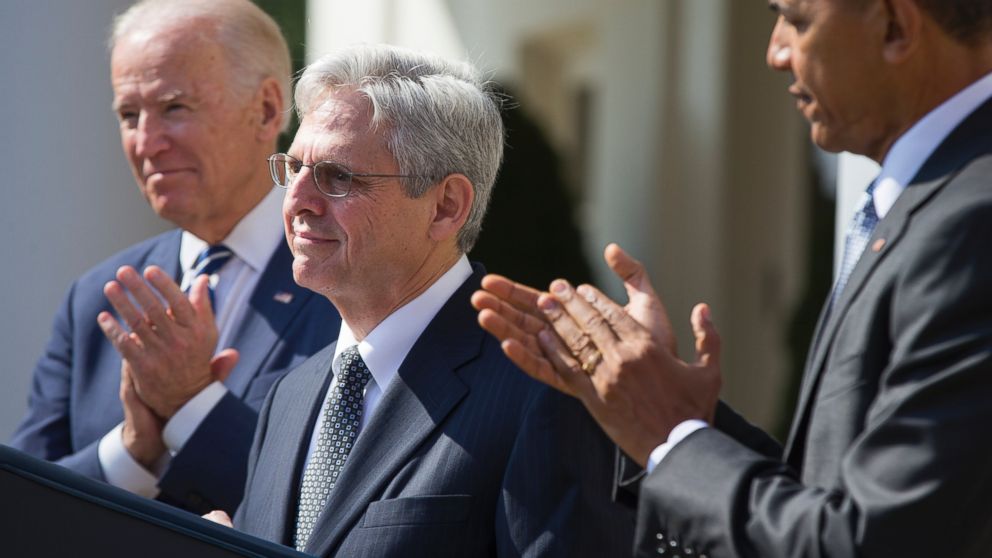
— -- President Obama nominated federal judge Merrick Garland to the Supreme Court this spring after Justice Antonin Scalia's unexpected death.
"This is the greatest honor of my life,” Garland said alongside Obama during his nomination announcement. “For me, there could be no higher public service than serving as a member of the U.S. Supreme Court.”
But Senate Republicans have refused to hold hearings on the nomination, arguing that the next president should choose his or her Supreme Court nominee. The result is that the Supreme Court began its 2016 term last week with only eight justices.
ABC News spoke to Supreme Court contributor Kate Shaw for a Q&A on Garland's nomination and what comes next:
Question: Who is Merrick Garland?
Answer: Merrick Garland, 63, is the chief judge of the D.C. Circuit Court of Appeals. Obama nominated him March 16, 2016, to fill the Supreme Court vacancy left by Scalia’s death. Garland has now been waiting for a confirmation hearing for 205 days, which makes him the longest-pending Supreme Court nominee in history, obliterating Justice Brandeis’ previous record of 125 days.
Q: Why hasn’t he been confirmed yet?
A: Well, it’s certainly not personal. It’s virtually impossible to find a person in Washington with anything bad to say about Garland. In an op-ed earlier this week, the president called him “a distinguished legal mind, a dedicated public servant and a good and decent man” – and I think even many GOP Senators would agree with that.
But Senate Majority Leader Mitch McConnell, R-Ky., and Judiciary Committee Chairman Chuck Grassley, R-Iowa, have taken the position that because the vacancy occurred during an election year, the next president should be the one to pick the next justice.
Though there have been a couple of defections, most Republican senators have supported the strategy. The Republicans control the Senate, so they get to schedule hearings, and they’ve refused to do so with Garland. And, at least nowadays (this wasn’t always the case), no hearing means no confirmation.
Q: OK, so McConnell wants to wait until after the election. What does that mean about the lame-duck session?
A: That depends, of course, on who wins in November. If Republican presidential nominee Donald Trump wins, Garland likely goes back to life as the chief judge of the D.C. Circuit, and, after inauguration, Trump nominates someone new (subject to a possible wrinkle I discuss below).
If Democratic nominee Hillary Clinton wins, there are a few possibilities. Garland’s nomination will remain pending in the Senate after the election unless Obama moves to withdraw it, which doesn’t seem likely.
So Senate Republicans could take stock, decide that Clinton would likely nominate someone younger and more progressive if given the chance, and move quickly to confirm Garland, who’s widely viewed as a moderate and is relatively old by Supreme Court nominee standards (he’ll turn 64 in November).
Q: When does his nomination expire?
A: The nomination expires when the Senate adjourns sine die; that is, the end of this congressional session, likely sometime in mid-December.
Q: So what happens in January?
A: Things could get interesting here. The new Senate will convene on Jan. 3 (that’s in the Constitution), and Obama remains the president until Jan. 20 (also in the Constitution). So for a few weeks in January, the Senate will have changed, but not the president.
At this point, Obama could renominate Garland. If Trump is the president-elect and the Senate is still held by Republicans, no way there’s a confirmation. But if Trump is the president-elect and the Senate is controlled by Democrats, there’s a good chance Senate Democrats move quickly to confirm Garland before Inauguration Day.
If Clinton is the president-elect, it seems likely that Obama will consult with her before moving to renominate Garland. If that happens, some people assume she’ll ask him to hold off and let her make the pick. But it’s possible that a swift and clean confirmation of Garland before Inauguration Day would free up Clinton and her team to focus on things like staffing the cabinet and getting policy initiatives ready to roll out quickly.
So it seems at least possible that she’d agree to a renomination, especially if she were confident she’d have the chance to fill at least one other seat on the Supreme Court, and perhaps several.
So there are a few different ways we could see a Justice Garland by the end of January.
Q: What about the filibuster? Doesn’t it take 60 votes to confirm a Supreme Court justice?
A: In a word, yes. But that could change. Two of the justices on this court were actually confirmed without reaching a filibuster-proof 60-vote threshold (Justice Clarence Thomas was confirmed 52-48, and Justice Samuel Alito was confirmed 58-42). But recent years have seen an increase in the use of the filibuster in judicial confirmations, so it doesn’t seem likely at the moment that anyone would make it onto the Supreme Court without 60 votes.
The Democrats actually changed the filibuster rule in 2013, eliminating its use for all lower court judges but stopping short of the Supreme Court. But there has been talk of expanding the rule change to include the Supreme Court.
So if the Senate convenes Jan. 3 with a Democratic majority, it’s entirely possible that the Democrats would use that same mechanism (the 2013 rule change was done by simple majority vote, so this would presumably be the same) to eliminate the filibuster for Supreme Court nominees, and then quickly hold a hearing and confirm Garland.
ABC News’ Audrey Taylor, Ben Bell and Geneva Sands contributed.