Summer 2025 forecast shows hotter-than-average temperatures: What to know

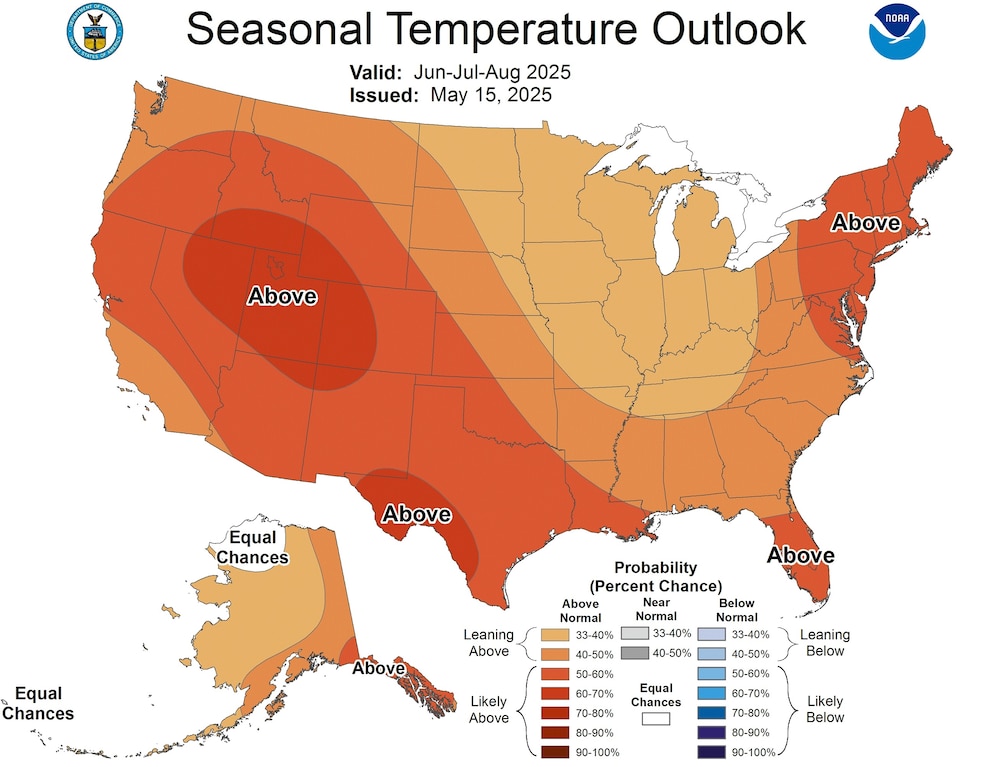
The latest summer season outlook by the National Oceanic and Atmospheric Administration (NOAA) shows hotter-than-average temperatures are predicted across much of the country this summer, with the greatest likelihood of extreme heat hitting swaths of the East Coast, southern Plains and West.
The outlook from NOAA's Climate Prediction Center forecasts whether the seasonal average temperature for a particular area will end up above, below or near average during the three-month period of the meteorological summer.
However, the outlook focuses on a seasonal average temperature and does not detail temperature variations that occur over the course of days, weeks or even one out of the three months included in the forecast.
June in a particular region could feature rather typical summer conditions, however, July and August could end up well above average, tipping the three-month average to above for the entire season.
What this means for a local area depends greatly on the typical climate of a certain location.
For example, average high temperatures in Phoenix, Arizona, this summer range from 104 to 106 degrees Fahrenheit. This is already hot, as it is typically expected to be.
Contrast this with Caribou, Maine, where average high temperatures during the summer months range from 72 to 77 degrees Fahrenheit. Some people may consider this warm, but not hot.
Both locations are shaded red on NOAA's forecast map, indicating that temperatures are expected to average above the typical summer range. However, "above average" could mean just one degree higher -- or several.
And for places like Caribou, above average doesn't necessarily mean hot. These forecasts also consider overnight lows, so in some areas, warmer-than-average temperatures might come from milder nights rather than scorching afternoons.
While the seasonal outlook highlights where above-average warmth is likely, it doesn't tell us how hot or long-lasting any extreme heat might be.
When do summer's hottest temperatures typically occur?
The hottest temperatures of the summer typically occur much later in the season, with different regions of the country experiencing their warmest average temperatures at varying times.
For the contiguous United States, on average, July is the hottest month of the year.
However, some regions of the country typically don't experience their warmest average temperatures until August or even September.

A majority of the country, including much of the Northeast, Midwest and West, experiences the hottest temperatures of the year on average, during the second half of July and first half of August.
Much of the South typically experiences its peak average temperatures during the second half of August. However, along much of the West Coast, the warmest temperatures of the year usually don't occur until September.
What previous summers have taught us
For the past two summers in a row, the seasons in the Northern Hemisphere ranked as the warmest on record with extreme heat bringing persistent, dangerously hot conditions across several continents, according to a 2024 report by Copernicus, the European Union's Climate Change Service.
Summer 2024 (June through August) was the warmest summer on record for the Northern Hemisphere, beating the previous record set in 2023 by .66 degrees Celsius, or 1.19 degrees Fahrenheit, the report found. The Northern Hemisphere's top 10 warmest summers on record have all occurred within the past 10 years, according to Copernicus.
"The temperature-related extreme events witnessed this summer will only become more intense, with more devastating consequences for people and the planet unless we take urgent action to reduce greenhouse gas emissions," Samantha Burgess, deputy director of Copernicus, said in a statement at the time.
The last time Earth recorded a cooler-than-average year was in 1976, according to the National Oceanic and Atmospheric Administration (NOAA).
While it is unlikely that summer 2025 will surpass last year's record, this forecast shows that scorching temperatures could be on the way for much of the U.S. this season.