Why SCOTUS election law ruling doesn't stop North Carolina congressional map from being changed

The U.S. Supreme Court decision on Tuesday rejecting a theory that would grant state legislatures broad authority to unilaterally craft and enforce election laws has little impact on the actual issue that sparked the case -- North Carolina's House map.
The state Legislature, controlled by Republicans and able to set congressional district lines without the Democratic governor's signoff, initially drew a map favoring their party after the 2020 census. But those lines were swiftly the center of a lawsuit, and the state Supreme Court ordered new ones to be created.
Republicans appealed, taking their case to the U.S. Supreme Court where they argued that they had ultimate power to define the terms of federal elections, including congressional maps.
That "independent state legislature" theory was shut down in Tuesday's 6-3 ruling, written by Chief Justice John Roberts.
"State courts retain the authority to apply state constitutional restraints when legislatures act under the power conferred upon them by the Elections Clause," the majority found (with three conservative justices dissenting). "In interpreting state law in this area, state courts may not so exceed the bounds of ordinary judicial review as to unconstitutionally intrude upon the role specifically reserved to state legislatures by Article I, Section 4, of the Federal Constitution."
Yet the dispute over the map itself is now moot -- and the court did not rule on whether the lines had to be redrawn.
That's because the North Carolina Supreme Court, which was controlled by a 4-3 Democratic majority last year, flipped to a 5-2 Republican majority after the 2022 midterms. And in April, the new majority overturned its prior ruling on partisan gerrymandering, allowing Republican lawmakers in the state to again move forward with crafting a favorable map.
"There is no judicially manageable standard by which to adjudicate partisan gerrymandering claims. Courts are not intended to meddle in policy matters," the state's chief justice, Paul Newby, wrote for the court's majority.
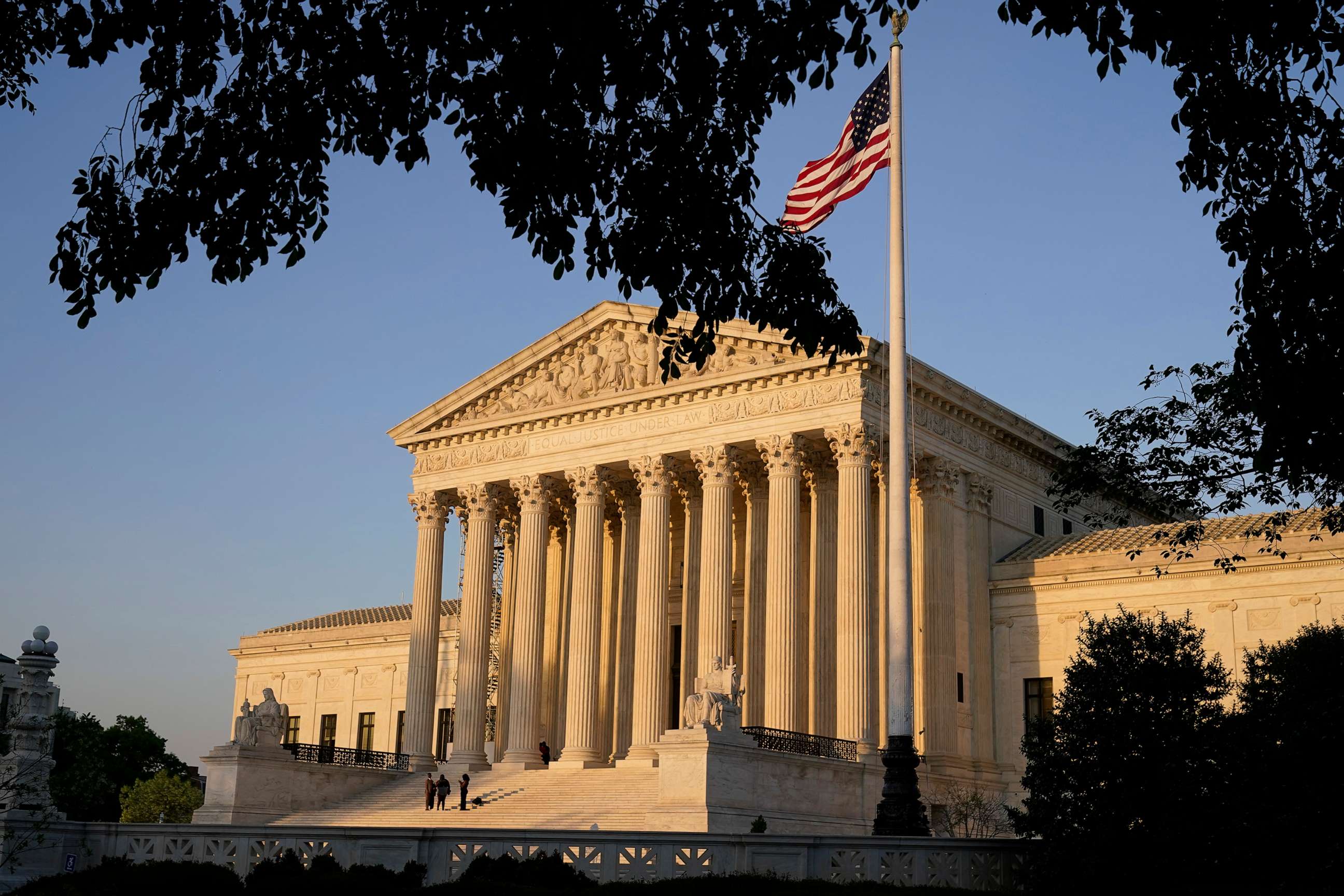
North Carolina Republicans hailed Tuesday's U.S. Supreme Court decision, saying they plan on drawing new maps "later this year."
"Today the United States Supreme Court has determined that state courts may rule on questions of state law even if it has an impact on federal elections law. Ultimately, the question of the role of state courts in congressional redistricting needed to be settled and this decision has done just that. I am proud of the work we did to pursue this case to the nation's highest court," state House Speaker Tim Moore said.
"Fortunately the current Supreme Court of North Carolina has rectified bad precedent from the previous majority, reaffirming the state constitutional authority of the NC General Assembly. We will continue to move forward with the redistricting process later this year."
North Carolina's 14-seat House delegation is currently split evenly, though conservatives in Raleigh could conceivably draw a map that wins them 11 seats, a prospect that Democrats on the state Supreme Court noted in their April dissent.
"Today, the majority strips the people of this right; it tells North Carolinians that the state constitution and the courts cannot protect their basic human right to self-governance and self-determination," wrote Justice Anita Earls. "Efforts to downplay the practice do not erase its consequences and the public will not be gaslighted."
The potential four-seat gain by Republicans looms large ahead of the 2024 elections, where the GOP will seek to defend a narrow five-seat majority in the House and recently faced setbacks in redistricting elsewhere in the country.
Democrats could see one-seat gains in Alabama and Louisiana, respectively, after the U.S. Supreme Court paved the way for each of those states to add a second majority-Black district to be more representative of Black voters' power relative to their share of population.
There are similar legal battles over redistricting playing out in Georgia and South Carolina.
New York Democrats, who control the state government there, are also optimistic that they will be able to redraw their own maps before the 2024 cycle.