Tales of horror emerge from Darfur after rebels take control of key city
Hawa arrived at a refugee camp in Tawila, a town 35 miles from the city of El Fasher in Sudan's Darfur region, on Oct. 20 after being separated from her 16-year-old son.
"We walked for days on rough terrain, our feet scorched," she said, in testimony shared with ABC News by U.S.-based nonprofit Avaaz, an online activist network. "When they carried out executions, that was the first time I saw someone slaughtered in front of me. It was traumatizing."
Hawa is one of the thousands who have managed to flee El Fasher since a Sudanese paramilitary group, the Rapid Support Forces (RSF), seized the city last month.
El Fasher, the capital of Sudan's North Darfur state, was the last major holdout in the wider western Darfur region, under total siege for more than 18 months before falling to the RSF. Since then, reports of atrocities have emerged from the city, with a communications blackout rendering contact with the outside world almost impossible.
Before fleeing, Hawa said many women and children were held separately and subjected to abuse, while others were beaten if they fell asleep.

"They took young girls from us as a form of currency," she said.
There are some 500,000 displaced people in the Tawila camp, which has absorbed the majority of the refugees from El Fasher, according to the NRC. But despite the violence, only around 6,000 people have arrived in Tawila since the RSF entered El Fasher -- meaning many thousands more remain unaccounted for. Some humanitarian observers and families told ABC News fear they are being held by RSF.

The scale of the violence is difficult to ascertain, according to Shashwat Saraf, the Norwegian Refugee Council's country director for Sudan. The NRC is running the day-to-day operations of the Tawila camp, which is in an area controlled by a militant group known as the Sudan Liberation Movement/Army -- SLA-AW -- who are not currently party to the conflict, Saraf said.
"The violence is a horror show," Saraf told ABC News from Tawila. "It's very bad. It's very difficult to even describe what we hear in our own words."
"We don't know the scale at which it's happening," he added. "Every single testimony, every single person who's arrived has talked about violence, about dead bodies, about people being killed, about being kidnapped, about people being kept hostage, and also all forms of abuses that have taken place, particularly on women."
Testimony from several residents of El Fasher who have fled the violence paint a horrifying picture of targeted violence, extortion and assaults on the perilous journey to Tawila. ABC News has changed the name of the survivors for fear of reprisals.
Ala, who is 8 months pregnant and the mother of a 2 and a 12-year-old, said repeated displacement and food shortages forced her to flee.
"We lived under constant bombardment and hunger," she told ABC News. "We even ate leather to survive." Ala said she has lost five sisters in this war.
And Mohammed, a 65-year-old man from El Fasher, recounted leaving the city at dawn and passing through numerous checkpoints.
"They searched everyone, including children," he said. "Girls were searched in ways that violated their privacy. At one stop, 17 people from our group were taken away and executed."
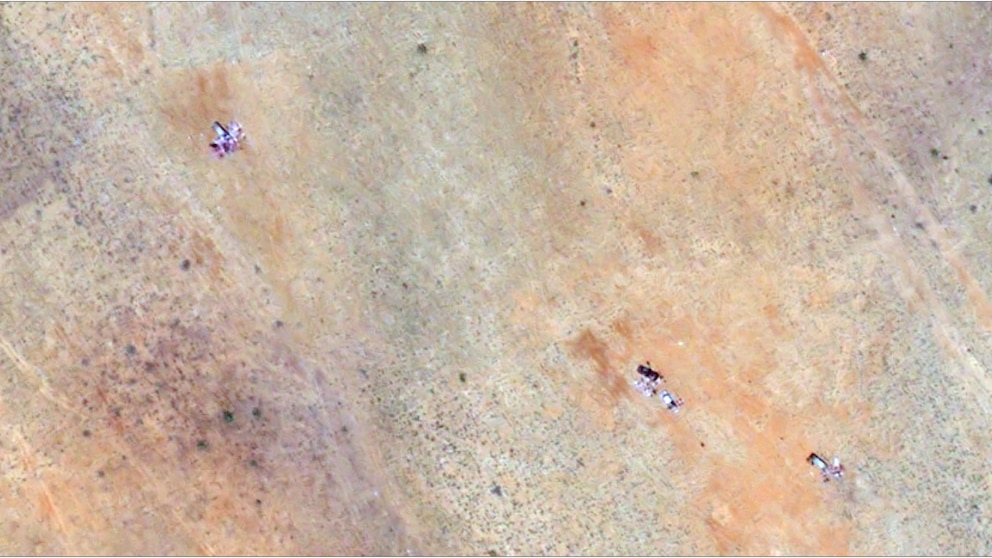
ABC News has verified a series of videos from the ground in El Fasher that, cross-referenced with high-resolution satellite imagery, reveal how the RSF entered the city, built a berm encircling it and systematically targeted civilians attempting to flee.
The footage documents the RSF tactics in shocking detail: burning homes and vehicles, chasing down those attempting to flee, and carrying out what appears to be cold-blooded executions.
In one clip verified by ABC News, a man smiles at the camera, standing amid dozens of charred vehicles and lifeless bodies. Satellite imagery from the same location shows the identical cluster of burned cars, in the form of a dark scar on the earth beside the newly constructed berm trapping El Fasher's civilians inside. Such is the scale of the violence that blood and piles of bodies are visible from space, according to experts at the Yale Humanitarian Research Lab.
The IPC, the UN-backed, globally recognized monitor for food security, declared this week that famine had taken hold in El Fasher and surrounding areas. The effects are keenly felt in El Fasher, where at the field hospital run by Doctors Without Borders, women, children and the elderly have arrived suffering from "catastrophic levels of malnutrition." On a single day on Oct. 27, all of the 70 children under 5 years old at the hospital were acutely malnourished, according to MSF.
"Between Oct. 26 and Oct. 29, we received 396 injured people and treated over 700 new arrivals from El Fasher in a dedicated hospital emergency room," said Dr Livia Tampellini, MSF's deputy head of emergencies, said in a statement. "The main injuries of patients currently being treated at the hospital are gunshot wounds, fractures, and other injuries linked to beatings and torture. Some suffer from infected wounds or complications of surgical procedures already performed in El Fasher amid desperate conditions with virtually no access to medical supplies and drugs."
Since the ruling coalition collapsed in 2023, almost two years after a military coup dissolved Sudan's power-sharing transitional government, the RSF has been engaged in a devastating civil war with the Sudanese military. In January, the U.S. Department of State said that both sides had committed war crimes, and concluded "that members of the RSF and allied militias have committed genocide in Sudan," citing the systematic murder of civilians, sexual violence and denial of lifesaving supplies to people caught in the conflict.
The past two weeks in El Fashar represent another grim chapter in the spiralling crisis in Sudan, which the International Rescue Committee describes as "the largest humanitarian crisis ever recorded."
There is hope in the form of U.S.-led proposal for a peace plan, involving a group of mediating countries known as the Quad -- Egypt, Saudi Arabia, the United Arab Emirates and the United States. On Thursday, the RSF announced it had agreed to a humanitarian truce brokered by the Quad.
A State Department spokesperson, while not confirming that a truce is formally in place just yet, said Thursday that the U.S. continues to engage directly with the warring sides and urges both to reach an agreement. But for now, the violence showed no signs of stopping -- and Saraf, of the NRC, said the world cannot forget about Sudan as the war-ravaged North African nation faces a scale of suffering beyond our comprehension.
"I think this crisis is both forgotten and is also being ignored," Saraf told ABC News. "And I think we cannot forget and we cannot ignore this crisis. We need to make sure that. We just don't talk about numbers. We're talking about millions of people. Every single number has a face, has a family, and has a life, and I think we need to respect it."