Can Trickery Save the Country's Ash Trees?
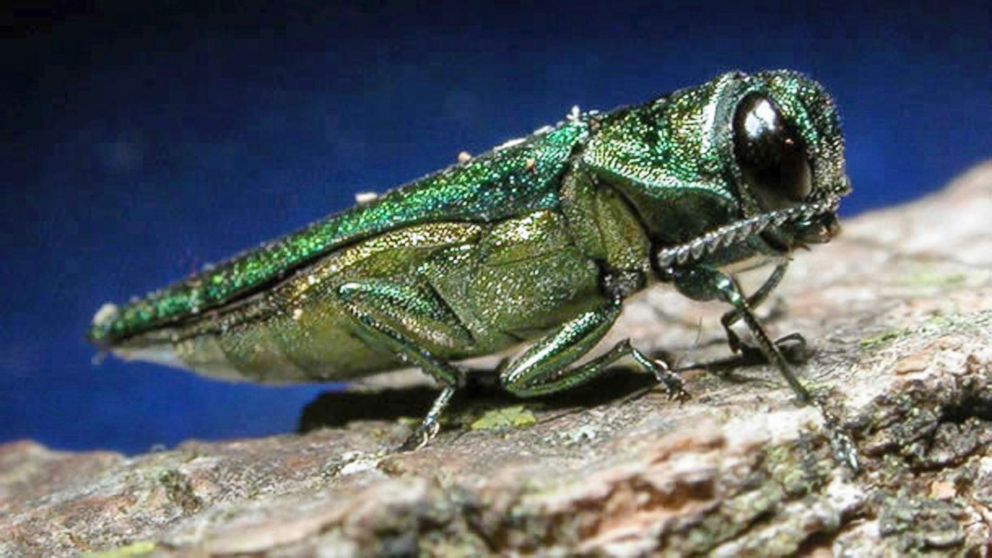
— -- A tiny foreign beetle that has devastated ash trees in forests, urban parks and suburban lawns across North America since arriving here from Asia less than two decades ago will soon face an artificial beetle that will give males more than they wanted when attempting to mate with females.
The small decoy is the same size and color as the real thing, only about a third of an inch long, but as soon as the male lands on its back it will zap him with a 4,000-volt charge to either stun him or kill him.
An international team of scientists and engineers hope the mechanical version of the emerald ash borer will help forestry experts tell which way the giant colonies of beetles are moving so they can alert those in its deadly track in time to save the trees before it's too late.
How the Clever Hummingbird Tortures Scientists
How The Naked Mole Rat Could Help You Live Longer
Why You Don't Smell Like a Dog
Early detection of an infestation is critical because according to the U.S. Forest Service, just a couple of years is all the time it takes to doom an entire forest. And it's very difficult to detect the presence of the bug in that early stage.
The borer has killed tens of millions of trees in 22 (some say 24) states and two Canadian provinces, leaving countless once tree-shaded streets with nothing but dead trees along their sidewalks. Damages run into the billions. And controlling the epidemic will also cost billions.
That's why scientists from several institutions joined an international project led by Thomas C. Baker and Akhlesh Lakhtakia of Pennsylvania State University to see if they could fool male borers to land on a decoy while looking for a suitable mate.
They succeeded, but it wasn't easy. The male, it turns out, clearly knows what it wants.
According to Michael Domingue, postdoctoral fellow in entomology at Penn State, lead author of a study published in the Proceedings of the National Academy of Sciences, building a substitute for the real thing took a lot of hands-on detailed work on the nano-scale level to bring it off.
The replication included features so small that they cannot be seen by the human eye, so the researchers relied on the real thing to replicate the bug. They took the wings of a dead female and used those to make a mold, which was then used to shape the wings, a meticulous process that limits the numbers that can be made, so this is not intended to disrupt the sex lives of billions of bugs.
Instead, it will help experts figure out which way the colony is moving because "we expect adult males to be constantly actively searching for mates" and thus moving into new territory, Domingue said in an email.
"It is for population monitoring rather than direct control," he said.
Since the entire colony is likely to follow the males, understanding the direction they are moving could provide enough time for officials to administer several insecticides ahead of the migration, hopefully saving trees before the bugs take over the forest.
The females tunnel underneath the bark and lay their eggs inside the outer layer of the wood, which the larvae feed upon. That blocks the capillaries that carry nutrients up the trunk, thus starving the canopy and killing the tree.