Trump's pledge to stop 'war games' with South Korea throws critical exercises into question
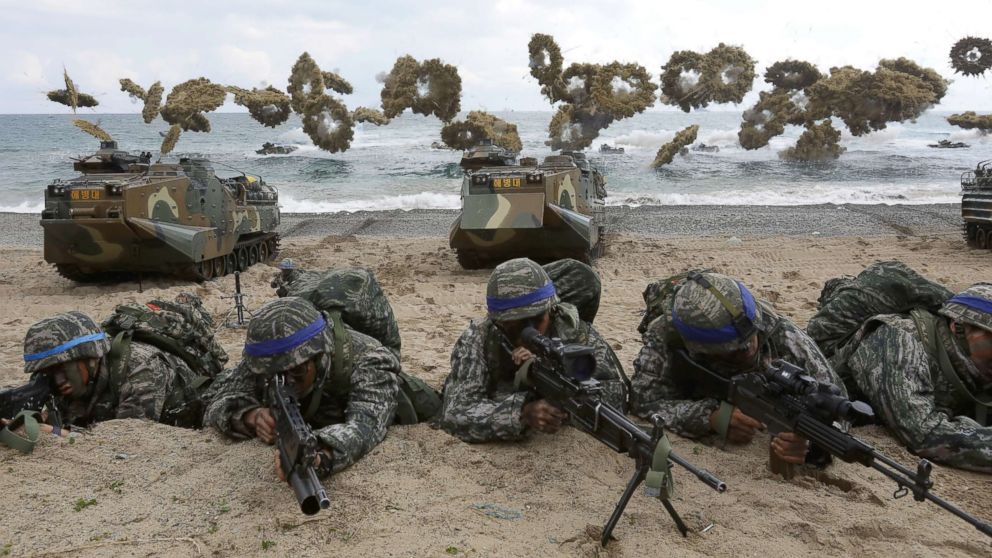
The biggest surprise to emerge from President Donald Trump's summit with North Korea's Kim Jong Un in Singapore was not included in the final agreement: Trump's pledge to stop U.S. military exercises routinely held with South Korea. Trump's pledge has drawn criticism as giving North Korea too much in return for vague promises. It remains unclear what impact Trump's announcement will have on planning for the next big exercise slated to begin in August.
The Pentagon has consistently labeled the annual large-scale exercises as defensive in nature and crucial to maintaining the readiness of both American and South Korean troops to fight back any military aggression from North Korea.
But Trump's announcement raised questions about when the exercises will stop and whether the military forces of both countries will be able to maintain their ability to fight without them.
President Trump cited the high costs of the large-scale exercises as one reason why he was stopping them and surprisingly called them "very provocative," a complaint often made by North Korea.
As reports emerged that the South Korean government was surprised by the announcement to suspend exercises, questions were raised if U.S. policymakers were also caught off guard.
But the Pentagon said Defense Secretary Jim Mattis was consulted beforehand about the president's announcement.
“There were no surprises, they had spoken on all of these issues in advance,” Dana White, the chief Pentagon spokesperson told ABC News.
Meanwhile, the U.S. military command in South Korea said it was proceeding with planning for Ulchi Freedom Guardian, the next major exercise, that will begin in August.
"We have not received any updated guidance about have received no updated guidance on execution or cessation of training exercises - to include Ulchi Freedom Guardian," said Colonel Chad Carroll, a spokesman for U.S. Forces Korea. "In coordination with our ROK partners, we will continue with our current military posture until we receive updated guidance from the Department of Defense (DoD) and/or Indo-Pacific Command (INDOPACOM).”
"We will be stopping the war games, which will save us a tremendous amount of money unless and until we see the future negotiation is not going along like it should," Trump said at a news conference in Singapore. "But we'll be saving a tremendous amount of money, plus, I think it's very provocative."
Pentagon officials could not provide details about the costs of the previous exercises that President Trump had complained about.
The 28,500 American troops permanently stationed in South Korea participate year round in a variety of air, ground and sea exercises with the South Korean military.
The exercises focus on ways that the U.S. and South Korea could repel a North Korean attack at a moment's notice, a commitment reflected in U.S. Forces Korea's motto of "Fight Tonight."
But there are several large-scale exercises that involve larger numbers of troops and conflict scenarios.
The most well-known of the annual exercises is "Foal Eagle" an umbrella term for a variety of smaller exercises held for two months each spring throughout South Korea. Sometimes American forces are sent to South Korea to participate in the exercises.
This year's edition of the exercise was delayed until after the conclusion of the PyeongChang Winter Olympics in South Korea.
Surprisingly in his initial offer to meet with President Trump, Kim Jong Un backtracked on decades of North Korean complaints about Foal Eagle exercises.
Kim "understands that the routine joint military exercises between the Republic of Korea and the United States must continue," South Korean national security adviser Chung Eui-Yong told reporters during his March 8 to Washington when Trump agreed to meet with the North Korean leader.
The exercise kicked off in April, but in a much less public fashion than previous years given the backdrop of the potential for a warming in U.S. and North Korean relations.
Despite the lower profile the U.S. and South Korea continued with planned large-scale exercises including an amphibious landing by U.S. Marines on a beach southwest of Seoul and long-range bomber aircraft stationed in Guam that flew training missions to South Korea.
Sometimes the joint exercises are virtual in nature even though they still involve thousands of troops.
For example, the next big one will be Ulchi Freedom Guardian a largely computer-based exercise that last year involved 17,000 American troops.
Last year's exercise was also held at a time of heightened tensions raised by President Trump's "fire and fury" comments that in turn drew bellicose rhetoric from North Korea.
It remains unclear when an announcement will be made about the future of this year's exercise.
Given the high level of readiness that both the U.S. and South Korean militaries always operate under it's possible the lack of exercises may not have a lasting impact on readiness.
"The President is taking a bit of a risk by halting the U.S.-South Korean military exercises," said Steve Ganyard, an ABC News contributor. "But, these exercises can be turned on very quickly."
But others think it will have a significant impact, including Rep. Adam Smith of Washington, the top Democrat on the House Armed Services Committee, who said it "appears to concede U.S. military readiness in exchange for a vague open-ended denuclearization pledge from North Korea, plus additional talks."
"The exercises that the United States conducts with allies and partners on and around the Korean Peninsula are invaluable tools for maintaining the readiness to respond to potential North Korean aggression," said Smith, who also raised concerns that Trump labeled them provocative and apparently did not consult South Korea's government in advance.
"The Department of Defense welcomes the positive news coming out of the summit and fully supports the ongoing, diplomatically-led efforts with the Democratic People's Republic of Korea," said White, the Pentagon spokesperson, in a statement.
"Our alliances remain ironclad, and ensure peace and stability in the region," she added. The Presidential summit outcome is the first step along the path to the goal: complete, verifiable and irreversible denuclearization of the Korean Peninsula and a free and open Indo-Pacific."