University presidents reflect on academic freedom amid Trump’s push to reshape higher education
The Trump administration has expanded its review of colleges and universities across the country this year, threatening to withhold critical funding from some institutions if they do not comply with administration's policies.
Many universities rely on federal funding for a sizable portion of their research funding. According to Neeli Bendapudi, the president of Penn State University, it is "important" that the federal government "continue that tradition of investing in our higher education system because it's a huge competitive advantage."
She, along with several university presidents, recently spoke with ABC News' Linsey Davis in a wide-ranging discussion on the future of higher ed for ABC News' "All Access with Linsey Davis.
Bendapudi said that if Penn State had received the administration's "Compact for Academic Excellence" memo, which offers preferential access to federal funding for higher education institutions, the university would have rejected it.
"It's very important for universities to have the academic freedom to discuss," she said. "It's hard to imagine an institution of higher education where you're not confronted by ideas and experiences that are not just echo chambers of your own. That is part and parcel of what it means to get a degree, right? So it's very critical for us. Whoever you are, when you come in, we embrace you, you're part of the culture of Penn State and we want you to succeed."
In March, the Department of Education’s office for civil rights launched dozens of investigations into private and public higher education institutions, accusing the institutions of "allegedly awarding impermissible race-based scholarships and one university for allegedly administering a program that segregates students on the basis of race."
Amid the investigation, a hold on federal funding put millions of dollars for critical research efforts at risk and threatened the progress of scientific innovation at various institutions.
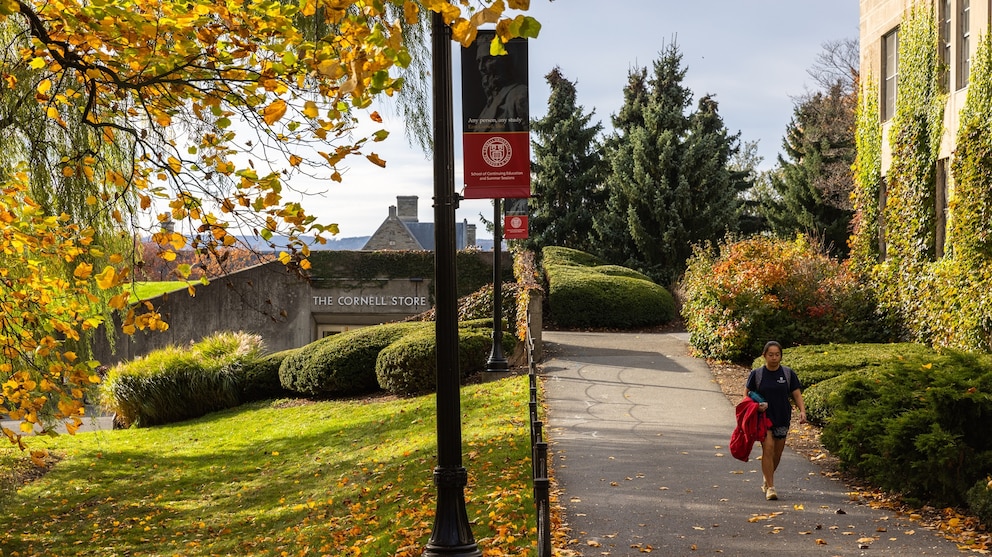
Cornell University in Ithaca, New York, was among those higher education institutions that were investigated by the Trump administration over the past year.
Cornell's president, Michael Kotlikoff, announced on Nov. 7 that the university had reached a $60 million agreement with the government that would restore more than $250 million in funding for research grants. Cornell was fined $30 million and agreed to invest an additional $30 million for research to support America’s farmers, according to the U.S. Department of Justice. The federal investigation into the university has since been closed.
Kotlikoff reflected on the agreement during the conversation on "All Access," saying Cornell had multiple "complaints" lodged against the university through the DOJ’s office of civil rights.
"When we started out this discussion with the federal government, we had two goals. One was to restore our relationship with the federal government and restore our funding. And the second was to do it in a way in which we did not compromise our principles," Kotlikoff said. “We did not have the government dictate our policies or our procedures. And I think we achieved both of those goals, but as part of that, we did agree for the government to end these suits at Cornell, which would have cost us in excess of 30 million to fight, [and] it was costing many careers while our grants were suspended."
According to the memo, which was reviewed by ABC News, the administration demanded that universities ban the use of race, sex, religion in hiring and admissions; freeze tuition rates for five years; cap the undergraduate enrollment of foreign students; require that applicants take the SAT or a similar admission test as well as change governance structures in the universities that punish conservative ideas.
A White House official confirmed to ABC News in October that letters were sent to nine universities to get feedback about the memo and try to secure agreements. Since then, the offer was extended to other higher education institutions – none of which have agreed to the compact so far.
The University of Arizona in Tucson was one of the nine institutions that received the memo on Oct. 1. In a statement, university president Suresh Garimella said he had "not agreed" to the so-called "compact."
Garimella said that some proposed federal recommendations "deserve thoughtful consideration" and some are "already in place at the U of A," but he added that "principles like academic freedom, merit-based research funding, and institutional independence are foundational and must be preserved."
"As a result, the university has not agreed to the terms outlined in the draft proposal," Garimella said, indicating that the university submitted a statement of principles to the U.S Department of Education.
Garmella reflected on the university’s decision to reject the compact during the conversation with other presidents on "All Access."
"The University of Arizona, I believe, demonstrated a serious and a transparent and a constructive approach to this national policy discussion," Garimella said, adding that the university's "comprehensive" response to the draft proposal "reflected our commitment to academic excellence, to accountability, to meaningful engagement."
ABC News' Arthur Jones II and Hannah Demissie contributed to this report.