Defense Secretary James Mattis Visits South Korea and Japan in 1st Overseas Trip
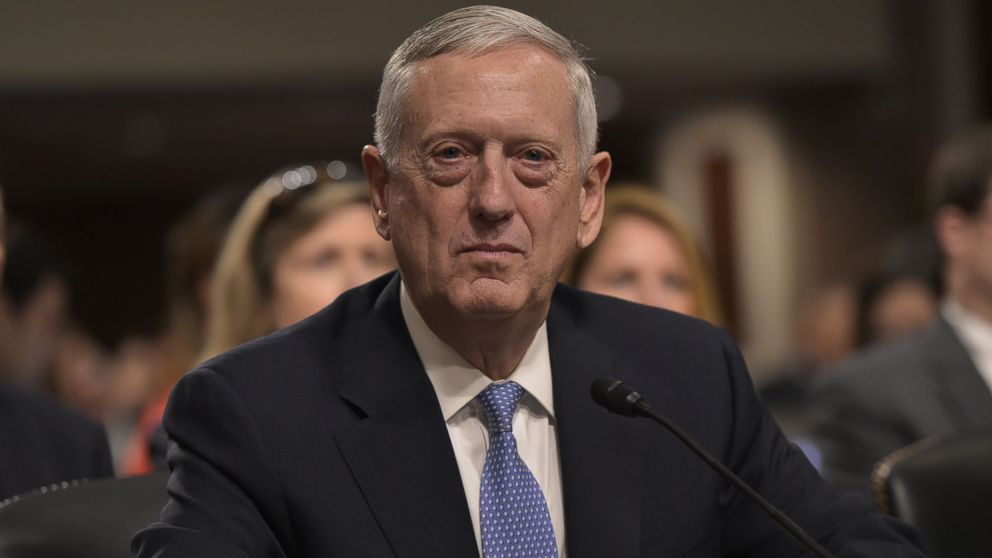
— -- New Defense Secretary James Mattis is set to arrive later today in South Korea as he begins his first overseas trip that will also take him to Japan, highlighting the Pacific region's importance to U.S. security interests.
"The trip will underscore the commitment of the United States to our enduring alliances with Japan and the Republic of Korea, and further strengthen U.S.-Japan-Republic of Korea security cooperation," Capt. Jeff Davis, a Pentagon spokesman, said last week when the trip was announced.
Mattis' visit is intended to reassure U.S. allies in the region that it will maintain its security commitments, especially at a time when North Korea has grown increasingly provocative in the development of its ballistic missile and nuclear weapons programs.
President Trump's withdrawal from the Trans-Pacific Partnership (TPP) trade agreement has unsettled some of America's allies in the region.
Tensions have also been heightened in the South China Sea, where China's territorial claims and its construction on disputed islands have raised alarms in neighboring countries.
ABC News takes a look at some of the security issues in the region.
North Korean Provocations
Mattis' first overseas stop will be in South Korea, where the United States has 28,500 troops to deter North Korean aggression.
North Korean leader Kim Jong-un announced earlier this month that his military would soon begin preparations to conduct a test of an Intercontinental Ballistic Missile (ICBM) that could potentially reach the mainland United States. U.S. officials have said that no test appears imminent, but the announcement culminated a year's worth of provocative behavior by North Korea that included two nuclear test explosions and a slew of long-range missile launches.
Some of the missile tests were spectacular failures, but the pace of the testing raised concerns that North Korea was determined to make fast advancements.
North Korea's goal is to develop a nuclear weapon small enough to be placed atop a long-range missile. Late last year, a senior U.S. military official said it appeared that North Korea has still not mastered the re-entry technology that would make an ICBM with a miniaturized warhead a viable threat.
To address South Korean concerns, the United States will soon deploy a missile intercept system, known as Terminal High Altitude Air Defense (THAAD), which would protect Seoul and other parts of South Korea from a missile attack. The United States has maintained that the system is defensive, but China opposes it out of concerns it is designed to contain its missile programs.
South China Sea
Over the past few years, China has built up man-made islands around seven reefs in the Spratly Island chain in the South China Sea that it claims are Chinese territory. To bolster its long-term claims, the artificial islands have been equipped with ports, runways and radar facilities. Despite assertions that it does not intend to militarize the islands, commercial satellite images released late last year indicated that large anti-aircraft guns and weapons systems had been installed on the islands.
The United States did not take sides in South China Sea territorial disputes under the Obama administration. But to ensure the right of passage through what it considers international waters and airspace, U.S. Navy warships have transited within the 12 nautical mile limits of some of the disputed islands in what are called "freedom of navigation operations."
China reacted negatively to comments this week from White House press secretary Sean Spicer, who said that if the disputed islands are in international waters "and not part of China proper, then yes, we're gonna make sure that we defend international territories from being taken over by one country."
A Chinese Foreign Ministry spokesperson responded that the United States was not a party to the South China Sea issue and said: "Our position is clear. Our actions have been lawful."
Trans-Pacific Partnership
Earlier this week, President Trump kept a campaign promise and withdrew the United States from the Trans Pacific Partnership (TPP) trade agreement. Trump had said leading up to the election that it was not beneficial to American workers.
Prospects for U.S. participation in the agreement were already in doubt under the Obama administration because it did not have the votes in the Senate needed to win approval.
News of America's withdrawal from the TPP drew concern from partners in the region who had seen the trade pact as a check on China's economic and geopolitical influence.
Without U.S. participation in the deal, China is free to work its own trade pacts or push an alternative regional treaty that does not include the United States.
The Obama administration emphasized the pivot to Asia as a key feature of future American security concerns. The Trump administration is expected to continue to focus on security in the region.