• Video
  • Shop
  • Culture
  • Family
  • Wellness
  • Food
  • Living
  • Style
  • Travel
  • News
  • Book Club
  • Newsletter
  • Privacy Policy
  • Your US State Privacy Rights
  • Children's Online Privacy Policy
  • Interest-Based Ads
  • Terms of Use
  • Do Not Sell My Info
  • Contact Us
  • © 2026 ABC News
  • News

Sea Snail's Weird Hunting Method Sheds New Light on Insulin
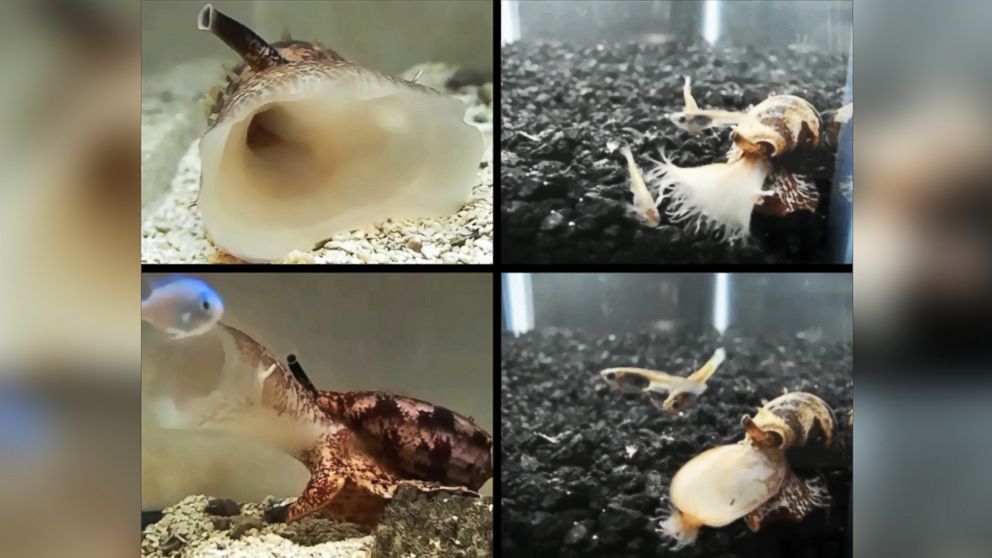
The images show two species of cone snail, Conus geographus (left) and Conus tulipa (right) attempting to capture their fish prey. As the snails approach, they release a specialized insulin into the water, along with neurotoxins that inhibit sensory circuits, resulting in hypoglycemic, sensory-deprived fish that are easier to engulf with their large, distensible false mouths. Once engulfed, powerful paralytic toxins are injected by the snail into each fish.
Courtesy Jason Biggs and Baldomero Olivera
ByALYSSA NEWCOMB
January 20, 2015, 8:27 PM

— -- The questionably cute but slimy sea snail has a secret weapon for capturing its prey, scientists have discovered.

The cone snails have a have a high level of insulin in their venom that allow them to render small schools of fish sluggish by either shooting the potent venom into the water or via a harpoon-like sting.

Related Articles

Space Pictures from Far Reaches of Universe

Related Articles

NASA Shares Incredible Photo of First Big Solar Flare of 2015

Related Articles

NASA Probe Gets Up Close and Personal With Dwarf Planet Ceres

Next, the sluggish snails can then catch up to their prey and feast, according to a study from researchers at the University of Utah that was published in the Proceedings of the National Academy of Sciences.

Scientists tested a synthetic version of the insulin on zebrafish and found that it caused blood glucose levels to fall and created a noticeable change in the swimming behavior of the fish.

"This is a unique type of insulin. It is shorter than any insulin that has been described in any animal," Baldomero Olivera, a biology professor and an author of the study, said in a statement. "We found it in the venom in large amounts."

The insulin has just 43 amino acid building blocks, making it shorter than any other known insulin, researchers said, noting that when the insulin mixes with venom, it creates a cocktail that is able to quickly slow down schools of fish and put them in hypoglycemic shock.

Aside from the ick and cool factors of the discovery, researchers said it could also be used to help them better understand how energy is metabolized in humans.


Up Next in News—

What to know about 'Lulu's Law' requiring emergency shark attack notifications

May 21, 2026

Father, daughter speak after Lyft driver is accused of using AI-generated image for damage claim

May 20, 2026

Police officer speaks out after rescuing choking toddler in incident caught on camera

May 20, 2026

Google DeepMind CEO says AI could unlock breakthroughs in medicine, energy and more

May 20, 2026

Shop GMA Favorites

ABC will receive a commission for purchases made through these links.

Sponsored Content by Taboola

The latest lifestyle and entertainment news and inspiration for how to live your best life - all from Good Morning America.
  • Contests
  • Terms of Use
  • Privacy Policy
  • Do Not Sell My Info
  • Children’s Online Privacy Policy
  • Advertise with us
  • Your US State Privacy Rights
  • Interest-Based Ads
  • About Nielsen Measurement
  • Press
  • Feedback
  • Shop FAQs
  • ABC News
  • ABC
  • All Videos
  • All Topics
  • Sitemap

© 2026 ABC News
  • Privacy Policy— 
  • Your US State Privacy Rights— 
  • Children's Online Privacy Policy— 
  • Interest-Based Ads— 
  • Terms of Use— 
  • Do Not Sell My Info— 
  • Contact Us— 

© 2026 ABC News