Older Men Need to Take Closer Look for Melanomas
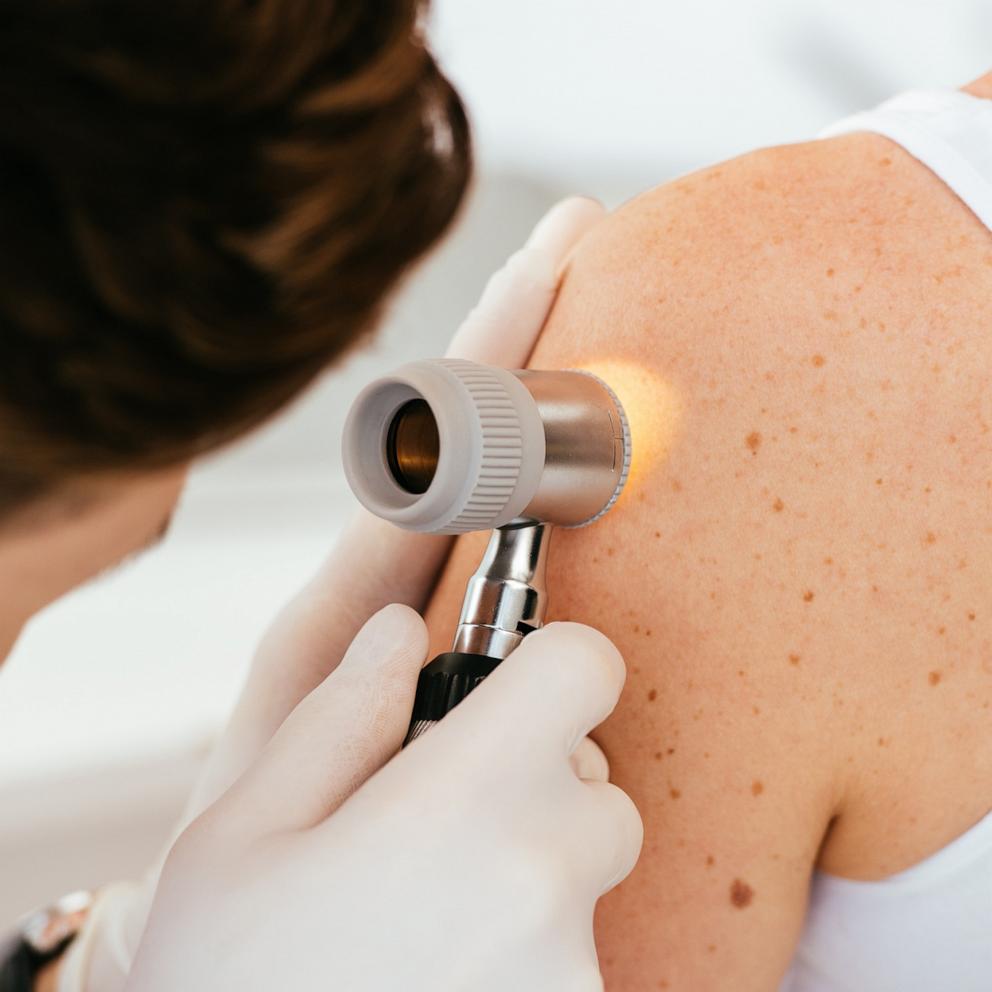
April 21 -- MONDAY, April 20 (HealthDay News) -- A new study delivers a lifesaving message to older men about the potentially deadly skin cancer known as melanoma: If you can't examine your own back, have a loved one take a look, and if there's something suspicious, see a doctor.
"We were trying to understand why it is that when a doctor finds a melanoma, it usually is thinner compared to a person finding it by himself," said Alan C. Geller, a senior research scientist at the Harvard School of Public Health, and a co-author of one of two reports on melanoma in older men that appears in the April issue of the Archives of Dermatology.
Detecting a melanoma early, while it is thin, is an essential first step in surviving the skin cancer, said Dr. June K. Robinson, editor of the journal and a professor of clinical dermatology at the Northwestern University Feinberg School of Medicine, who wrote an accompanying editorial.
"The numbers are startling," she said. "If it is diagnosed at an early stage, the chance of survival is 90 percent. At a later stage, it is 20 percent."
There will be more than 62,000 cases of melanoma diagnosed in the United States this year, the U.S. National Cancer Institute estimates, and 8,420 Americans will die of the cancer. Half of those deaths will be in white men over the age of 50.
So, a group led by Dr. Susan M. Swetter of Stanford University interviewed 227 men aged 40 and older within three months after they had been diagnosed with melanoma. A quarter of them had tumors more that two millimeters thick -- about a third of the thickness of a pencil eraser, but enough to mark a dangerous borderline for effective treatment.
Analysis of the data by a group led by Geller found that men whose melanomas were detected by physicians tended to be older, and that 46 percent of the physician-detected melanomas were on the back.
"The back is the place that should be examined by a doctor and by the person himself," Geller said. "We found that one of the major reasons for doctors finding thinner melanomas was that they were more carefully examining the back. If you do it yourself and see something unusual, go to a doctor and say, 'Give me a referral to a dermatologist.' "