Booster coverage is lowest among Black and Hispanic Americans: CDC

Fewer Black and Hispanic Americans have gotten a first or second COVID-19 vaccine booster compared to people of other races and ethnicities, new federal data finds.
The report, published by the Centers for Disease Control and Prevention Thursday, looked at the share of eligible Americans aged 5 and older who've received a primary booster and those aged 50 and older who've received a second booster.
As of Aug. 5, 2022, about half of the eligible U.S. population has received a first booster and one-third has gotten a second booster.
Among eligible Black Americans, 42.9% have received a first booster dose and 28.1% have received a second booster. Hispanic Americans had even lower percentages at 37.3% of those eligible with a first booster and 24.4% with a second booster.
By comparison, white and Asian Americans had much higher percentages. Data showed 54.7% of eligible white people had a first booster and 36.6% of those eligible had a second booster.
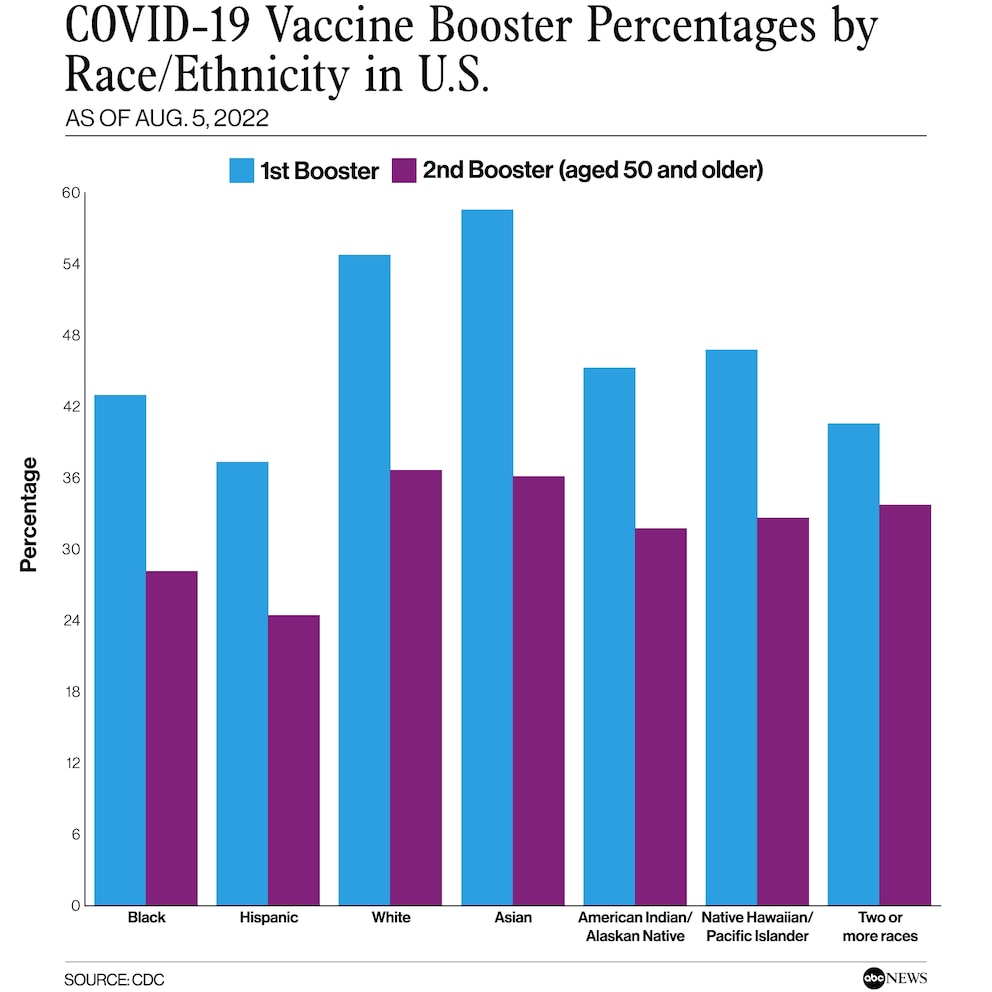
Meanwhile, 58.5% of eligible Asian Americans had a first booster and 36.1% were given a second booster.
Also found in the CDC report to have lower booster coverage were younger Americans, regardless of race or ethnicity.
However, when looking at the racial and ethnic breakdown of boosters among children between ages 5 and 11, 9.8% of eligible Black children and 10.4% of Hispanic children had received a booster.
About twice as many eligible white and Asian children were boosted, at 17.7% and 20.6%, respectively.
"This is once again an indication that this pandemic has exposed incredible disparities, first in access to testing, treatment and vaccines," said Dr. John Brownstein, an epidemiologist at Boston Children's Hospital and an ABC News contributor. "Now, certain populations are not getting access to important, life-saving boosters."
Brownstein said one reason for the low percentages, especially with the second booster, may be because of the innovative methods used to vaccinate people earlier in the pandemic that have since disappeared.
"There was a huge drive to get people that primary series and meeting people where they were with pop-up sites and drive-through vaccination, and much of that infrastructure has gone away," he said. "We're now relying on more traditional measures, like pharmacies and primary care."
Research has shown people of color are more likely to live in pharmacy deserts with less geographic access to primary care physicians.
"They may mean some populations get left behind and unfortunately, that often means minorities," Brownstein added.
The authors wrote understanding what is contributing to lower booster coverage and addressing interventions "is crucial to ensuring equitable access to COVID-19 vaccination."
Brownstein said increasing uptake is even more vital as autumn approaches with colder weather and more people heading indoors increasing the risk of COVID-19 infection.
"There is urgency to try to figure this out ahead of a surge," he said. "We expect emergence of a new variant and as we see limited masking and full mobility, that increases the risk."
"Some minority populations will feel the impact the greatest. We have a new opportunity with a new booster to avoid getting to a point with unnecessary hospitalizations and deaths among Black and Hispanic Americans," Brownstein continued.