Deaf Toddler Hears For First Time With Device Implanted in Brainstem
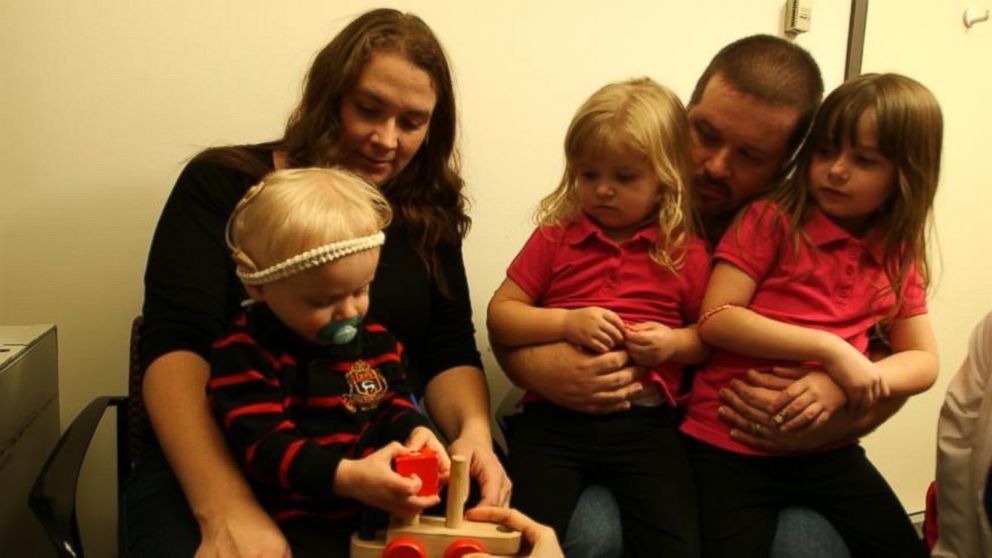
March 5, 2014— -- At a hospital in Boston, sound registered in Alex Frederick's brain for the first time.
Alex, just 17 months old at the time, is deaf, but a device, not yet approved in the United States for children, is helping to change that. It was implanted directly into his brain.
Alex was born two months prematurely, weighing just four pounds and four ounces at birth. He spent the first month of his life in the neonatal intensive care unit of St. John Hospital in Detroit. His early arrival brought him into the world facing a host of challenges. Scans would show that Alex had a heart condition, while his vision appeared to be compromised. And then there was the matter of his hearing. Alex failed the hearing test given to all newborns. Then he failed a second hearing test two months later.
"That was a blow," said Alex's father Phil Frederick. "The most difficult part for me was that first time… he failed his first hearing test, because I really thought, 'this is going to go fine.' … that was the most, for me personally, most heart-wrenching point."
Alex has two older sisters, Evelyn, 6, and Izabella, 3. Phil was watching one day as Evelyn played with her brother.
"She wanted to get a response from him and something she was doing with a toy… and I was like, 'Well, Evelyn, he can't hear… he might not see what you are trying to hand him,'" Phil said. "She just said, 'no, I don't want that for him'… 'how's he ever going to play with us' or 'how's he ever going to play with anyone?'"
When Alex was 1 year old, his parents tried for a cochlear implant, a 40-year-old technology that uses electrodes to stimulate auditory nerves. The surgery commenced, but was halted in mid-operation when it became evident it would not work due to the irregular structure of the toddler's inner ear. The scar from that failure is still evident behind his right ear.
Through all this, life for Alex went on as a constant round of visits to specialists to undergo more tests for his heart, and then begin sign language classes, as it started to sink in for his parents what all this meant.
"There's things that were going to happen in his life that… I wouldn't know how to help him through those situations where he needed help," Phil said.
Phil kept looking for an answer, for some other technology that would help his son hear. In the course this research, he learned about an approach for children that had been pioneered in Italy by Dr. Vittorio Colletti, and it was about to undergo a series of clinical trials in the U.S. to win FDA approval.
It's called an Auditory Brainstem Implant (ABI), a small antenna that is implanted on the brainstem so that it can pick up signals from a tiny microphone worn on the ear and relay them back inside as electrical signals that reach the area of the brain associated with interpreting sound.
Dr. Colletti had some successful outcomes with his ABI surgeries, including a young woman, previously deaf, who can now carry on phone conversations without issue, but it took her years after the ABI was implanted to be able to get to that point. Another one of Colletti's patients was a boy named Andrea, whose case demonstrated that for children who have never had the ability to hear, it takes years to learn what hearing means. But years after having the surgery, Andrea learned to play the guitar.