Kelly Stafford reveals 'new norm' after successful 12-hour surgery to remove brain tumor
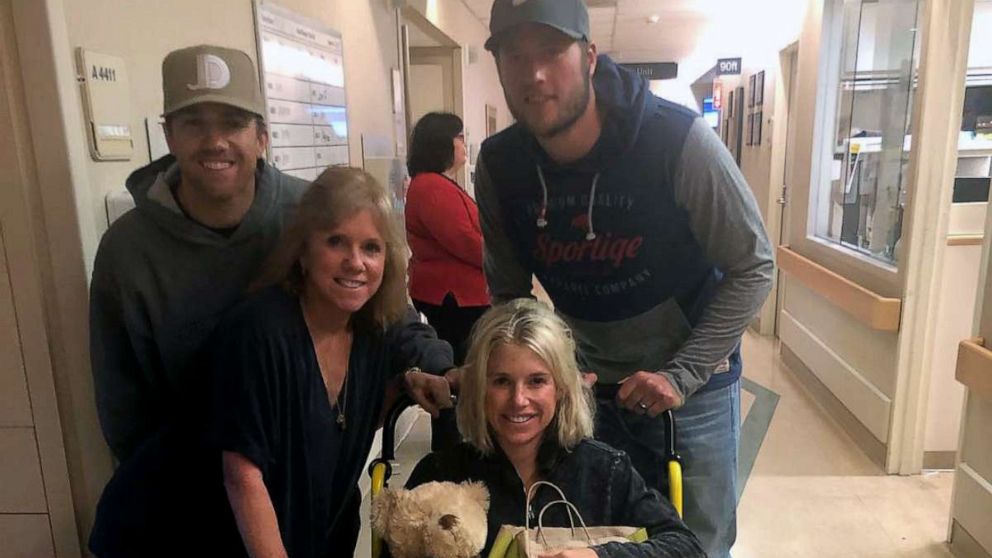

Kelly Stafford, wife of Detroit Lions quarterback Matt Stafford, successfully underwent a 12-hour surgery to remove an acoustic neuroma from her cranial nerves.
She took to Instagram Easter Sunday while recovering at home to thank everyone for their prayers and shared more details about the medical experience.
"This Easter is the beginning of a new life for me. I wanna take a second to thank all of you for all the prayers. They have worked. I know they have," she wrote. "When they opened me up, I had an abnormal vein ... maybe abnormal for other neurosurgeons, but not the one we chose. He had seen it before and written a paper on it. That's truly God's work."
She continued, "A six hour surgery went to 12 hours and although they were anxious and scared, your prayers got them through. Thank you. Thank you so much."
"Now I am home and learning my new norm. It'll take some time, but I really just wanted to say thank you," she added. "Thank you for all your support, thoughts and prayers. It means more than y'all will ever know. #cupscrew"
Earlier this month ahead of the surgery, the 29-year-old shared a photo alongside her husband followed by an MRI image of her head from the day she received her diagnosis.
She said within the last year she began to notice dizziness and "feeling off balance" and found "things that I had been doing my entire life were now, all of a sudden, difficult."
The mother of three said she experienced her "first spell of vertigo" in January that then persisted, landing her in the emergency room.
"Several vertigo spells later, Matthew's team doctor recommended we go get an MRI of my brain to rule everything major out. A few days later we were hit with the results. I had a tumor sitting on some of my cranial nerves. The medical term they used was an acoustic neuroma or vestibular schwannoma," she shared, followed by details of their plan to have it removed and ask for prayers.
Stafford said she was "terrified" to have doctors open her head with the possibility of loss of hearing or facial function.
Prior to her diagnosis, Stafford seemed to be the picture of health, with videos in her feed of herself boxing and working out regularly.
"The Detroit Lions fully support Kelly, Matthew and the entire Stafford family during this difficult time. Over the years, their selfless commitment to helping others and improving the communities in which we live and work has made a lasting impact on the lives of so many," her husband's team said in a statement.

"We thank everyone for the outpouring of support. On behalf of the Stafford family, we ask that everyone respect the privacy of the situation at this time," the team added.
More about this condition
What are acoustic neuromas?
"It's rare in general, even more rare in such a young person," ABC News' chief medical correspondent Dr. Jennifer Ashton explained. "This is a benign brain tumor that starts in the cells that surround the nerves and occurs in one in every 100,000 people."
Stafford was "outside the [age] range" for people most commonly diagnosed, which is 50.
What are the symptoms?
Symptoms include one-sided hearing loss, ringing in the ear, and vertigo, dizziness and balance problems.
Dr. Ashton added, "We have to remind ourselves that just because you may have these symptoms doesn't necessarily mean you have an acoustic neuroma."
What is recovery like?
When talking about neurosurgery, or surgery on the brain, Ashton said, "The most important thing is swelling and preserving the nerves, blood vessels and tissue around where the surgery is going."
She added Stafford has a "long road, but every reason to be optimistic."
And on the broader positive side, Ashton said, Stafford speaking out raises "awareness about something that's rare and the underlying message of hope, which is the foundation of medicine."
"Sometimes, brain tumors can be successfully treated," she said.