• Video
  • Shop
  • Culture
  • Family
  • Wellness
  • Food
  • Living
  • Style
  • Travel
  • News
  • Book Club
  • Newsletter
  • Privacy Policy
  • Your US State Privacy Rights
  • Children's Online Privacy Policy
  • Interest-Based Ads
  • Terms of Use
  • Do Not Sell My Info
  • Contact Us
  • © 2026 ABC News
  • Wellness

NASA is enlisting elephant seals to help them study climate science
6:27
News headlines today: Dec. 23, 2020
Sorbonne University/Etienne Pauthenet via NASA
ByErin Schumaker
December 06, 2019, 10:44 PM

NASA scientists have playful helpers for studying the earth's climate: elephant seals wearing hat-like antenna.

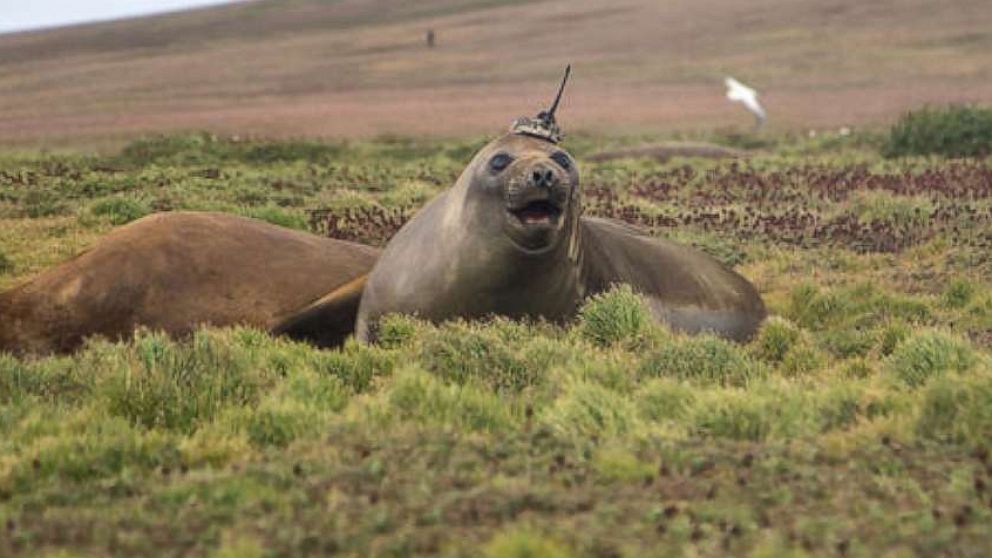
The antennae have sensors that take in information about the ocean's temperature and currents as the seals dive. While scientists have been tagging seals for decades to study their behavior, using them to study climate is a newer phenomenon.

Related Articles

(MORE: Why climate change is also a public health problem)

Seals spend roughly nine months of the year at sea, swimming thousands of miles and diving upward of 80 times per day, sometimes to depths of 3,300 feet. They surface for air, but can stay underwater for up to two hours at a time. Seals can also swim under the Antarctic sea ice, meaning they can accesses places that technical equipment can't reach, according to NASA.

The tags, which are attached with glue, fall off during molting season if scientists fail to collect one when retrieving the data.

PHOTO: An undated photo shows a tagged elephant seal basks on Kerguelen Island, a French territory in the Antarctic.
An undated photo shows a tagged elephant seal basks on Kerguelen Island, a French territory in the Antarctic. Elephant seals are tagged as part of a French research program called SO-MEMO (Observing System - Mammals as Samplers of the Ocean Environment), operated by the French National Center for Scientific Research (CNRS).
Sorbonne University/Etienne Pauthenet via NASA

Lia Siegelman, a visiting scientist at NASA's Jet Propulsion Laboratory in Pasadena, California, has been using data from a tagged female seal for a paper she published this week in the journal Nature Geoscience.

"Southern elephant seals may look sluggish on land, but in the water they're endurance athletes," Siegelman told ABC News. "With all this diving, a tagged elephant seal collects data from the entire top layer of the Southern Ocean."

The data the seals collect will help scientists to better understand how the oceans store heat, which could be crucial as our climate warms.

Related Articles

(MORE: Spacewalking astronauts perform complex repairs on $2 billion cosmic ray detector)

"Most current modeling studies indicate that the heat would move from the surface to the ocean interior in these cases, but with the new observational data provided by the seal, we found that that's not the case," Siegelman said in a statement.

"This could be an important implication for our climate and the ocean's role in offsetting the effects of global warming by absorbing most of the heat," she added.


Up Next in Wellness—

Katie Couric reveals transient global amnesia diagnosis: What to know

July 9, 2026

Nearly half of ovarian cancer cases are diagnosed in ER, missing critical treatment window, study finds

July 8, 2026

Amid heat wave, doctors warn of health risks for people taking GLP-1 drugs

July 7, 2026

Extreme heat during pregnancy: What to know to stay safe

July 1, 2026

Shop GMA Favorites

ABC will receive a commission for purchases made through these links.

Sponsored Content by Taboola

The latest lifestyle and entertainment news and inspiration for how to live your best life - all from Good Morning America.
  • Contests
  • Terms of Use
  • Privacy Policy
  • Do Not Sell My Info
  • Children’s Online Privacy Policy
  • Advertise with us
  • Your US State Privacy Rights
  • Interest-Based Ads
  • About Nielsen Measurement
  • Press
  • Feedback
  • Shop FAQs
  • ABC News
  • ABC
  • All Videos
  • All Topics
  • Sitemap

© 2026 ABC News
  • Privacy Policy— 
  • Your US State Privacy Rights— 
  • Children's Online Privacy Policy— 
  • Interest-Based Ads— 
  • Terms of Use— 
  • Do Not Sell My Info— 
  • Contact Us— 

© 2026 ABC News