WHO switches to Greek naming system for coronavirus variants
Pop quiz: In which country was the B.1.617.2 coronavirus variant first detected? If the answer (India), wasn't on the tip of your tongue, the World Health Organization is here to help.
On Monday, the WHO announced that it had a new naming system for SARS-CoV-2 "variants of concern" and "variants of interest," meaning versions of the virus with important mutations that are being carefully tracked by scientists. Moving forward, every virus variant will have a name based on the Greek alphabet, such as "Alpha," "Beta" or "Gamma," in an effort to help the public talk about the variants more easily without reverting to identifying them by the countries in which they were first identified.
The new names don't replace the existing scientific number-and-letter combinations, which will still be used in research, but the change should make it simpler for non-scientists to talk accurately and sensitively about variants.
"While they have their advantages, these scientific names can be difficult to say and recall, and are prone to misreporting," the WHO said in a statement Monday. "As a result, people often resort to calling variants by the places where they are detected, which is stigmatizing and discriminatory. To avoid this and to simplify public communications, WHO encourages national authorities, media outlets and others to adopt these new labels."
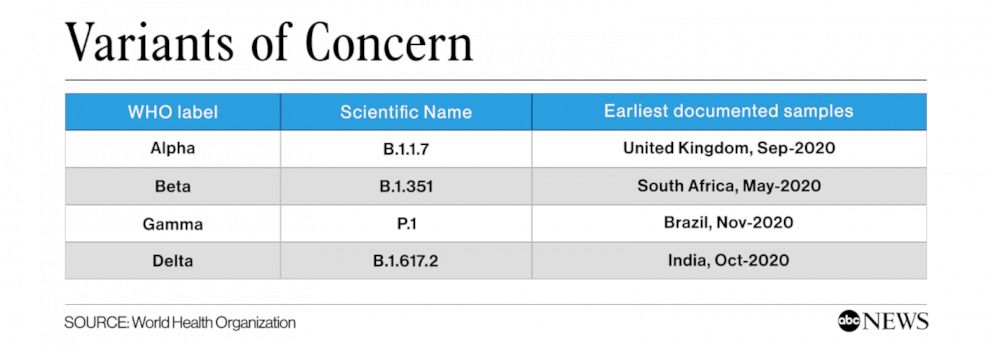
Under the new system, the B.1.1.7 variant, first identified in the United Kingdom, will be known as "Alpha," the B.1.351 variant first detected in South Africa will be "Beta," the P.1 variant found in Brazil will be "Gamma" and the B.1.617.2 variant currently associated with India will be "Delta."
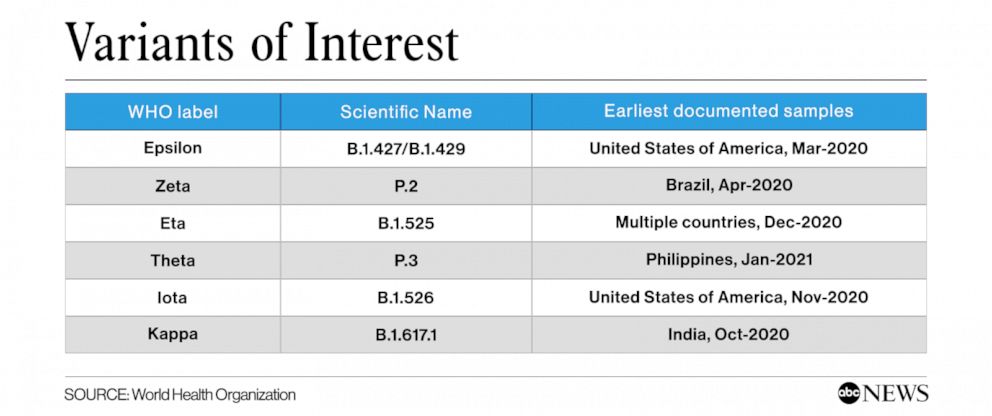
Variants of interest, a lower classification than variants of concern, will follow the same Greek alphabet naming convention.
In addition to simplifying scientific language for laypeople, moving away from place-specific language avoids placing blame on a country for first detecting a variant there or stigmatizing a group of people by associating them with an infectious disease, an old practice used in naming diseases such as in the Spanish flu and Middle East respiratory syndrome, which public health experts now discourage.
"No country should be stigmatized for detecting and reporting variants," Maria Van Kerkhove, the World Health Organization's COVID-19 technical lead, wrote on Twitter.
It's not just a rhetorical matter. According to a research article published in the American Journal of Public Health, which analyzed 1.2 million hashtags on Twitter during the course of the pandemic, 1 in 5 tweets that were tagged with #covid19 were anti-Asian, compared with half of tweets tagged with #chinesevirus.
"Everyone -- scientists, community members and politicians -- should use neutral, nonjudgmental language to avoid stigmatizing communities and perpetuating discrimination," the authors concluded. "Our analyses are consistent with recommendations to use neutral terminology."