• Video
  • Shop
  • Culture
  • Family
  • Wellness
  • Food
  • Living
  • Style
  • Travel
  • News
  • Book Club
  • Newsletter
  • Privacy Policy
  • Your US State Privacy Rights
  • Children's Online Privacy Policy
  • Interest-Based Ads
  • Terms of Use
  • Do Not Sell My Info
  • Contact Us
  • © 2026 ABC News
ABC News

Election 2024 updates: With Arizona, Trump sweeps all 7 swing states

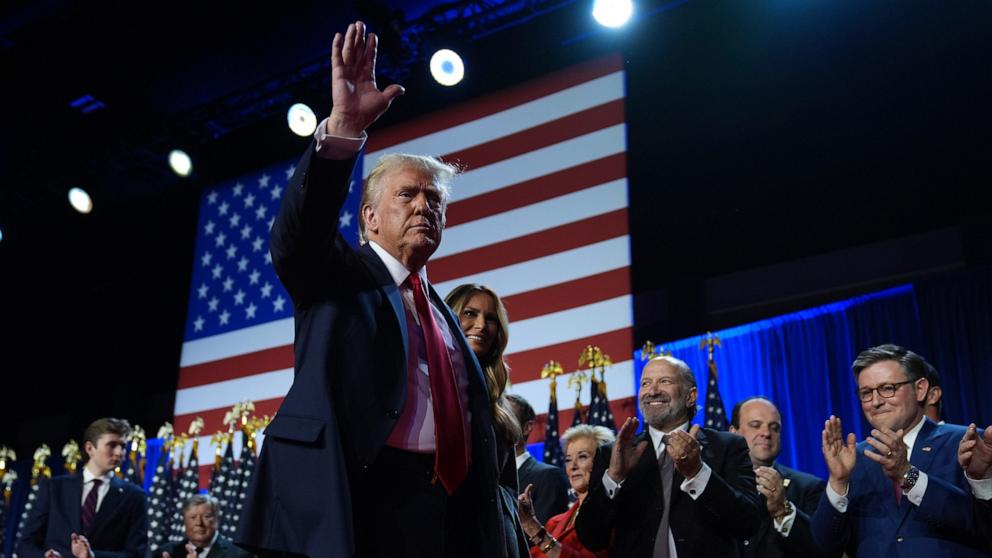
PHOTO: Republican presidential nominee former President Donald Trump and former first lady Melania Trump depart the stage at an election night watch party, Nov. 6, 2024, in West Palm Beach, Fla.
3:04
Evan Vucci/AP
Elon Musk joins Trump’s calls with world leaders
By 538 and ABC News
Last Updated: November 5, 2024, 8:44 PM

Just days after former President Donald Trump was projected to have won the presidency, Trump's transition team operation has begun, with transition co-chairs confirming that he will be selecting personnel to serve under his leadership in the coming days.

Trump is also the projected winner in Arizona, a state the former president flipped after losing it to Joe Biden in 2020.

Trump's projected win in the vital swing state marks a sweep of the battleground states.

Key Headlines

  • With Arizona, Trump sweeps all 7 swing states
  • Steve Witkoff and Kelly Loeffler to lead Trump's inaugural efforts
  • Trump to meet with Biden Wednesday
  • Maryland election boards receive bomb threats as ballots are counted
  • Steve Witkoff and Kelly Loeffler expected to lead Trump's inaugural efforts
  • Trump projected winner in Nevada
  • Trump announces chief of staff
Here's how the news is developing.

Nov 05, 2024 8:44 PM
By G. Elliott Morris

Trump and Harris are both a normal polling error away from a blowout

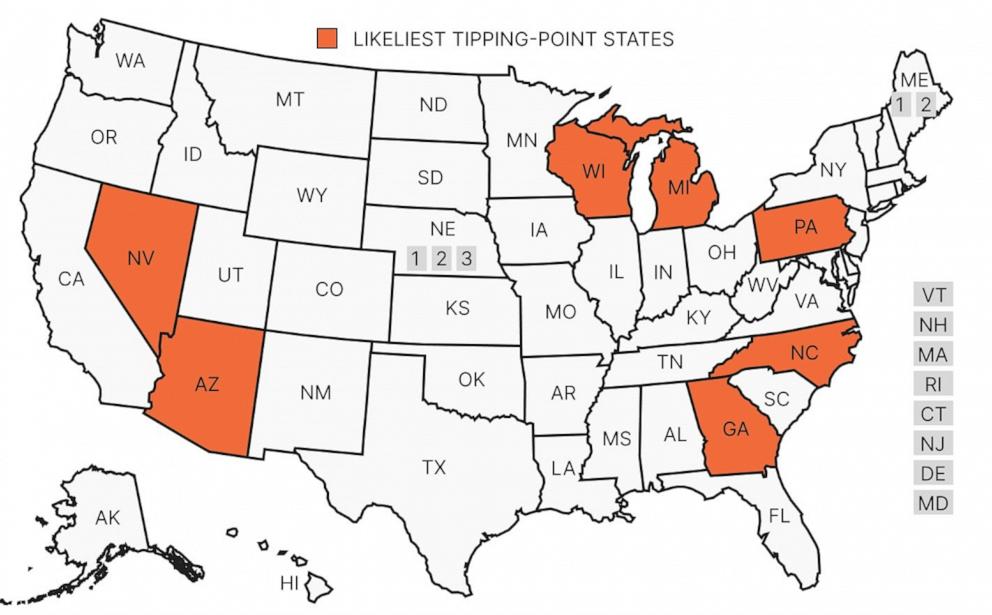
In 2020, polls overestimated Joe Biden's margin over then-president Donald Trump by about 4 percentage points in competitive states. The margin between Harris and Trump in 538's final polling averages of the 2024 race is 2 points or less — less than half the error from 2020 — in seven states: the familiar septet of Arizona, Georgia, Michigan, Nevada, North Carolina, Pennsylvania and Wisconsin. That means that, if the polling error from 2020 repeats itself, Trump would win all seven swing states and 312 Electoral College votes.

Of course, if the polls are off, it won't necessarily benefit Trump. The direction of polling error is impossible to predict in advance, and polls have overestimated Republicans plenty of times in the past. In a scenario where the polls overestimate Trump's margin by 4 points in every state, Harris would win all seven swing states and 319 electoral votes.

Both of these outcomes — and everything in between — are very much on the table today. But are these scenarios actually likely, or more like outside possibilities? Well, that's where the work we do for our election forecasting model can be helpful. In our final presidential forecast, Trump and Harris have nearly identical odds to win the White House.

Based on how much polls have been off in the past, our election model estimates that the average polling error in competitive states this year will be 3.8 points on the margin. In other words, the model is expecting a roughly 2020-sized polling error — although not necessarily in the same direction as 2020. (In 50% of the model's simulations, Trump beats his polls, and 50% of the time, Harris does.)

Given that all seven key swing states are so close, even small polling errors in the same direction can have a big impact on who wins the election. According to the simulations from our model, there is a 60-in-100 chance either candidate wins over 300 Electoral College votes — which Harris could do by winning five of the seven swing states and Trump six out of the seven. By modern standards, I think it's fair to consider this a blowout win — given how closely divided the country is, it's relatively unlikely for either candidate to win much more than this. (Even to get to 320 electoral votes, Trump would have to win a state like Minnesota and Harris would have to win a state like Florida.)

Of course, the probability of a blowout either way depends heavily on the popular vote outcome. This is on vivid display in the chart below, which takes all the simulations from our model and buckets them by popular vote outcome:

As you can see, Trump is favored to win the election even if he loses the popular vote by 1-2 points, which is what our national polling average currently suggests. And if the national polls turn out to be underestimating him, with Trump winning the popular vote by 1-2 points, he would be favored to win in a blowout.

Meanwhile, our model reckons Harris needs to win the popular vote by 2.1 points to be favored to win the election because swing states are more Republican-leaning than the nation as a whole. And if she wins the popular vote by 4.5 points (Biden's popular-vote margin in 2020), she is favored to win in a blowout of her own.


Nov 05, 2024 8:32 PM
By Geoffrey Skelley

How changes in party preference and turnout could swing the 2024 presidential election

538's Swing-O-Matic interactive shows what could happen in the 2024 election if Harris or Trump gain ground with different demographic groups — and if turnout shifts among others. To build it, we used data from the U.S. Census Bureau and several pollsters to estimate turnout and vote choice in the 2020 election sorted by five key demographic traits: age, education, sex, income and race. The starting map reflects vote preference and turnout levels from 2020's matchup between Trump and President Joe Biden, adjusted for demographic shifts since then.

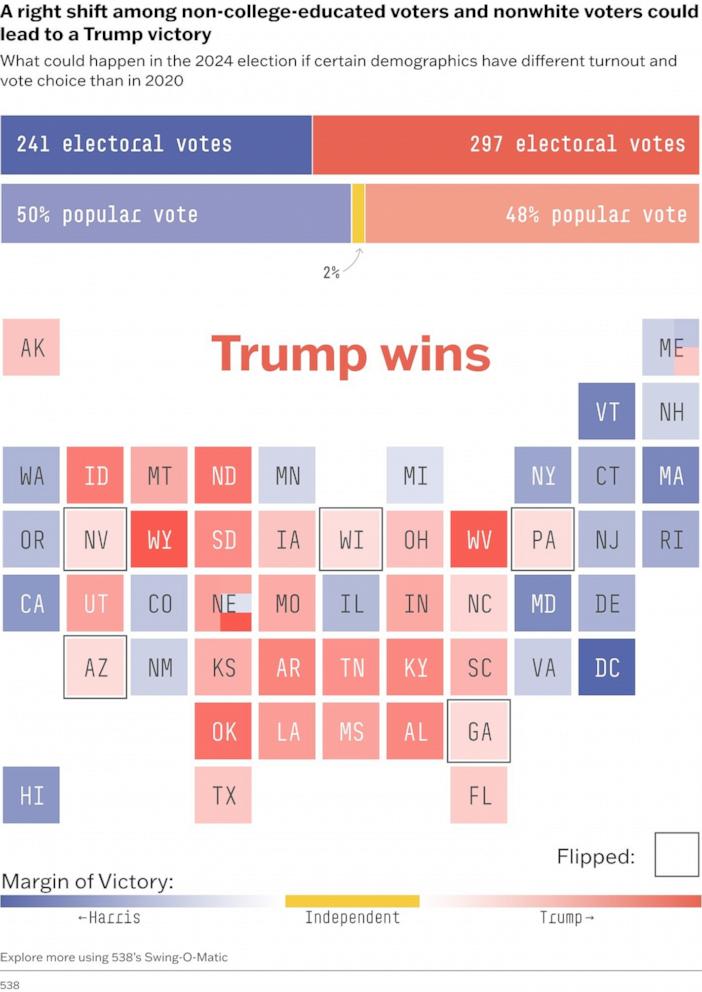
Use the buttons below, or scroll down the page, to explore how hypothetical changes in vote choice and turnout among different groups could alter the outcome of the 2024 election. To get you started, we've laid out some potential scenarios of demographic swings and their outcomes, such as a potential Trump victory from non-college-educated voters and nonwhite voters shifting right:

PHOTO: A right shift among non-college-educated voters and nonwhite voters could lead to a Trump victory.
Katie Marriner and Amina Brown for 538
A right shift among non-college-educated voters and nonwhite voters could lead to a Trump victory.
Katie Marriner and Amina Brown for 538

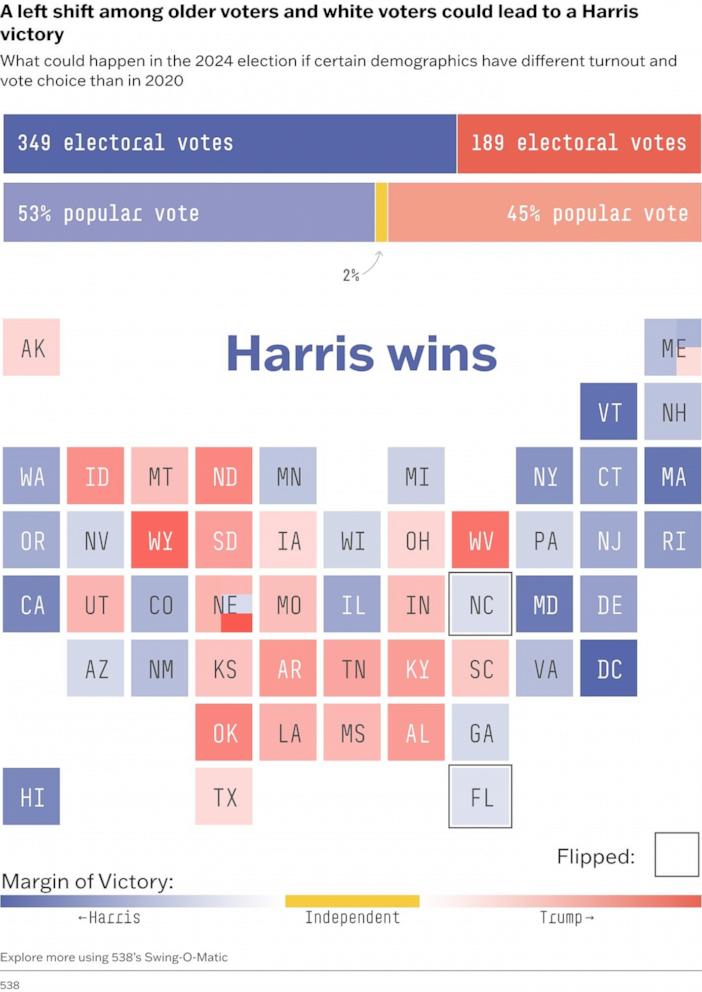
Conversely, a potential Harris win might stem in part from older voters and white voters moving to the left:

PHOTO: A left shift among older voters and white voters could lead to a Harris victory.
Katie Marriner and Amina Brown for 538
A left shift among older voters and white voters could lead to a Harris victory.
Katie Marriner and Amina Brown for 538

So while we're waiting on election results, go ahead and click "Explore on your own" to create your own election scenario and play around with the electorate to your heart's content!


Nov 05, 2024 8:23 PM
By Nathaniel Rakich

Do VP candidates matter?

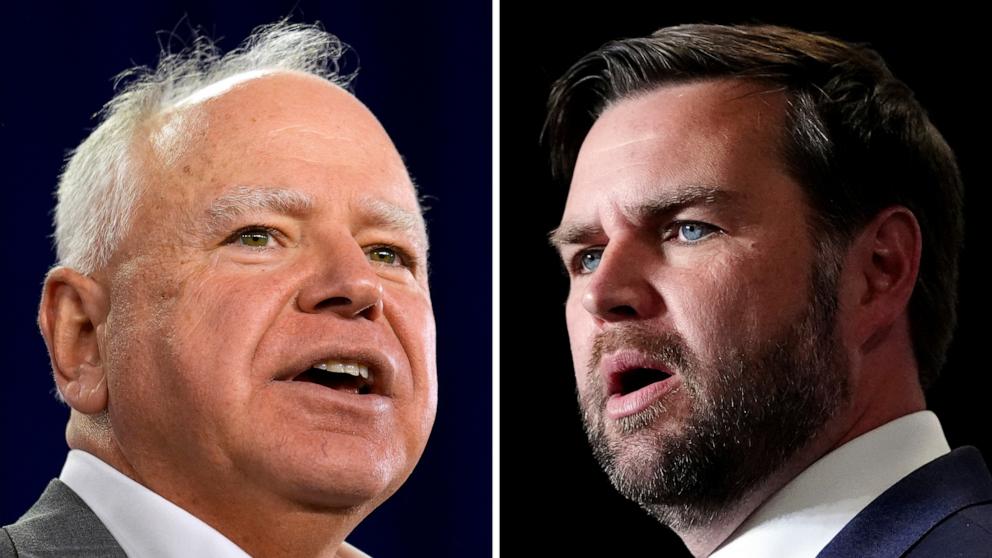
Trump and Harris get most of the attention, but today is also a big day for JD Vance and Tim Walz, who will find out if they will become the 50th vice president of the United States. Just as they are on the presidential candidates, Americans are pretty divided in their opinions of the VP aspirants, but one is narrowly above water with the American people and the other is not.

PHOTO: This combination of photos shows Democratic vice presidential nominee Minnesota Gov. Tim Walz and Republican vice presidential nominee Sen. JD Vance.
AP
This combination of photos shows Democratic vice presidential nominee Minnesota Gov. Tim Walz and Republican vice presidential nominee Sen. JD Vance.
AP

According to 538's averages, 41% of Americans have a favorable opinion of Walz, while only 39% have an unfavorable opinion of him. By contrast, only 38% of Americans have a favorable opinion of Vance, while 45% have an unfavorable one.

With the resurfacing of some of his old comments (like calling liberals "childless cat ladies"), Vance made a bad first impression with the public, and his image never really recovered. However, Republicans can take solace in the fact that vice presidential candidates rarely affect the outcome of the election. Virtually everyone makes their decision based on the names at the top of the ticket, not the bottom.


Nov 05, 2024 8:15 PM
By Meredith Conroy

Republican women are underrepresented in Congress. This cycle won't change that.

As I mentioned earlier on the blog, women make up 41% of Democrats' members of Congress, but just 15% of Republicans' members of Congress. That gap is unlikely to shrink after all the races today are projected, because the GOP nominated fewer women to run this cycle, compared to the last two cycles, and only a handful were nominated to run in safe districts.

While there are a number of incumbent female Republicans in Congress almost certain to retain their seats today, []() of GOP primary races, there will likely only be two new faces among the ranks of GOP women in the chambers. That's because non-incumbent female nominees were very uncommon in competitive or safely Republican seats this year. There are only two non-incumbent women running in districts rated as Solid Republican in 538's latest forecast: Julie Fedorchak in North Dakota and Sheri Biggs in South Carolina, who are both shoo-ins for open seats currently held by Republican men.

There are seven other non-incumbent Republican women we will be watching tonight, but they are running in races that our forecast rate as "Likely Democratic" Of these, only two are in open races, while the rest are challenging Democratic incumbents: Kari Lake, who is running in the open Arizona Senate race and wins just 22-in-100 simulations in our forecast against Ruben Gallegos, and Caroleene Dobson, who wins just 9-in-100 simulations against Shomari Figures.

We will be watching these races, and a handful of others where Republican women could win, today:


Nov 05, 2024 11:03 PM
By Geoffrey Skelley

538's shorthand guide for watching election night results

On election night, information overload is almost unavoidable. With this in mind, 538 is here to offer you a guide for knowing whether a state might be in play as votes are tallied. We estimated county-level benchmarks for every state (save Alaska, which doesn't report votes by county) to offer a back-of-the-envelope gauge for how the election is going.

The benchmarks estimate what percentage of the vote Democrats or Republicans would need in each county for a statewide race to be roughly tied. That means if a candidate is performing consistently better than their party's benchmark as we get a meaningfully large number of returns (keeping in mind that the partisan split from early returns may shift significantly as the count continues), it's a decent sign that contender is on track to come out ahead in the final results. In the interactive, you can look for any state or county in the search bar above the map.

PHOTO: 538's benchmarks estimate how well candidates need to do in each county.
Katie Marriner and Amina Brown for 538
538's benchmarks estimate how well candidates need to do in each county.
Katie Marriner and Amina Brown for 538

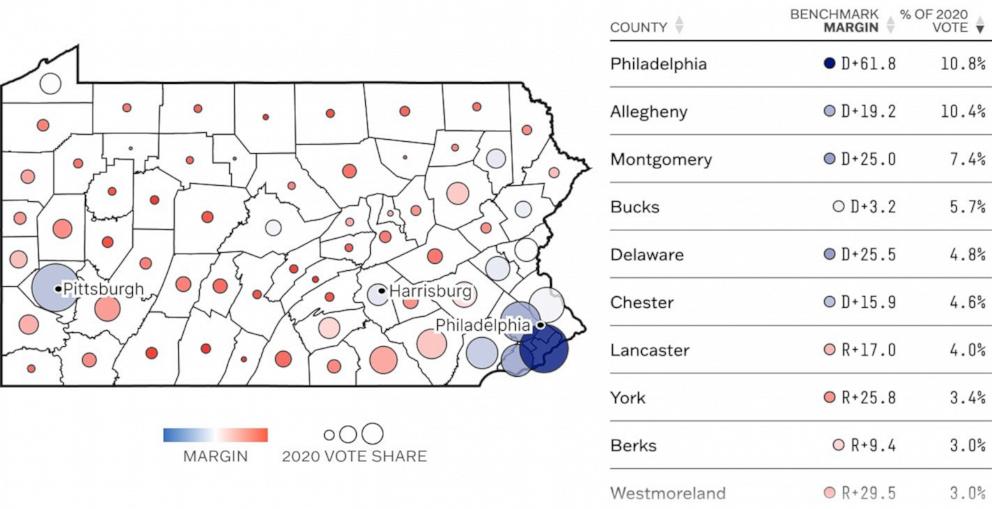
To explore how to use the benchmarks, let's take a look at one of the key swing states, Pennsylvania. On its state page, you'll find a county-level map and a table with benchmark figures, along with the share of the statewide vote that each county contributed in the 2020 presidential race. Above the map, you can toggle between the statewide races, choosing among president, Senate and governor (where applicable). And above the table, you can toggle between viewing benchmarks by margin (how much a candidate leads by) or by party vote share (what percentage of the vote each candidate has).

PHOTO: How to tell who's on track to win Pennsylvania on election night.
Katie Marriner and Amina Brown for 538
How to tell who's on track to win Pennsylvania on election night.
Katie Marriner and Amina Brown for 538

The map displays both the benchmark margin and the 2020 share of the vote from each county. The bluer a place, the more Democratic it would be in the case of a statewide result that's about tied, and vice versa for red and more Republican. And, the larger the bubble over a county, the more votes it contributed in the 2020 presidential election.

Take Philadelphia. Heavily Democratic, it contributed nearly 11% of Pennsylvania's statewide vote in 2020, so it's represented by a big, blue bubble. Based on our benchmark, we can expect the statewide result to be very close if Harris is leading in Philadelphia by about 62 percentage points (80% to 18%). If she's doing a bit better than that, it could signal that she's running ahead of where she needs to be in order to win; if she's doing a bit worse, it could be a sign that Trump has an edge in the state.

Of course, you should never rely on just one data point as determinative. Instead, you'll want to consider what the returns are saying across a large number of counties, and only once a large portion of the vote has come in from each of those places. Additionally, you might look at a place like Erie County in the state's northwest corner, which has a reputation for being one of the state's bellwethers. Tellingly, our benchmark there is basically a tie, so if one candidate is running a few points ahead, that is probably a good sign for them.

We hope these numbers prove to be a helpful shorthand for who might be leading in close races as the returns come in. And even in the uncompetitive states, they could provide a hopeful Republican a sense of what it would take for their party to carry California in this day and age, and a hopeful Democrat a clue as to what their party would need to compete in South Dakota!


GMA Newsletters

Sign up for our newsletters to get GMA delivered to your inbox every morning!

Up Next in news

PHOTO: As part of his civic curriculum, Leon Smith takes his students at Haverford High School to the Pennsylvania state capitol.

Black educators say they're committed to the profession amid growing pressures, underrepresentation

May 8, 2026
PHOTO: In this April 20, 2025, file photo, Prince Andrew leaves after attending the Easter Matins Service at St. George's Chapel, Windsor Castle in Windsor, England.

Man arrested near former Prince Andrew's home

May 7, 2026
PHOTO: Jake Reiner attends the Los Angeles premiere of "Things Like This" at Landmark Theatres Sunset on May 13, 2025 in Los Angeles, California.

Jake Reiner discusses death of parents Rob and Michelle Reiner in return to podcast

May 7, 2026

The latest lifestyle and entertainment news and inspiration for how to live your best life - all from Good Morning America.
  • Contests
  • Terms of Use
  • Privacy Policy
  • Do Not Sell My Info
  • Children’s Online Privacy Policy
  • Advertise with us
  • Your US State Privacy Rights
  • Interest-Based Ads
  • About Nielsen Measurement
  • Press
  • Feedback
  • Shop FAQs
  • ABC News
  • ABC
  • All Videos
  • All Topics
  • Sitemap

© 2026 ABC News
  • Privacy Policy— 
  • Your US State Privacy Rights— 
  • Children's Online Privacy Policy— 
  • Interest-Based Ads— 
  • Terms of Use— 
  • Do Not Sell My Info— 
  • Contact Us— 

© 2026 ABC News